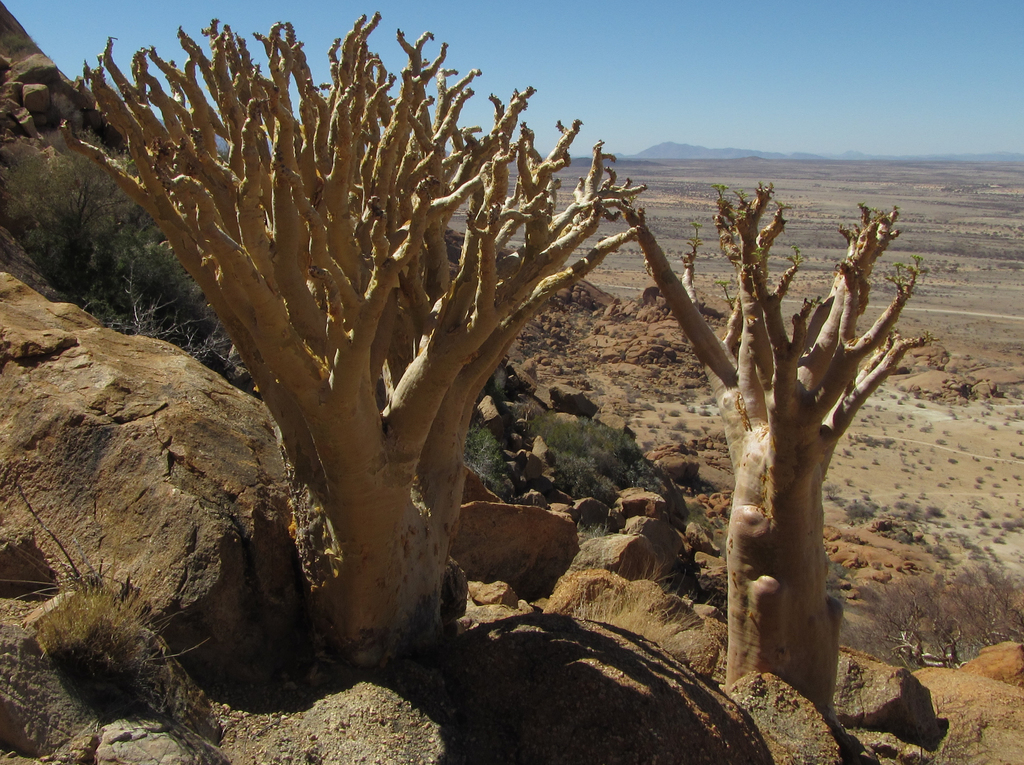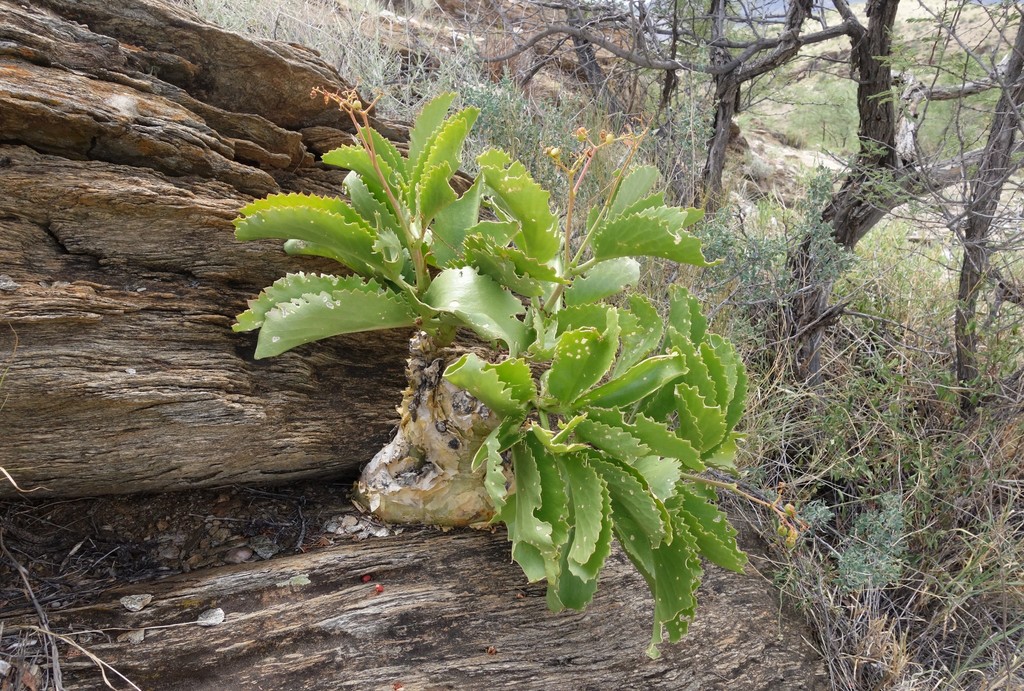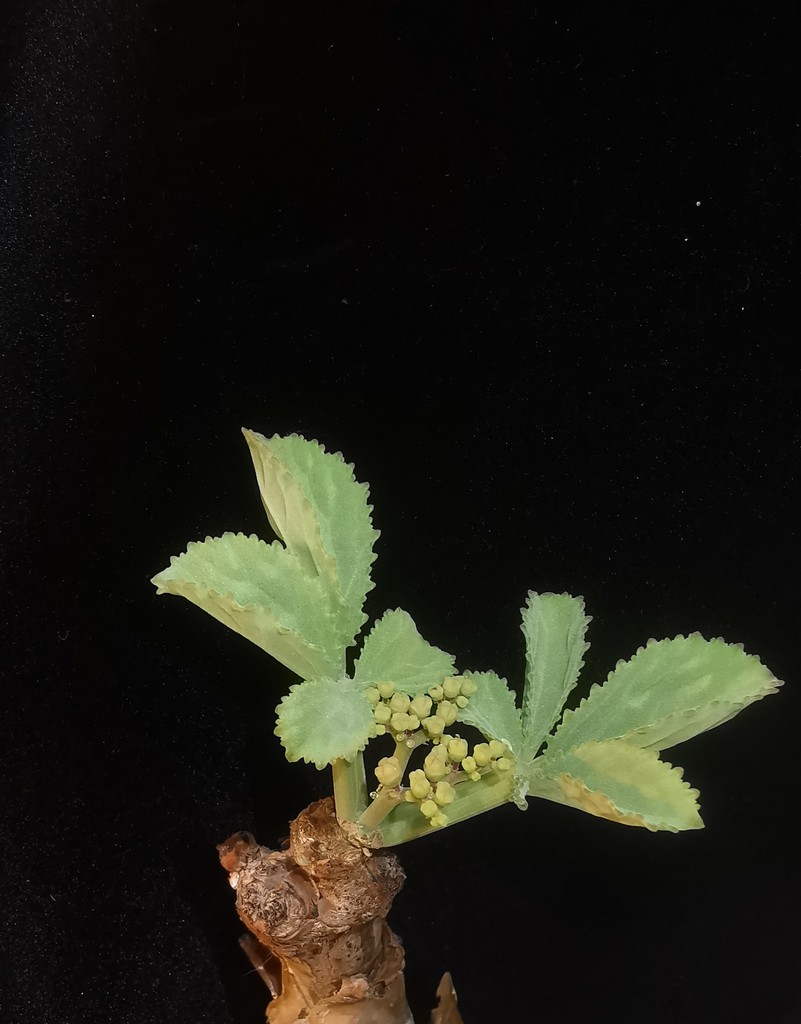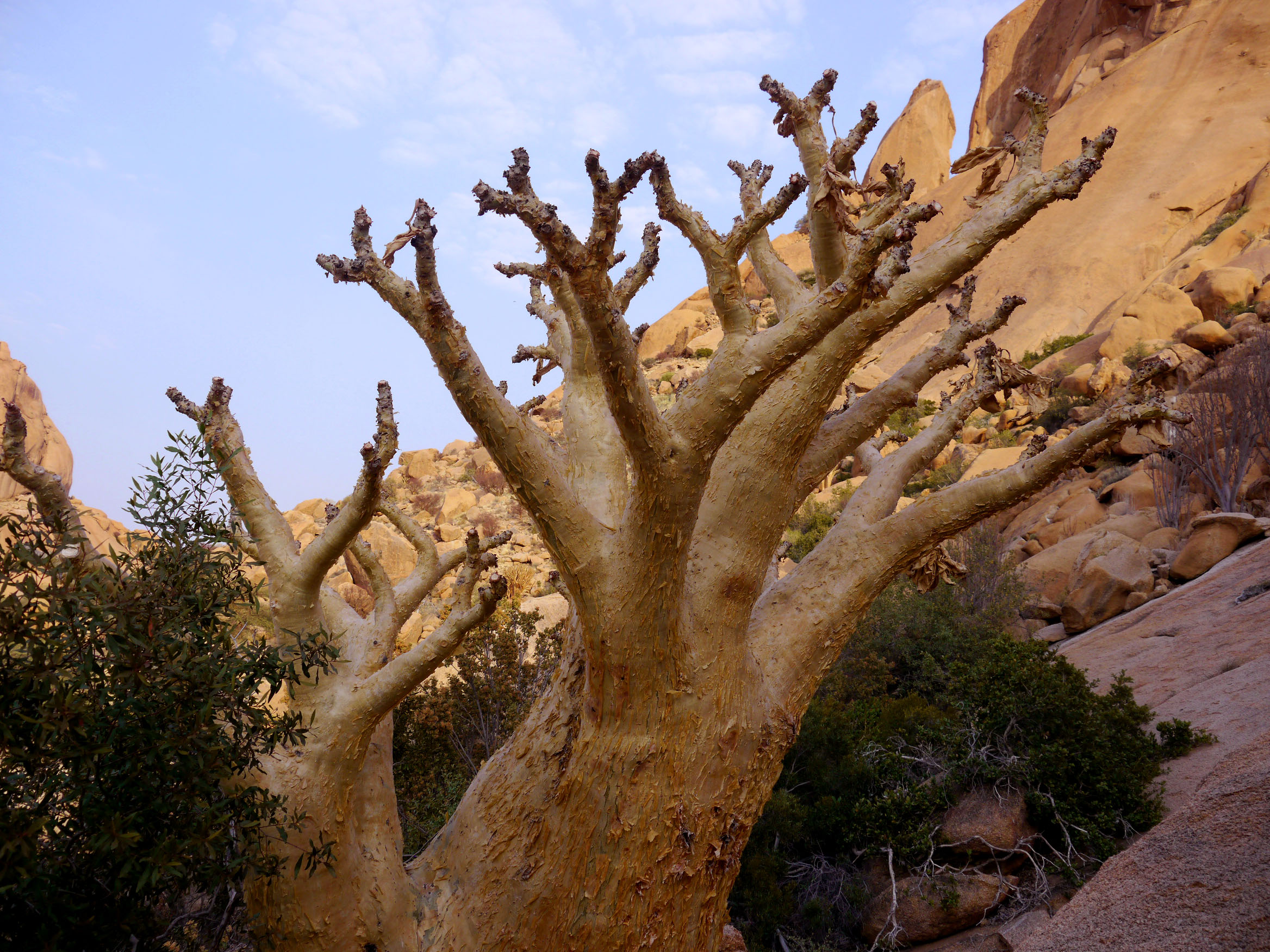
A caudiciform grape of the Vitaceae, among the largest in its genus, ranging from southwestern Angola into northwestern and west-central Namibia. Its accepted POWO name is Cyphostemma currorii (Hook.f.) Desc., tracing to a specimen collected in Angola in the mid-19th century by the British naval surgeon Andrew Curror and first described under Cissus. In the Japanese horticultural trade it circulates widely under the name Cyphostemma macropus (from Welwitsch's collection, transferred to Cyphostemma by Descoings in 1967, now a synonym of currorii), and this site follows that trade name — though the taxonomically correct name is currorii. That said, its leaf characters (the undulate margins among them) also recall its relative C. uter, and it was once even treated as a variety of uter — a plant whose placement has shifted back and forth (the full account is in the feature "A Caudex of Three Names — currorii, uter, and macropus"). In habitat it roots on the granite inselbergs of Brandberg and Spitzkoppe, sometimes exceeding 6 m in height. The papery yellow-to-orange bark that peels to reveal a green underbark is its hallmark; a summer-grower, rewarding to fatten from seed over the long term.
Native climate
Rain concentrates in the warm season, with a dry season of roughly 9 months. Overall a mild climate.
* Accurate distribution data is scarce for this species, so these values are taken from the climate near the approximate center of its native range instead.
Sources: climate & elevation WorldClim 2.1 (1970–2000) · occurrences GBIF · native range POWO · current weather Open-Meteo
Care
Light & Placement

In habitat this caudex grows on rocky, east-facing slopes along the eastern edge of the Kaokoveld desert, exposed to strong sun and dry wind. During active growth, give it full sun outdoors — strong light firms the caudex and brings out the papery bark texture. The leaves are thin and full of moisture, so move pots out of typhoon-strength winds and prolonged rain. Through Japan's midsummer, light shading at 20–30% with the pot raised on a bench for airflow is the safer setting. After leaf drop in autumn it goes dormant — overwinter on a bright sunny window kept above 8°C and dry.
Watering
In active growth, wait until the surface is fully dry, then water deeply and let it dry out again — sharp wet/dry cycles. Native habitat is summer-rainfall semi-desert, and prolonged sogginess will rot the caudex fast. Go fully dry once the leaves drop.
Substrate
Drainage first, inorganic-led. Akadama : Kanuma : pumice = 3:3:4. This species is rot-sensitive, so the pumice share is set a little higher to dry faster. A deeper pot lets the roots run straight down.
Fertilizer & Supplements
A small pinch of slow-release at repotting, or double-diluted liquid feed once a month in active growth. Pushing too hard stretches branches and softens the bark texture — keep doses modest.
Temperature & Overwintering
Optimal 22–35°C, 5°C minimum. Bone-dry plants tolerate brief drops near freezing, but damp soil below ~10°C is fatal. Wait for full leaf drop, then go dry and bring indoors to a bright window.

Starting from Seed
Where to source seeds
Pre-sowing treatment
If fruit pulp remains, soak briefly to soften it and remove it completely before treating. Soak seeds for about half a day (overnight) in a mix of a registered seed-treatment fungicide (Benlate or Daconil) and a plant tonic (Menedael; outside Japan, SUPERthrive or a chelated iron / seaweed extract works similarly), each diluted per label. Floaters are likely past their prime; viability drops quickly in storage.
Substrate
A fine-grained, near-sterile seedling mix: fine Akadama, fine Kanuma, vermiculite in 1:1:1 parts. Sterilize with boiling water or a microwave pass — this species is prone to damping-off.
Sowing method
Sow with no covering, or only the thinnest dusting so seeds remain partly visible. Space at least 1 cm apart.
Light & temperature
Bright shade at 25–30°C. Germination depends on seed freshness, but with fresh seed it is reasonably steady. Germination is spread over two weeks to two months — hold steady heat and stay patient with stragglers.
Watering
Bottom-water with the level 1–2 cm up the pot. For the first 2–3 weeks, don't let things dry out, then drop the level gradually.
Fertilizer
No feeding right after germination. Once true leaves emerge, give heavily diluted liquid fertilizer once or twice a month. Growth is slow, so don't push the dose.
From Germination to Repotting
Germination through true leaves
Continue bottom watering, avoid strong light.
Weaning off bottom watering
Phase it out gradually over 1–2 months.
First repotting
In the first or second year, once root-bound.
Common Pitfalls
Mold & damping-off
- Cause: excess moisture, contamination, leftover fruit pulp
- Prevention: sterilize substrate, clean off all pulp, ensure airflow
Etiolation
- Cause: insufficient light
- Prevention: bring LEDs closer or move to bright shade outdoors. This species is naturally well-branched, so giving it light early helps the form settle quickly
Seeds fail to germinate
- Cause: stale seed, insufficient warmth, leftover fruit pulp
- Prevention: fresh seed, 25–30°C on a heat mat, and clean fruit thoroughly
Notes
Leaves and sap contain oxalic acid (partly as needle-shaped raphides) and can irritate skin and mucous membranes — wear gloves when repotting. The berries are also toxic and should not be eaten. C. macropus itself is not CITES-listed, but importing wild-collected plants still requires the proper Angolan or Namibian export documentation.