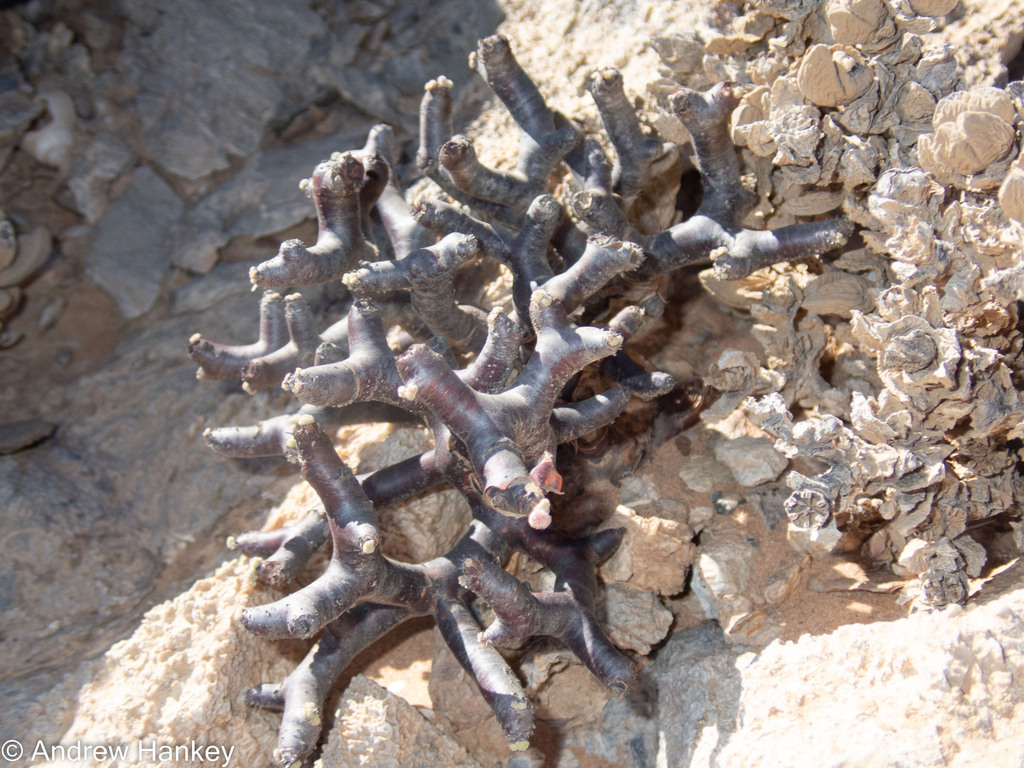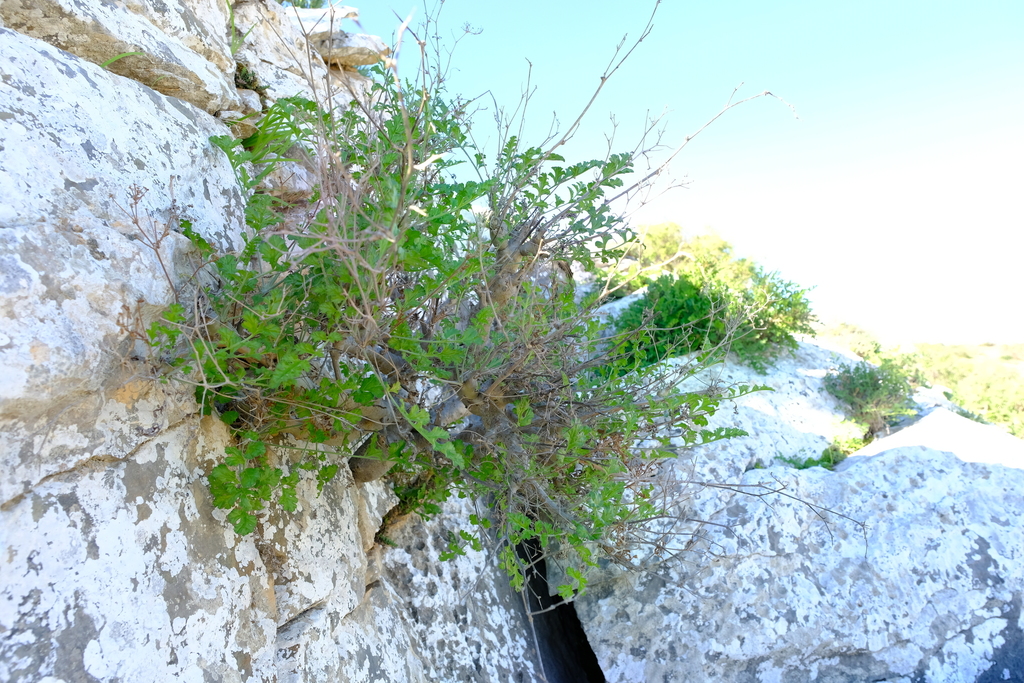
A semi-succulent subshrub widely distributed across the winter- and intermediate-rainfall belts of southern Africa, from the Western and Northern Cape of South Africa into southern Namibia. Described as Geranium carnosum by Linnaeus in 1756 and transferred to Pelargonium by L'Héritier in 1789, the species name carnosum — "fleshy" — refers to the thick, knobby, water-storing trunk that defines this plant. Reaching about 75 cm, it carries grey-green pinnate leaves through autumn and spring, drops them through summer, and rests as bare carnose stems through the dry months. SANBI lists it as Least Concern, and it is not listed under any CITES Appendix. Tougher and faster than many of its relatives, it is one of the easier ways into the genus for someone starting Pelargonium from seed.
Native climate
Rain concentrates in the cool season, with a dry season of roughly 5 months. Overall mild, with a wide temperature range.
A broad-scale picture of the native range. Real growing spots — rock crevices, fog belts — can be milder.
Sources: climate & elevation WorldClim 2.1 (1970–2000) · occurrences GBIF · native range POWO · current weather Open-Meteo
Care
Light & Placement

Habitat across the Little Karoo, West Coast and Namaqualand sees ~100–250 mm of mostly winter rain a year, with sandy and stony soils on flats and gentle slopes under intense sun. Through the autumn-to-spring growing season in Japan, give it as much direct sun as possible — strong light keeps internodes tight and the trunk thickening visibly. The hard problem is summer placement for a winter-grower: move the pot to bright shade out of direct sun (north-facing eaves or 50–70% shade cloth), raise it on a bench, and run a circulation fan. The species is not frost-tolerant, but a bright window above 5°C indoors carries it through winter without trouble.
Watering
Restart with light watering in autumn (September–October) once leaves begin to push, ramping up as the canopy fills in. Stop when leaves yellow and drop in spring and keep essentially dry through summer. Watering through summer dormancy is the single most reliable way to rot this species.
Substrate
Drainage first, inorganic-led: Akadama : Kanuma : pumice = 4:3:3. Mirror the sandy native soils with a deep pot that lets water exit cleanly and the column dry from surface to core.
Fertilizer & Supplements
Through the active autumn-to-spring season, a heavily diluted liquid feed once a month, or a small pinch of slow-release at repotting. This is a lean-soil plant; pushing fertilizer elongates internodes and dulls the trunk.
Temperature & Overwintering
Optimal 15–25°C, minimum 5°C. The plant tolerates a few degrees lower if dry, but damp soil under cold is fatal. As with most winter-growers, summer is harder than winter: through June–September, prioritize shade, ventilation and dry soil.

Starting from Seed
Where to source seeds
Pre-sowing treatment
Soak seeds for about half a day (overnight) in a mix of a registered seed-treatment fungicide (Benlate or Daconil) and a plant tonic (Menedael; outside Japan, SUPERthrive or a chelated iron / seaweed extract works similarly), each diluted per label. Any seed that doesn't sink is likely past its prime. Pelargonium seeds tend toward hard-coated dormancy, and Japanese growers report that 2–3 weeks of cold-moist stratification in a refrigerator can lift germination meaningfully.
Substrate
A separate seedling mix, fine-grained and near-sterile: fine Akadama, fine Kanuma, vermiculite in 1:1:1, sterilized with boiling water or a microwave pass. A thin topping of coarse sand helps anchor the spiral-tailed seed.
Sowing method
Cover lightly, or place on the surface and pin with a dusting of coarse sand. The seed carries a hygroscopic spiral awn that twists in moist conditions, screwing the seed into the surface — this is its native dispersal mechanism. Thin clumps after germination.
Light & temperature
Bright shade at 15–22°C. Heating to 25°C or above actively suppresses germination in this winter-grower. September through November is the standard sowing window in Japan; SANBI gives "autumn (April–May)" for the Southern Hemisphere. Germination in 10 days to 1 month.
Watering
Bottom-water 1–2 cm up the pot. Keep the surface from drying for the first 2–3 weeks, then phase the water level down as seedlings establish. Avoid very cold water; use room-temperature.
Fertilizer
None immediately after germination. Once true leaves expand, a heavily diluted liquid feed once or twice a month. For a winter-grower this is on the faster side — many seedlings show a recognisable caudex outline within the first season.
From Germination to Repotting
Germination through true leaves
Continue bottom watering, keep in bright shade.
Weaning off bottom watering
Phase out gradually over 1–2 months.
First repotting
Year one or two, into a deeper pot in autumn.
Common Pitfalls
Mold & damping-off
- Cause: excess moisture, contamination, poor airflow
- Prevention: sterilize the substrate, refresh the bottom-water, run a circulation fan
Etiolation
- Cause: insufficient light. The active winter season runs through low-sun months
- Prevention: run an LED close indoors, or move to bright shade outdoors on clear days
Seeds fail to germinate
- Cause: stale seed, temperatures too high, hard-coat dormancy
- Prevention: sow soon after receipt at 15–22°C; try cold-moist stratification for stubborn batches
Summer stall and rot
- Cause: watering through summer dormancy, or hot humid still air. The single largest cause of loss in this species
- Prevention: cut water as leaves yellow in spring; through summer prioritize shade, ventilation and a cool spot — an air-conditioned room helps
Notes
No livestock-toxicity records, but avoid touching eyes after handling sap.