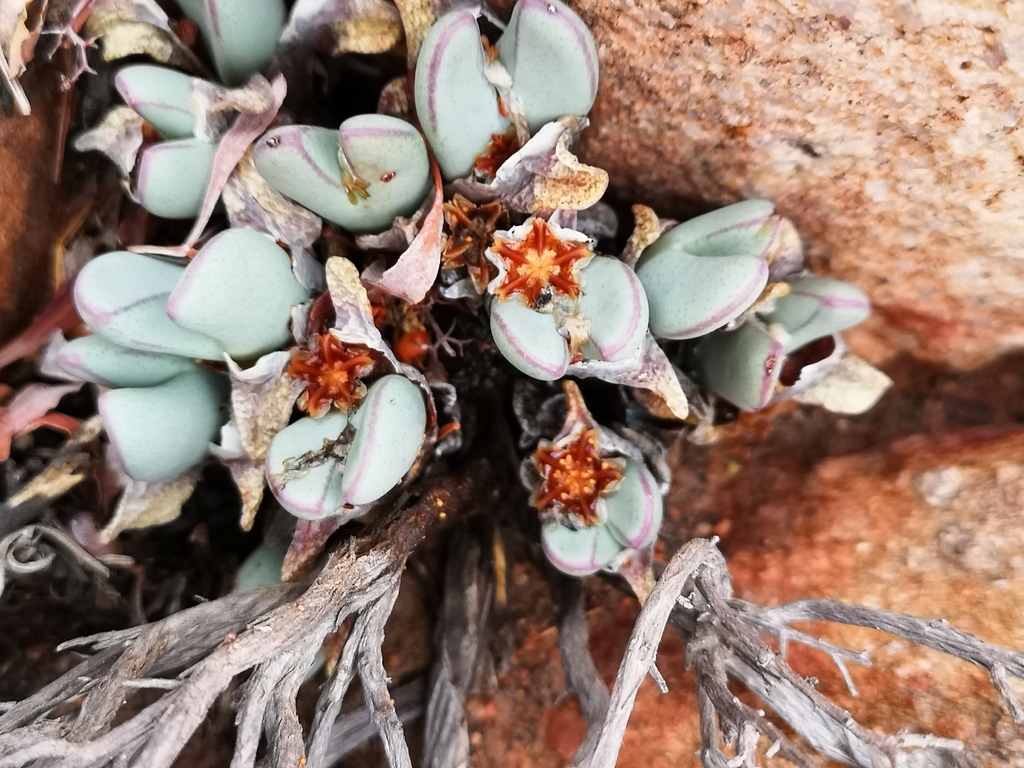
A small mesemb from the quartzite gravel flats of South Africa's Namaqualand. Two leaves are fused into a single inverted-egg-shaped body (1–2 cm across) whose tip is notched into two lobes — the source of the epithet bilobum, Latin for "two-lobed." Bright yellow flowers open from the body's centre in autumn (September–November in the Southern Hemisphere). As a winter-grower it grows through autumn and spring, then spends the summer encased in the papery remains of the previous year's body — a renewal cycle known as "moulting." Collected by Marloth and described by N.E. Brown in 1922, it is accepted without synonymy in POWO.
Native climate
Very little rain falls all year — an arid setting. Overall a mild climate.
A broad-scale picture of the native range. Real growing spots — rock crevices, fog belts — can be milder.
Sources: climate & elevation WorldClim 2.1 (1970–2000) · occurrences GBIF · native range POWO · current weather Open-Meteo
Care
Light & Placement

Namaqualand lies under the influence of Mediterranean-type weather — strong light, low humidity — and this plant grows best with comparable conditions. During the growing season (autumn through spring) a sunny outdoor position or a bright south-facing window indoors suits it well. Japanese early summer through midsummer coincides with dormancy, and plants are vulnerable to the combination of heat and humidity: move them under an eave or onto an indoor shelf, well out of rain, and reduce watering to almost nothing. Good airflow is the first defence against fungal rot, so keep pots on a bench rather than the ground and run a small fan if needed. In winter, ensure the indoor minimum stays above 3°C.
Watering
Through the active autumn-to-spring period, water thoroughly once the substrate is fully dry, then let it dry again before repeating. During moulting — when the old body is shrivelling — hold back and resume only once the new body has clearly emerged. From early summer to late summer, stop watering almost entirely; a light misting once or twice a month is enough.
Substrate
Drainage first. A primarily inorganic mix of akadama fine : kanuma fine : pumice = 4:3:3 works well; use fine-grade particles to suit the plant's compact size.
Fertilizer & Supplements
A dilute liquid feed (double the label dilution or weaker) once a month during the growing season is sufficient. Over-feeding stretches the body and invites root rot.
Temperature & Overwintering
Active-growth optimum 10–25°C with 3°C as a safe winter floor. Dry plants tolerate brief dips near 0°C, but damp substrate combined with cold damages roots. The dormant summer body handles moderate heat, but avoid a sealed space over 40°C.

Starting from Seed
Where to source seeds
Pre-sowing treatment
Soak seeds for half a day in water mixed with a fungicide (Benlate, Daconil 1000) and a plant tonic (Menedael or similar) at label dilution. Viability varies with storage conditions, so sow as soon after purchase as practical.
Substrate
A separate fine-grained, near-sterile sowing mix: akadama fine : kanuma fine : vermiculite = 1:1:1, pre-sterilised by microwave or boiling water. Level the surface carefully so the tiny seeds sit evenly.
Sowing method
Surface-sow with no cover. The seeds are very small; placing them one by one with the tip of a damp toothpick is the most controllable method. Leave at least 5 mm between seeds.
Light & temperature
Bright shade, with the substrate held steadily at 18–22°C. Germination takes 7–21 days. Germination depends on seed freshness, but with fresh seed it is reasonably steady.
Watering
Bottom-water with the pot standing in 1–2 cm of water. For the first weeks, prioritise keeping the surface from drying out; once germination is even, lower the water level in stages.
Fertilizer
None immediately after germination. Once the first true leaves expand, a dilute liquid feed at double the label dilution or weaker, once or twice a month, is enough.
From Germination to Repotting
Germination through true leaves (~2 months)
Continue bottom watering; keep plants in bright shade.
Weaning off bottom watering (2–4 months)
Lower the water level in stages; transition to tray watering.
First repotting (1–2 years)
Move to a fine-grained inorganic mix once roots fill the pot.
Common Pitfalls
Mold & damping-off
- Cause: contaminated substrate, overwatering, poor airflow
- Prevention: sterilise the mix, refresh the bottom water regularly, and run a fan for air movement
Etiolation
- Cause: insufficient light
- Prevention: move the grow light closer immediately after germination, or shift seedlings to bright outdoor shade
Seeds fail to germinate
- Cause: stale seed, or temperature too low (autumn sowing in cold conditions)
- Prevention: buy from reliable suppliers; use a heat mat to hold 18–22°C
Notes
Watering during the moult lets the old body soak up moisture and impedes new growth.
