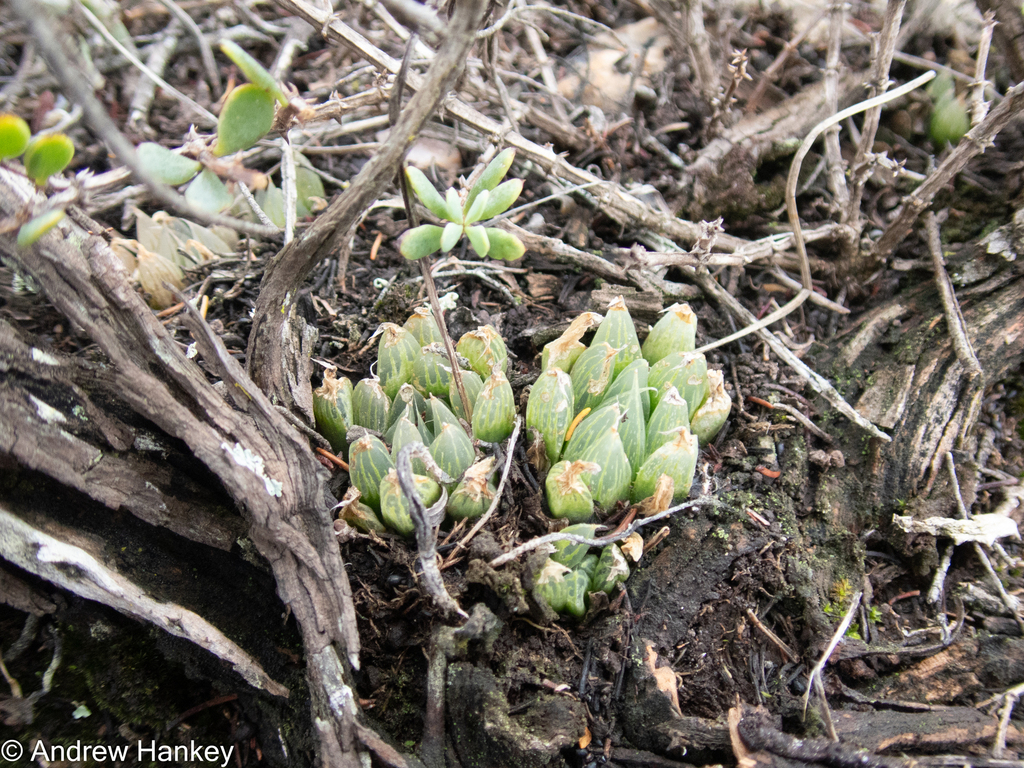
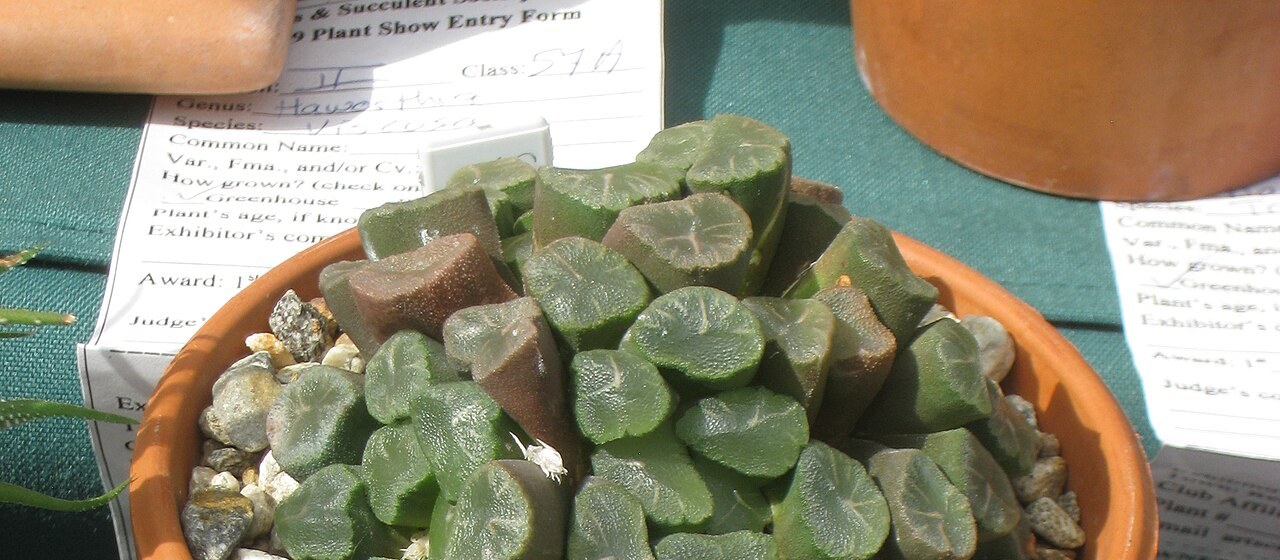
A flagship soft-leaved Haworthia from a small area around Riversdale in the Western Cape of South Africa. Its leaves end abruptly in a flat, almost truncated triangle (the retuse tip), and the upper face carries a clear "window" with fine line markings — letting light reach the photosynthetic tissue inside even when the plant is half-buried in the ground. In its habitat, only those triangular leaf tips show above the surface among the clayey, stony slopes. In Japan it has been cultivated for generations under the name "Kotobuki" (寿), and many selected clones circulate, though seed-grown plants of the wild type will not fully reproduce a cultivar's parent traits.
Native climate
Rainfall is spread fairly evenly across the year. Overall a mild climate.
A broad-scale picture of the native range. Real growing spots — rock crevices, fog belts — can be milder.
Sources: climate & elevation WorldClim 2.1 (1970–2000) · occurrences GBIF · native range POWO · current weather Open-Meteo
Care
Light & Placement

In habitat it grows on clayey, stony hillsides around Riversdale, Heidelberg, and Albertinia, sheltered by low shrubs and stones, with only the leaf windows exposed. It prefers diffuse light over direct sun — strong direct exposure scorches the leaves to red-purple and clouds the windows. During the spring and autumn growing periods, keep it in bright outdoor shade or under 50–60% shade cloth, where the windows show their full transparency. Move it to a cool shaded spot through high summer and onto a bright indoor window above 5°C for winter. Year-round airflow matters.
Watering
Water thoroughly when the soil dries during growth; in summer dormancy give only one or two light waterings a month. In winter let the soil go dry for a few days at a time to avoid cold-and-wet conditions.
Substrate
Drainage first, with a slightly finer mix suited to soft-leaved Haworthia. Fine Akadama, fine Kanuma, and small pumice at 4:3:3 work well. A dressing of decorative gravel on the surface helps avoid surface wetness.
Fertilizer & Supplements
A dilute liquid feed once or twice a month during growth is enough. Overfeeding clouds the windows and stretches the leaves, breaking the tight rosette form. Lean feeding produces firmer plants with better form.
Temperature & Overwintering
Optimal 15–25°C. Growth slows above 30°C and the plant enters summer dormancy. It holds its leaves down to about 5°C in winter. Cold wet soil is the biggest single risk — keep it on the dry side through the cold months.
Starting from Seed
Where to source seeds
Pre-sowing treatment
Seeds are fine and dry out quickly — keep them sealed until sowing. Mix a fungicide (Benlate, Daconil, or similar) with a rooting supplement (such as Menedael) at the recommended dilutions, and soak the seeds for about half a day to reduce surface microbes before sowing.
Substrate
Use a separate seedling mix that's fine-grained and near-sterile: fine Akadama, fine Kanuma, and vermiculite in 1:1:1 parts. Sterilizing beforehand with boiling water or a microwave pass helps prevent damping-off losses.
Sowing method
Sow on the surface without any covering. Space the seeds at least 5 mm apart and avoid overlap to limit early damping-off.
Light & temperature
Keep the tray in bright shade at 22–28°C. Germination takes 7–21 days and depends strongly on seed freshness — fresh seed usually emerges evenly.
Watering
Bottom-water with the level 1–2 cm up the pot. For the first month, prioritize not letting things dry out, then drop the water level gradually once seedlings are stable.
Fertilizer
No feeding right after germination. Once true leaves emerge, give a heavily diluted liquid fertilizer once or twice a month — go lighter than the bottle suggests, since young seedlings are easily pushed into etiolation.
From Germination to Repotting
Germination through true leaves
Continue bottom watering in bright shade.
Weaning off bottom watering
Phase it out gradually over 1–2 months.
First repotting
In the first or second year, once roots have filled the pot.
Common Pitfalls
Mold & damping-off
- Cause: excess moisture, contamination
- Prevention: sterilize the substrate, change the bottom-water frequently, ensure good air flow
Sunburn & clouded windows
- Cause: direct strong sun, abrupt environment change
- Prevention: move to 50–60% shade and transition new placements gradually over a week
Seeds fail to germinate
- Cause: stale seeds, insufficient warmth
- Prevention: use fresh seeds and a heat mat
Summer rot from heat and moisture
- Cause: high heat with wet substrate, poor airflow
- Prevention: keep it cool and on the dry side through midsummer, with a fan moving air across the bench
Notes
No known sap toxicity has been reported.