
A gymnosperm of the order Cycadales, family Zamiaceae, endemic to the Karoo of South Africa's Eastern Cape Province. Described by Lehm. in 1834, the epithet honours the German botanist J.G.C. Lehmann. A stout pale-grey trunk one to two metres tall carries a tidy rosette of stiff, silver-blue leaves — among the most strikingly blue cycads in the genus. Compared with its neighbour E. horridus, the leaflets do not overlap and the marginal spines are far gentler, giving the crown an orderly, sculptural composure. Hardy enough for the cool dry winters of the Karoo, but extremely slow-growing. As with all Encephalartos, listed on CITES Appendix I.
Native climate
Rainfall is spread fairly evenly across the year. Overall mild, with a wide temperature range.
* Accurate distribution data is scarce for this species, so these values are taken from the climate near the approximate center of its native range instead.
Sources: climate & elevation WorldClim 2.1 (1970–2000) · occurrences GBIF · native range POWO · current weather Open-Meteo
Care
Light & Placement
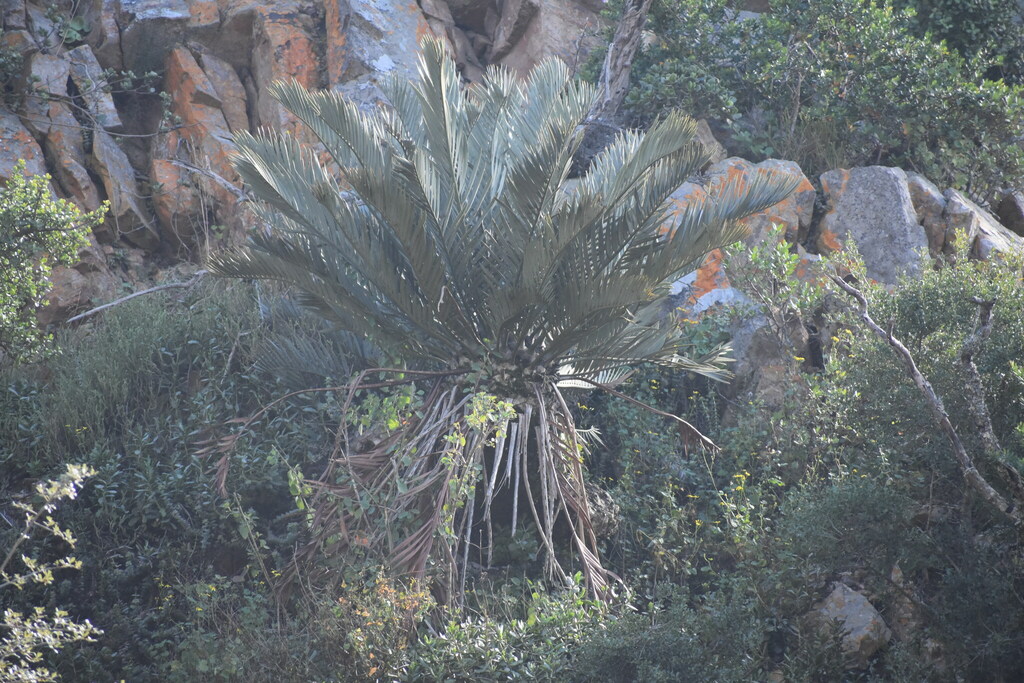
The species grows on sun-baked sandstone slopes of the Eastern Cape Karoo, and strong direct light is what brings out its silver-blue colour. In half-shade or with too much moisture the leaves turn green and elongate. In active growth give it full sun outdoors with airflow on a raised bench. Through Japan's midsummer, light shading at 20–30% prevents leaf scorch while keeping the bright base setting that holds form. Overwinter under a dry eave outdoors or on a sunny indoor window, kept dry.
Watering
In active growth, wait until the substrate is fully dry, then water thoroughly and let it dry out hard again. Native annual rainfall is only 250–350 mm, so overwatering goes straight to trunk rot. Taper from autumn and keep almost completely dry through winter.
Substrate
Drainage and aeration first, inorganic-led. Akadama : Kanuma : pumice = 3:3:4. A deeper pot lets the root run straight down and supports a sharp wet-dry rhythm.
Fertilizer & Supplements
A pinch of slow-release at repotting, or a once-monthly diluted liquid feed in active growth. Growth is so slow that overfeeding does not bulk it up — it just damages leaf colour. Stay restrained.
Temperature & Overwintering
Optimal 22–32°C, 5°C minimum. Among the hardier Encephalartos thanks to its Karoo origin; bone-dry plants tolerate brief light frost. Damp soil with cold is fatal, so dry off completely before bringing indoors. No supplementary heating needed.

Starting from Seed
Where to source seeds
Pre-sowing treatment
The red fleshy seed coat (sarcotesta) invites rot — soak briefly to soften and remove it before sowing. Soak seeds for about half a day (overnight) in a mix of a registered seed-treatment fungicide (Benlate or Daconil) and a plant tonic (Menedael; outside Japan, SUPERthrive or a chelated iron / seaweed extract works similarly), each diluted per label. Floaters indicate stale stock. Germination requires steady warmth of 25–32°C.
Substrate
Fine Akadama : fine Kanuma : vermiculite = 1:1:1, sterilized with boiling water or a microwave pass. The seeds are large, so use a deep enough container.
Sowing method
Lay seeds on their side and cover only halfway, leaving the tops exposed. Space them 3–5 cm apart so the radicles have room to extend.
Light & temperature
Bright shade at 25–30°C. Germination takes 30–90 days — hold steady warmth on a heat mat and stay patient.
Watering
Bottom-water with the level 1–2 cm up the pot. Don't let it dry out until the radicles emerge, then lower the water level in stages.
Fertilizer
No feeding right after germination. Once true leaves emerge, give heavily diluted liquid fertilizer once a month — keep it weak, growth is slow.
From Germination to Repotting
Germination through true leaves
Continue bottom watering, avoid strong light.
Weaning off bottom watering
Over three to six months, in stages.
First repotting
In the second or third year, once root-bound.
Common Pitfalls
Mold & damping-off
- Cause: excess moisture, contamination, sarcotesta left on
- Prevention: sterilize substrate, always remove the fleshy seed coat, ensure airflow
Etiolation
- Cause: insufficient light, excess humidity
- Prevention: bring LEDs closer or move to bright shade outdoors. Without strong light the leaves green up and the silver-blue colour never develops
Seeds fail to germinate
- Cause: stale seed, insufficient warmth
- Prevention: fresh seed from a trusted source, steady 25–30°C on a heat mat
Notes
The whole genus is on CITES Appendix I — live plants require permits for international transfer. The leaflet margins carry small spines; wear gloves to avoid cuts. The seeds are highly toxic; keep them out of reach of children and pets.


