
A medium-sized species from the Karoo dry scrub of South Africa's Western and Northern Cape, extending into southern Namibia. Described by Kensit in 1908 and named for South African botanist Neville Stuart Pillans. Gasteria and Haworthia share the family Asphodelaceae and sit as sister genera in molecular phylogenies. The defining character of Gasteria — even in mature plants — is that the leaves remain in two opposite ranks (distichous) rather than forming a full rosette, a reliable way to tell the two genera apart. The firm, cross-banded leaves, orange tubular flowers, and accessible germination rates have kept the plant in circulation for generations under the common name toranomaki ("tiger's scroll").
Native climate
Rain concentrates in the cool season, with a dry season of roughly 6 months. Overall mild, with a wide temperature range.
A broad-scale picture of the native range. Real growing spots — rock crevices, fog belts — can be milder.
Sources: climate & elevation WorldClim 2.1 (1970–2000) · occurrences GBIF · native range POWO · current weather Open-Meteo
Care
Light & Placement
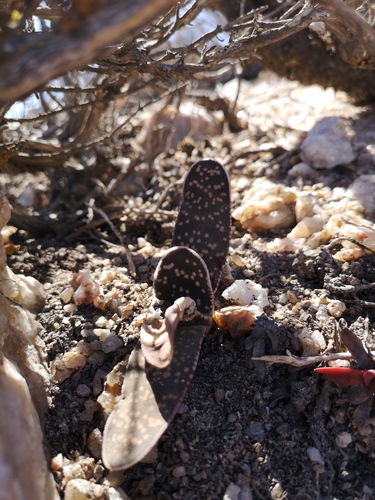
In habitat the plant favours the partial shade of rocky overhangs and shrub bases, so unfiltered direct sun is not its native situation. Through the spring and autumn growing months keep it in bright shade or under 30–50% shade cloth; in high summer and strong heat, increase the shade or move it to bright indirect light. Prolonged strong sun turns the leaves dark brownish. Indoors, an east or south-east window behind a lace curtain works well. A bench with good airflow beats the ground. A bright, unheated indoor window is adequate in winter.
Watering
In the spring and autumn growing season, water well once the substrate has dried out. In the half-dormancy of high summer and deep winter, ease back to one or two light waterings a month. Gasteria is sensitive to excess moisture.
Substrate
Balance drainage with a degree of water retention. Akadama fine : Kanuma fine : pumice = 4:3:3, leaning toward smaller particles for the fine root system.
Fertilizer & Supplements
A dilute liquid feed once or twice a month during the growing season, at double or weaker than label strength, is plenty. Heavy feeding stretches the leaves.
Temperature & Overwintering
Active-growth optimum 15–28°C with 3°C as a sensible winter floor. Dry plants can dip close to 0°C without harm, but cold combined with a wet substrate quickly rots the roots. Carry the plant through deep winter on a bright indoor window, keeping the substrate on the dry side.

Starting from Seed
Where to source seeds
Pre-sowing treatment
Soak seeds for half a day in water mixed with a fungicide (Benlate or Daconil 1000) and a plant tonic (Menedael or equivalent) at label dilution. Viability can decline with storage, so sow as soon after receipt as practical.
Substrate
Use a separate fine-grained, near-sterile sowing mix: Akadama fine : Kanuma fine : vermiculite = 1:1:1, pre-sterilised in a microwave or with boiling water.
Sowing method
Surface-sow with little or no cover. Space seeds at least 5 mm apart; the tip of a damp toothpick is a practical way to place them individually.
Light & temperature
Bright shade, with the substrate held steadily at 22–28°C. Germination takes 7–21 days. Fresh seed germinates in the easy range; storage conditions are the main factor in keeping viability.
Watering
Stand the pot in 1–2 cm of water (bottom-watering). For the first three to four weeks, keep the surface from drying out; once germination is even, lower the water level in steps.
Fertilizer
None for the first weeks. Once the first true leaves expand, a dilute liquid feed (double label dilution or weaker) once or twice a month is enough.
From Germination to Repotting
Germination through true leaves (~2 months)
Continue bottom-watering in bright shade.
Weaning off bottom watering (2–4 months)
Lower the water level in steps; switch to tray watering.
First repotting (1–2 years)
Move to a fine-grained inorganic mix once roots fill the pot.
Common Pitfalls
Mold & damping-off
- Cause: contaminated substrate, overwatering, poor airflow
- Prevention: sterilise the mix, refresh the bottom water regularly, use a fan for air movement
Leaf darkening
- Cause: prolonged strong light or high heat
- Prevention: increase shade in summer, move to indirect light; step any environment changes gradually
Seeds fail to germinate
- Cause: stale seed or low temperature
- Prevention: buy from suppliers that note a harvest year, and use a heat mat to hold 22–28°C
Notes
The leaf margins are thin and snap easily — handle carefully when repotting.
