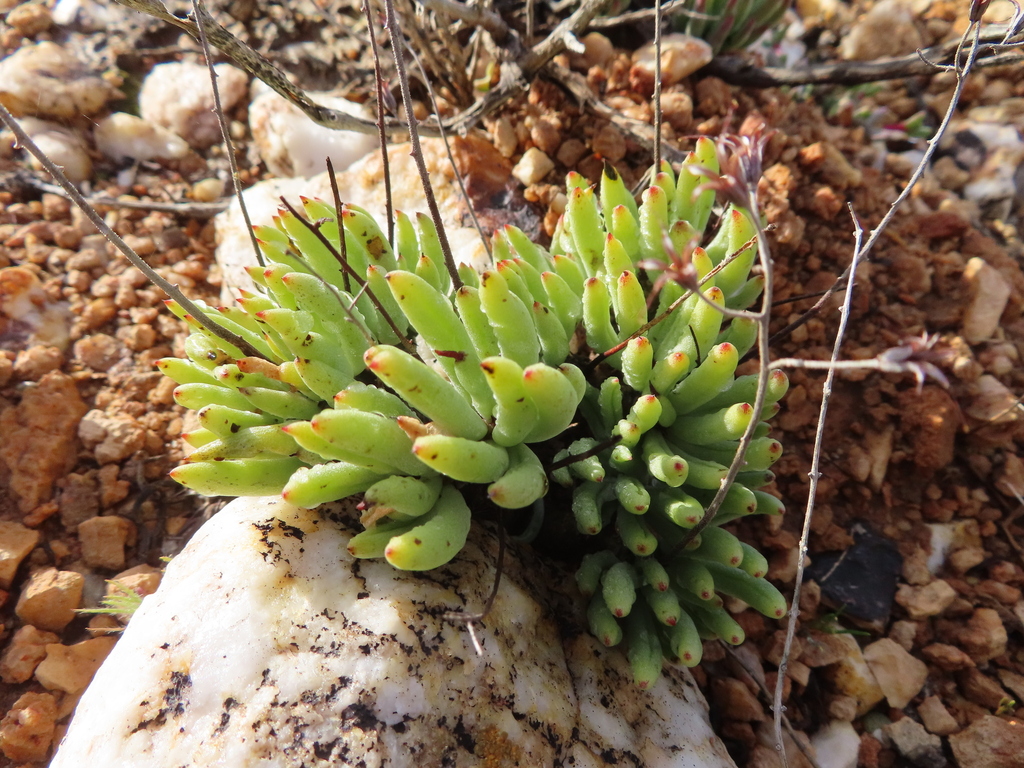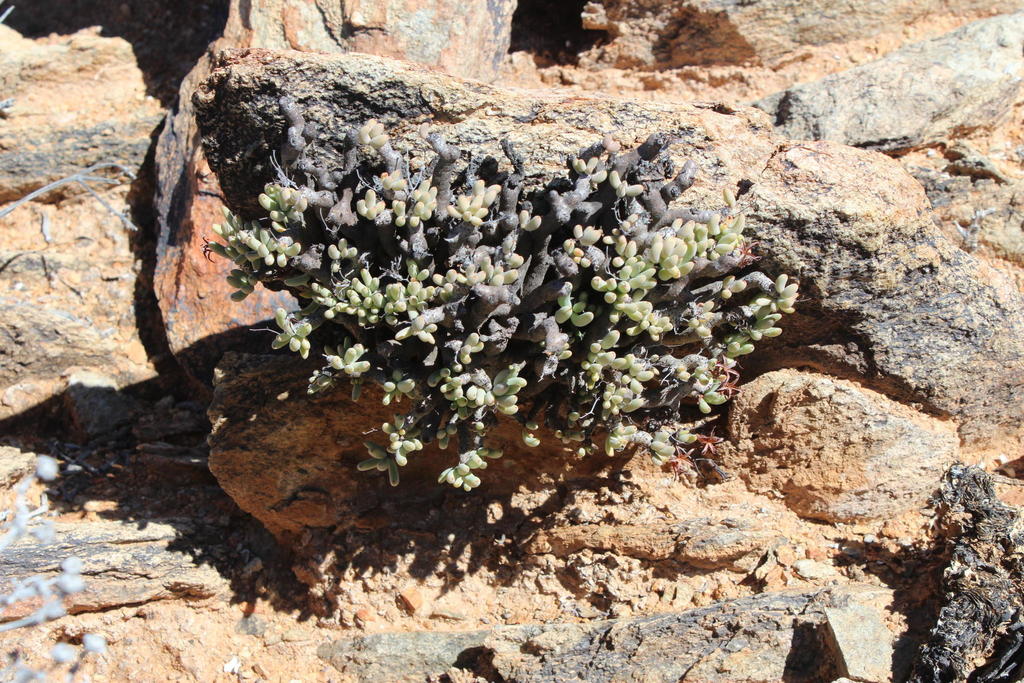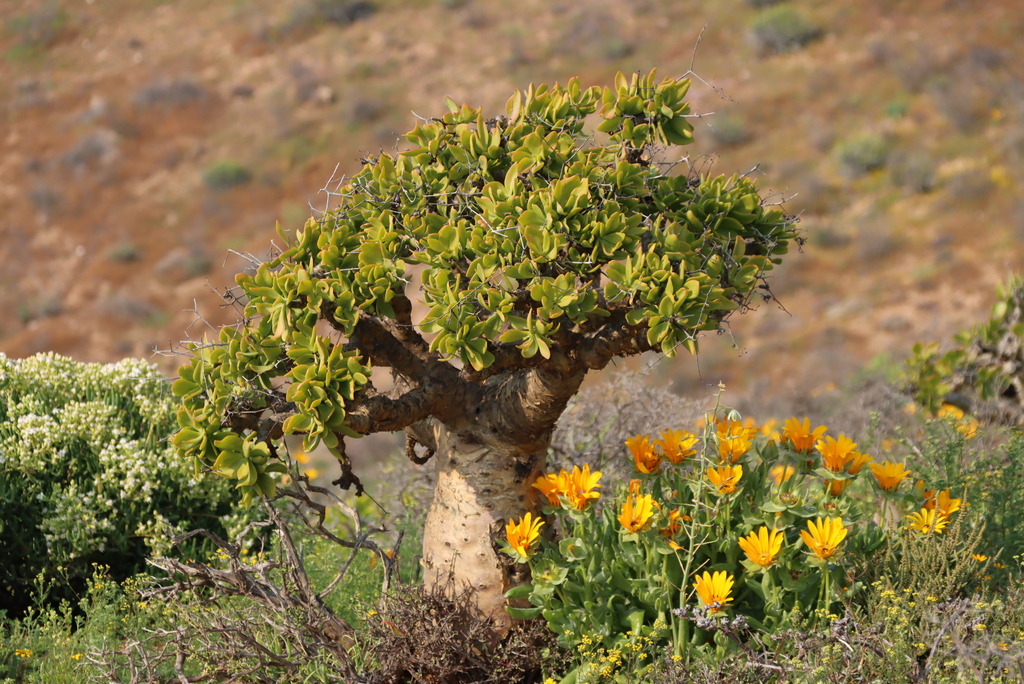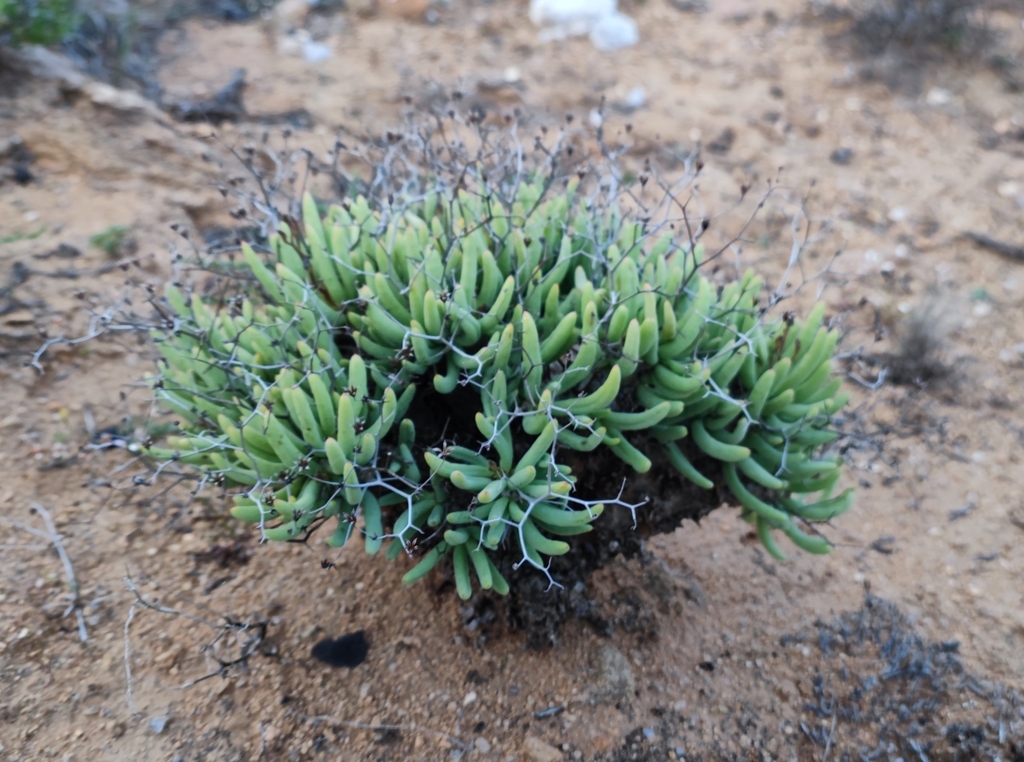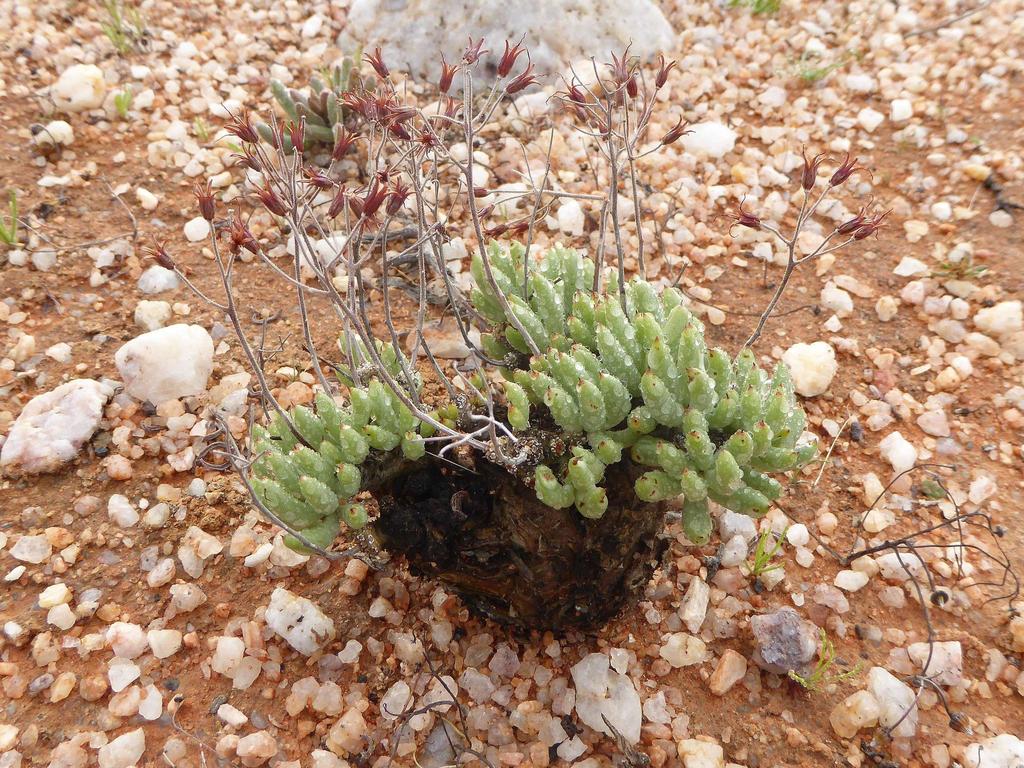
A small Tylecodon distributed from Namaqualand and the area around Vanrhynsdorp in South Africa's Northern Cape, up into southwestern Namibia, on gentle slopes and open plains lightly covered in quartzite gravel. Schönland first described it as Cotyledon pearsonii in 1912, and Tölken transferred it to the new genus Tylecodon in 1978; the epithet honours the collector H. H. W. Pearson. A swollen, caudex-like base sends up a few short branches, the whole plant reaching about 30 cm, with the base occasionally thickening to ~12 cm across. Leaves emerge through the cool autumn-to-spring growing season, followed by a loose panicle of pale brown tubular flowers in early summer — a winter-grower. In habitat it is a quiet, locally frequent species, and in cultivation it is one of the more forgiving members of the genus once the summer is handled properly.
Native climate
Rain concentrates in the cool season, with a dry season of roughly 6 months. Overall mild, with a wide temperature range.
* Accurate distribution data is scarce for this species, so these values are taken from the climate near the approximate center of its native range instead.
Sources: climate & elevation WorldClim 2.1 (1970–2000) · occurrences GBIF · native range POWO · current weather Open-Meteo
Care
Light & Placement
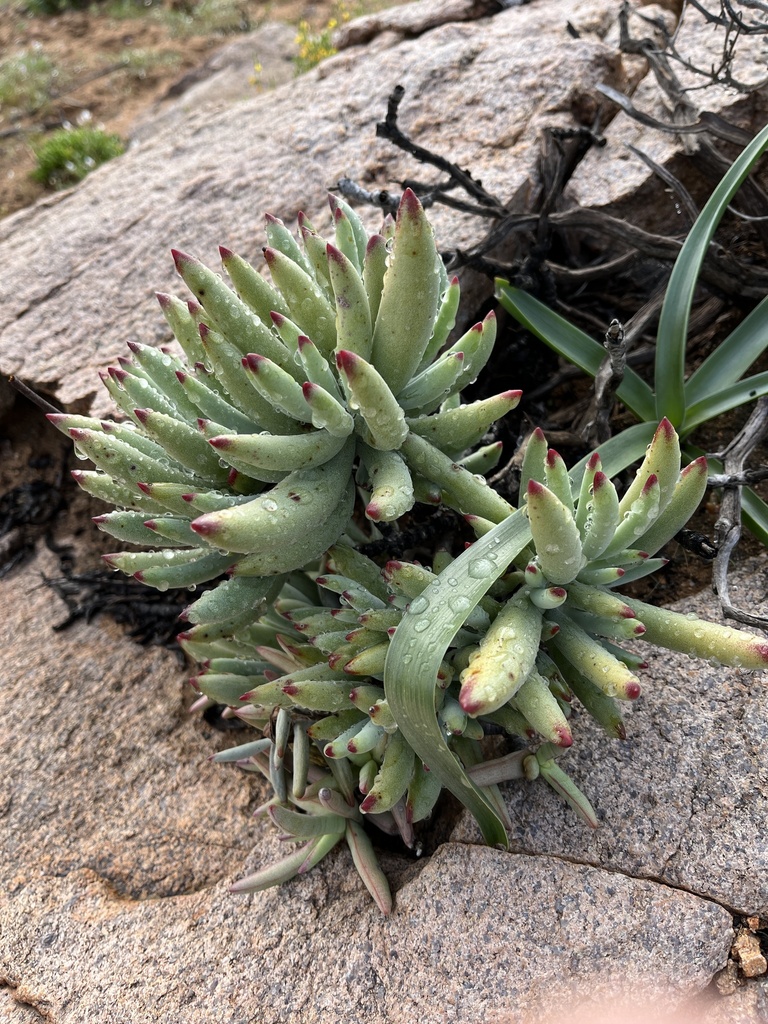
The Namaqualand-to-Vanrhynsdorp strip is a winter-rainfall belt where inland sites get only ~100–200 mm of rain a year and summers are dry, with a cool coastal airflow moving through. In habitat the plant sits on quartzite-gravelled slopes taking the full sun, with only its underground caudex sheltered from the heat. Give it strong outdoor or windowsill light through the autumn-to-spring growing season so the internodes stay short and tight. The real difficulty is the Japanese summer: from after the rainy season, move it to 30–50% shade with good airflow. Raising the pot off the ground and running a circulator nearby adds another layer of safety.
Watering
Restart watering in small amounts from September into October as nights cool. Once the leaves are coming in, water deeply each time the soil has dried, and continue through to early spring. From April–May, as leaves yellow and drop, taper off; through summer keep it essentially dry. Bare branches with no leaves are the correct summer state — watering out of worry is the most common way to rot the base.
Substrate
Drainage first, inorganic-led. Akadama : Kanuma : pumice = 3:3:4 — a higher pumice fraction dries out faster. The caudex spreads laterally rather than deep, so a shallow well-aerated pot suits it better than a tall one.
Fertilizer & Supplements
A heavily diluted liquid feed once a month through the growing season, or a pinch of slow-release at repotting. Habitat soils are very poor; pushing the plant softens the branches and breaks up the compact form it should hold. Nothing through summer dormancy.
Temperature & Overwintering
Optimal 15–25 °C — distinctly cooler than summer-grower caudex plants. Aim for a 5 °C minimum; wet soil plus cold is fatal. As with most winter growers, summering is the harder season: nights above 35 °C combined with any lingering moisture can collapse the base quickly. Keep it in shade, moving air, and complete dryness through summer; an air-conditioned room is a legitimate retreat.
Starting from Seed
Where to source seeds
Pre-sowing treatment
Soak seeds for about half a day in a mix of a registered seed-treatment fungicide (Benlate or Daconil) and a plant tonic (Menedael; outside Japan, SUPERthrive or a chelated iron / seaweed extract works similarly), each diluted per label. The seeds are tiny, pale brown and lose viability quickly — sow as soon as a batch arrives.
Substrate
A separate seedling mix, fine-grained and near-sterile: fine Akadama, fine Kanuma, and vermiculite in 1:1:1, sterilized with boiling water or a microwave pass. A thin layer of coarse sand on the surface anchors the minute seeds.
Sowing method
No covering. Scatter directly onto a moist surface, indoors away from any draft so they aren't lifted by air. Aim for 5 mm to 1 cm of spacing.
Light & temperature
Bright shade, 15–22 °C. As a winter grower it doesn't want a heat mat — 25–30 °C tends to disrupt germination rather than help it. September through November is the right window in Japan. Germination depends strongly on seed freshness, but with fresh seed it is reasonably steady.
Watering
Bottom-water 1–2 cm up the pot so the surface stays evenly moist. Hold that humidity for the first 2–3 weeks, then drop the water level gradually. Avoid cold water; room-temperature is preferable.
Fertilizer
None right after germination. Once true leaves emerge, a heavily diluted liquid feed once or twice a month. First-year seedlings only put on a few mm to about 1 cm — there is no rush.
From Germination to Repotting
Germination through true leaves
Continue bottom watering, keep in bright shade.
Weaning off bottom watering
Phase out gradually over 1–2 months.
First repotting
In the first or second year, in autumn, into a shallow pot.
Common Pitfalls
Mold & damping-off
- Cause: excess moisture, contamination, poor airflow
- Prevention: sterilize the substrate, refresh the bottom-water, run a fan
Etiolation
- Cause: insufficient light. The low winter sun in Japan makes it hard to gather enough light through the active season
- Prevention: indoors, place LEDs close; on clear days move to bright shade outdoors
Seeds fail to germinate
- Cause: stale seed, temperature too high
- Prevention: sow fresh seed at 15–22 °C. Avoid summer sowing — wait for autumn
Summer stall and rot
- Cause: watering during summer dormancy, or a hot stagnant spot with poor airflow
- Prevention: dry off when leaves yellow at the end of spring; through summer hold shade and airflow as the top priority. An air-conditioned room is a legitimate option
Notes
All Tylecodon species carry bufadienolide cardiac glycosides in their sap. Wear gloves when handling, and keep the plant away from livestock, pets and children.