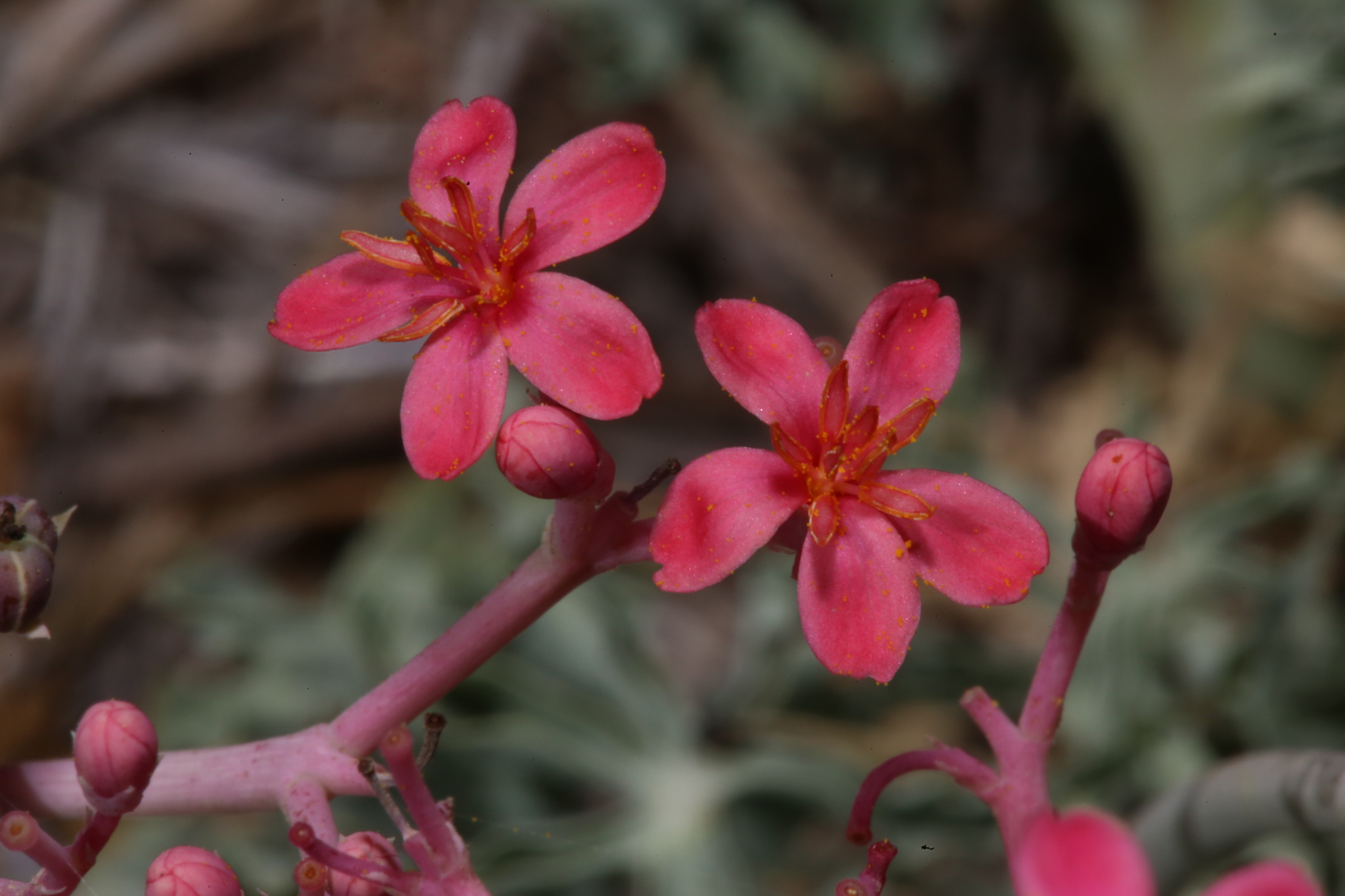
Described in 1832 by Terán & Berland., this caudex-forming spurge is native to the Tamaulipan thornscrub of southern Texas and northeastern Mexico (Coahuila, Nuevo León, Tamaulipas). It also circulates widely under the synonym Jatropha berlandieri Torr. — and in Japan often as "Yatropha berlandieri" or the trade name "Nishiki-sango" (錦珊瑚, "brocade coral"). A pale grey-white globose caudex sits half-buried in the ground; in active growth it sends up deeply palmate leaves and small, vivid red-to-coral flowers. The epithet cathartica literally means "purging": its seeds were historically used as a powerful laxative, and like other Jatropha the entire plant is strongly toxic, with phorbol esters in the milky sap.
Native climate
Rainfall is spread fairly evenly across the year. Overall mild, with a wide temperature range.
A broad-scale picture of the native range. Real growing spots — rock crevices, fog belts — can be milder.
Sources: climate & elevation WorldClim 2.1 (1970–2000) · occurrences GBIF · native range POWO · current weather Open-Meteo
Care
Light & Placement
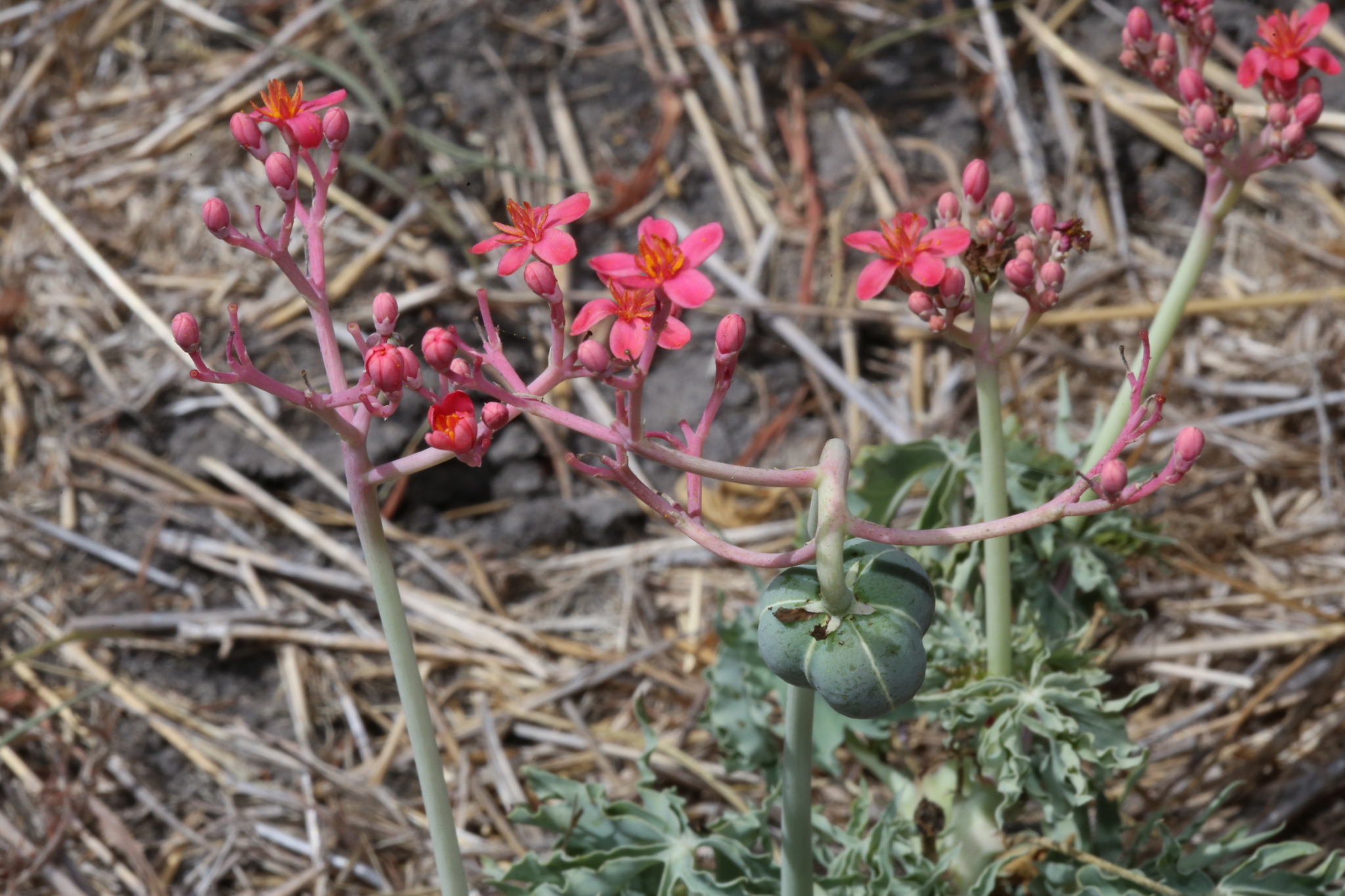
In habitat it grows on caliche hills and gravelly thornscrub slopes of southern Texas and northeastern Mexico, in unrelenting direct sun between thorny shrubs. Give it full sun outdoors during active growth — strong light keeps the caudex tight and the petioles short. In Japan's midsummer, light shading at 20–30% with the pot raised on a bench helps prevent scorch and stagnant air around the caudex. The plant is fully deciduous in winter; bring it under cover to a bright window kept above 5°C and bone-dry through dormancy.
Watering
In active growth, water thoroughly once the surface is fully dry, then let it dry out hard — this rhythm fattens the caudex. Cool, damp conditions rot it fast, so never leave water in the saucer. After leaf drop, hold completely dry through winter dormancy.
Substrate
Drainage and aeration first, inorganic-led: Akadama : Kanuma : pumice = 4:3:3. A taller pot with clear wet–dry cycles keeps the globose caudex from softening at the base.
Fertilizer & Supplements
A dilute liquid feed once a month in active growth, or a pinch of slow-release at repotting. Overfeeding stretches the petioles and softens the form, so go light.
Temperature & Overwintering
Active growth runs 22–35°C; aim for a 5°C winter minimum. Coming from Texas it is more cold-tolerant than Pachypodium podagrica and most Madagascan Jatrophas, but damp soil under cold is lethal. Overwinter on a bright indoor window, fully dry.
Starting from Seed
Where to source seeds
Pre-sowing treatment
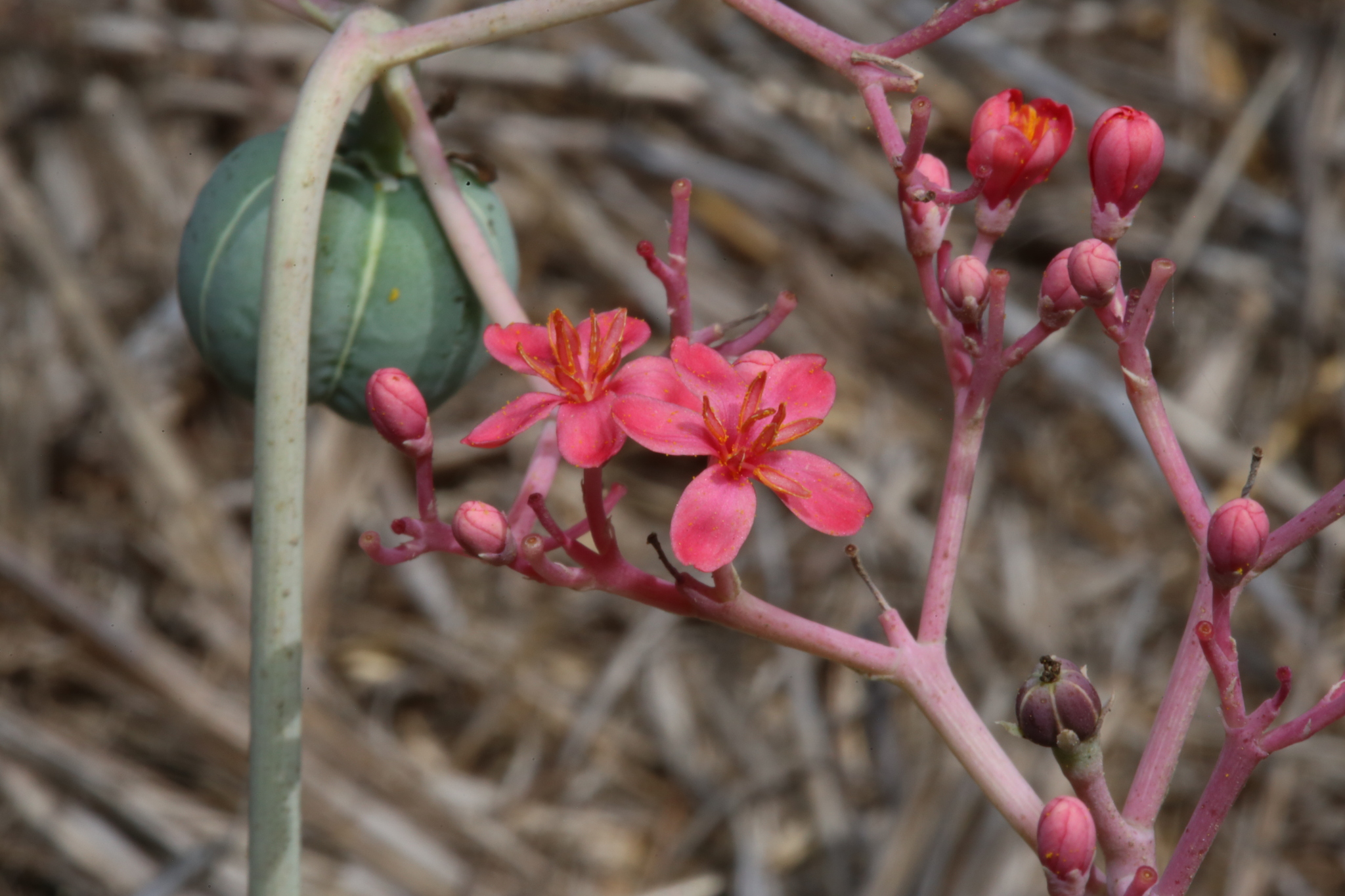
Soak seeds for about half a day (overnight) in a mix of a registered seed-treatment fungicide (Benlate or Daconil) and a plant tonic (Menedael; outside Japan, SUPERthrive or a chelated iron / seaweed extract works similarly), each diluted per label. Any that don't sink are likely past their prime. The seeds themselves are toxic — wash hands carefully before and after handling.
Substrate
Use a separate seedling mix that's fine-grained and near-sterile: fine Akadama, fine Kanuma, vermiculite in 1:1:1 parts. Sterilize with boiling water or a microwave pass before sowing.
Sowing method
Sow with no covering, or only the thinnest dusting of substrate so the seeds remain partly visible. Space at least 1 cm apart and don't let them clump or overlap.
Light & temperature
Bright shade or under a low-intensity LED at a steady 25–30°C. Expect germination in 7–21 days. Germination depends strongly on seed freshness, but fresh seed tends to come up well.
Watering
Bottom-water with the level 1–2 cm up the side of the pot. For the first 2–3 weeks, prioritize not letting the substrate dry out, then drop the water level gradually as seedlings come up.
Fertilizer
No feeding right after germination. Once the true leaves emerge, give a heavily diluted liquid feed once or twice a month — go lighter than the bottle suggests.
From Germination to Repotting
Germination through true leaves
Continue bottom watering, avoid strong light.
Weaning off bottom watering
Transition gradually over 1–2 months.
First repotting
In the first or second year, once root-bound.
Common Pitfalls
Mold & damping-off
- Cause: excess moisture, contamination, poor air flow
- Prevention: sterilize substrate, change bottom water often, use a circulation fan
Etiolation
- Cause: insufficient light
- Prevention: bring LEDs closer right after germination, or move to bright shade outdoors
Seeds fail to germinate
- Cause: stale seed, insufficient warmth
- Prevention: fresh seed and 25–30°C on a heat mat
Notes
The seeds are toxic; keep them out of reach of children and pets.