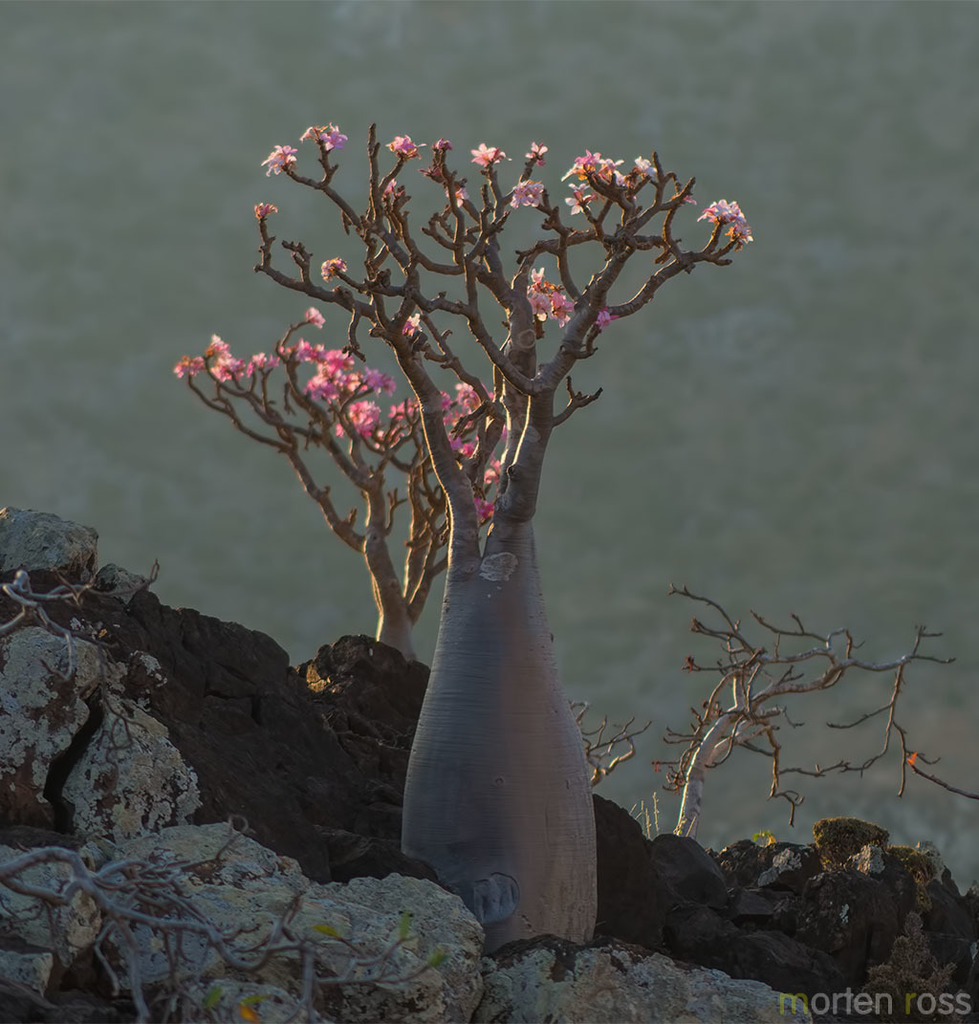
Endemic to the Yemeni island of Socotra, this rare species produces some of the largest caudexes in the Adenium genus. The thick, bottle-like trunk takes on a pale gray-white tone and, in habitat, can tower well above human height, with the oldest specimens believed to be hundreds of years old. Pale pink flowers appear on bare branches from winter into spring, but the plant takes many years to reach flowering age. Overall growth is markedly slower than other Adeniums. Seeds are hard to source and the plant is demanding to raise — sensitive to both cold and excess moisture, requiring strict control of temperature and watering — making it a coveted, advanced-grower species among caudex collectors. The currently accepted name in POWO (Kew) places this taxon as Adenium obesum subsp. socotranum, but in horticultural trade the Socotran fat-trunk type is treated distinctly, and that convention is followed on this site.
Native climate
Very little rain falls all year — an arid setting. Overall warm, with little seasonal swing.
* Accurate distribution data is scarce for this species, so these values are taken from the climate near the approximate center of its native range instead.
Sources: climate & elevation WorldClim 2.1 (1970–2000) · occurrences GBIF · native range POWO · current weather Open-Meteo
Care
Light & Placement

In habitat on Socotra it clings to sun-blasted limestone outcrops, so give it full direct sun outdoors through the growing season. It dislikes stagnant humidity, so light 20–30% shade plus strong airflow on a raised bench is essential through Japan's muggy midsummer. Move indoors early to a bright sunny window for winter, keeping it well above 12°C and away from any cold drafts.
Watering
Water thoroughly once the surface has dried during active growth to fatten the massive trunk, but stay alert to heat-and-humidity stress through the rainy season. In winter, withhold completely — holding 12°C or above is the single factor that decides whether it lives.
Substrate
Drainage above all — push the pumice ratio higher. Akadama : Kanuma : pumice = 3:3:4 is a good target, in a deeper pot with strong vertical airflow. Keep any slow-release feed to the smallest pinch.
Fertilizer & Supplements
A dilute liquid feed at most once a month in active growth, applied lightly. The species grows extremely slowly and asks little of fertilizer, so overfeeding directly pushes etiolation and root rot — restraint is the rule.
Temperature & Overwintering
Optimal 25–35°C — extremely heat-tolerant but unusually cold-sensitive for the genus, with a strict 12°C floor. Below 10°C, leaves blacken and bark blemishes appear. Overwinter completely dry on a bright sunny window and bring indoors well before autumn nights drop. The combination of damp soil and cold is genuinely lethal for this species.

Starting from Seed
Where to source seeds
links go directly to the product page; the rest are scientific-name searches. Stock fluctuates — verify availability on the destination site.
Pre-sowing treatment
Soak seeds for about half a day (overnight) in a mix of a registered seed-treatment fungicide (Benlate or Daconil) and a plant tonic (Menedael; outside Japan, SUPERthrive or a chelated iron / seaweed extract works similarly), each diluted per label. The ones still floating are likely no longer viable; seed is hard to find and loses viability quickly, so seek out the freshest harvest you can.
Substrate
Use a separate seedling mix that's fine-grained and near-sterile: fine Akadama, fine Kanuma, and vermiculite in 1:1:1 parts. Sterilizing beforehand with boiling water or a microwave pass meaningfully reduces damping-off.
Sowing method
Sow with no covering, or only the thinnest dusting of substrate so the seeds remain partly visible. Space the seeds at least 1 cm apart so they don't clump or overlap on the surface.
Light & temperature
Keep the tray in bright shade at a steady 28–32°C. Germination depends heavily on seed freshness, and even fresh seed stays on the lower side. High heat and fresh seed are decisive, and a heat mat is effectively mandatory for reliable results.
Watering
Bottom-water with the level 1–2 cm up the pot. For the first 2–3 weeks, prioritize not letting things dry out, then drop the water level gradually once seedlings are stable.
Fertilizer
No feeding right after germination. Once the true leaves emerge, give diluted liquid fertilizer at double dilution once or twice a month — applied very lightly.
From Germination to Repotting
Germination through true leaves
Continue bottom watering and keep strong light off them.
Weaning off bottom watering
Phase it out gradually over 1–2 months.
First repotting
In the first or second year, once roots have filled the pot.
Common Pitfalls
Mold & damping-off
- Cause: excess moisture, contamination
- Prevention: sterilize the substrate, ensure good air flow
Etiolation
- Cause: insufficient light
- Prevention: move LEDs closer right after germination, or shift the tray to bright shade outdoors
Seeds fail to germinate
- Cause: stale seeds, insufficient warmth
- Prevention: use fresh seeds and a heat mat
Notes
Particularly prone to cold-induced root rot. Pay close attention to winter temperature control. The sap is mildly toxic.


