
Described by Lem. in 1861, this Asparagaceae caudex tree is endemic to the Tehuacán-Cuicatlán Valley of south-central Mexico (Puebla and northern Oaxaca). Locally called "Sotolín" or "Pata de Elefante", it forms a pale grey, bottle-shaped trunk capped by a halo of stiff, short, silvery-green leaves held erect rather than cascading. Compared to the houseplant-favourite B. recurvata, this species is more drought-adapted: leaves are shorter and rigid, the form stays compact. Wild trees can reach 12 m, but growth is exceedingly slow — in pots the tightly-built silhouette holds for years. Also traded under the synonym Nolina gracilis.
Native climate
Rain concentrates in the one season, with a dry season of roughly 5 months. Overall mild, at high elevation.
A broad-scale picture of the native range. Real growing spots — rock crevices, fog belts — can be milder.
Sources: climate & elevation WorldClim 2.1 (1970–2000) · occurrences GBIF · native range POWO · current weather Open-Meteo
Care
Light & Placement
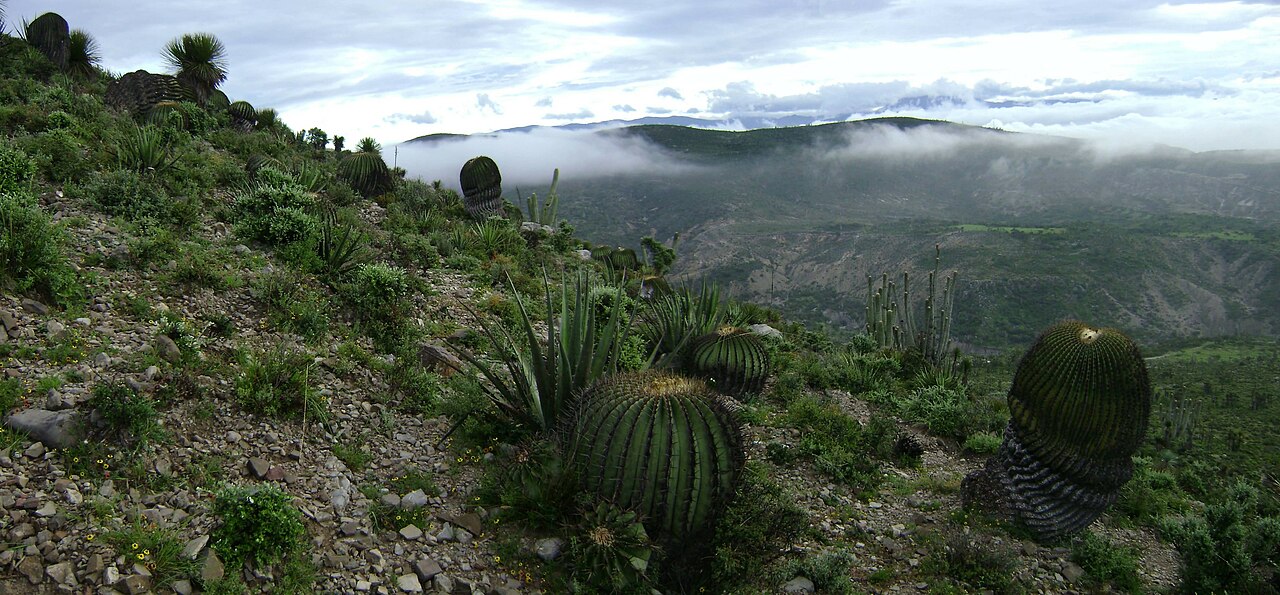
In the semi-arid matorral of the Tehuacán-Cuicatlán Valley (an "izotal" community alongside columnar cacti), it stands in unrelenting direct sun. During active growth, give it full outdoor sun — the trunk stays compact and the leaves stay short and rigid. Through Japan's midsummer, light shading at 20–30% with the pot raised on a bench helps avoid leaf burn and stagnant heat. Overwinter on a bright sunny window kept above 5°C and dry. More drought-tolerant than recurvata; provided wet soil at low temperature is avoided, outdoor management is forgiving.
Watering
In active growth, wait until the topsoil is dry, then water thoroughly — the wet/dry rhythm fattens the trunk. Don't leave water in the saucer. Through winter, go fully dry or at most a light monthly misting.
Substrate
Drainage and aeration first, inorganic-led. Akadama : Kanuma : pumice = 4:3:3 as a base. A deeper pot with clear wet/dry cycles protects the swollen trunk from rot.
Fertilizer & Supplements
A diluted liquid feed once a month in active growth, or a pinch of slow-release at repotting. Growth is slow, so don't overfeed — aim to thicken patiently.
Temperature & Overwintering
Optimal 22–35°C, 5°C minimum. Bone-dry plants tolerate brief cold, but damp soil under 10°C is fatal. Evergreen — overwinter on a bright window kept dry.
Starting from Seed
Where to source seeds
links go directly to the product page; the rest are scientific-name searches. Stock fluctuates — verify availability on the destination site.
Pre-sowing treatment
Soak seeds for about half a day (overnight) in a mix of a registered seed-treatment fungicide (Benlate or Daconil) and a plant tonic (Menedael; outside Japan, SUPERthrive or a chelated iron / seaweed extract works similarly), each diluted per label. Floaters tend to germinate poorly.
Substrate
Use a separate fine-grained, near-sterile seedling mix: fine Akadama, fine Kanuma, vermiculite in 1:1:1 parts. Sterilize with boiling water or a microwave pass.
Sowing method
Sow uncovered, or with the thinnest dusting so seeds remain partly visible. Space at least 1 cm apart and avoid overlapping.
Light & temperature
Bright shade or under LEDs at 22–28°C. Expect germination in 14–30 days. Germination depends strongly on seed freshness, but fresh seed tends to come up well.
Watering
Bottom-water with the level 1–2 cm up the pot. For the first 2–3 weeks, don't let things dry out, then drop the water level gradually.
Fertilizer
No feeding right after germination. Once true leaves are out, give heavily diluted liquid fertilizer once or twice a month. Slow grower, so a stronger dose offers little.
From Germination to Repotting
Germination through true leaves
Continue bottom watering, avoid strong light.
Weaning off bottom watering
Step down gradually over 1–2 months.
First repotting
In year 2 or 3, once root-bound.
Common Pitfalls
Mold & damping-off
- Cause: excess moisture, contamination, poor air flow
- Prevention: sterilize substrate, change bottom water frequently
Etiolation
- Cause: insufficient light
- Prevention: bring LEDs closer right after germination, or move to bright shade outdoors. Under weak light the leaves elongate and rarely revert to the proper short, rigid silver-green form
Seeds fail to germinate
- Cause: stale seed, insufficient warmth
- Prevention: fresh seed and 22–28°C on a heat mat
Notes
Watch the combination of damp soil and low temperature.
