
A cycad endemic to the dry-hot valleys of the Jinsha River basin in southern Sichuan and northern Yunnan, China, at 1100–2000 m elevation. Described by L. Zhou & S. Y. Yang in 1981, the epithet honours its type locality — the city of Panzhihua in Sichuan. The Chinese name is 攀枝花蘇鉄 (Panzhihua sago palm); the Japanese trade name is Saikasu Panzhi-fu-aensis. Plants reach 1–3 m with an unbranched grey trunk and a radial crown of blue-green to silvery pinnate fronds, occupying the highest altitudes recorded for the genus. It is the most cold-hardy Cycas — fronds tolerate −8 to −10°C and the trunk survives to −15°C in dry conditions, making it one of the few cycads that can be overwintered outdoors. Listed on CITES Appendix II; IUCN status is Vulnerable.
Native climate
Rain concentrates in the warm season, with a distinct dry season. Overall cool, at high elevation, and cold winters.
* Accurate distribution data is scarce for this species, so these values are taken from the climate near the approximate center of its native range instead.
Sources: climate & elevation WorldClim 2.1 (1970–2000) · occurrences GBIF · native range POWO · current weather Open-Meteo
Care
Light & Placement
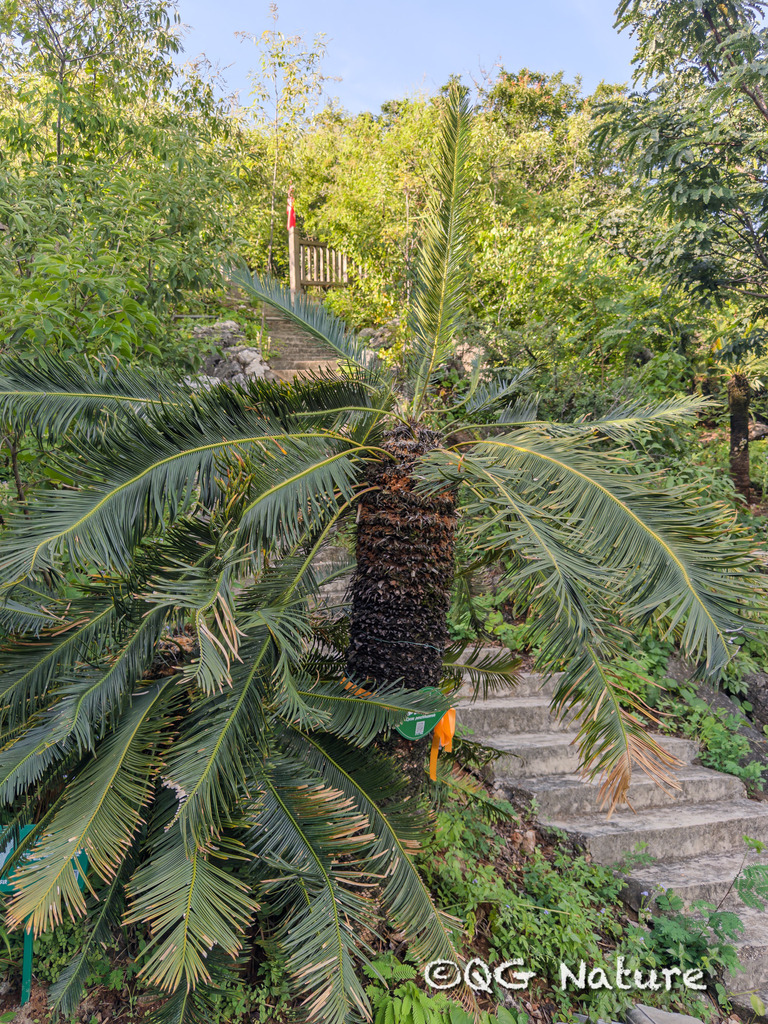
A full-sun plant from open, savanna-like slopes in the dry-hot Jinsha River valley. In active growth, give it as much direct sun as possible — strong light tightens the blue-green colour and keeps the rachises short and stiff. Shade lets the fronds elongate, dull out and droop. Even in Japan's midsummer keep shading under 30 percent, and raise the pot off the ground for airflow. The most cold-hardy cycad in the genus, it can stay outdoors year-round west of the Kanto region in Japan — but avoid prolonged early-winter rain combined with frost, so a frost-free eaves spot is the safest.
Watering
In active growth, water deeply once the substrate has fully dried, and never leave water in the saucer. Taper through autumn and water sparingly through winter, perhaps once or twice a month. Wet soil combined with cold significantly reduces cold tolerance.
Substrate
Drainage first, inorganic-led: Akadama : Kanuma : pumice = 3:3:4. Habitat soils are weakly alkaline, derived from limestone and sand shale, so a pinch of dolomite lime suits the species well.
Fertilizer & Supplements
A diluted liquid feed once a month in active growth, or a small pinch of slow-release at repotting. One of the faster-growing Cycas, but overfeeding stretches the rachises and lowers cold tolerance.
Temperature & Overwintering
Optimal 22–32°C, minimum −5°C. The most cold-hardy Cycas — fronds tolerate −8 to −10°C and the trunk reportedly survives to −15°C in dry conditions (USDA zone 7). Overwinter dry under frost-free eaves and outdoor cultivation is feasible.

Starting from Seed
Where to source seeds
Pre-sowing treatment
The red fleshy seed coat (sarcotesta) invites rot — soak briefly to soften and remove it before sowing. Soak seeds for about half a day (overnight) in a mix of a registered seed-treatment fungicide (Benlate or Daconil) and a plant tonic (Menedael; outside Japan, SUPERthrive or a chelated iron / seaweed extract works similarly), each diluted per label. Floaters tend to be old or infertile. Germination requires steady warmth of 25–32°C.
Substrate
Lean toward straight inorganic — pumice fines as the base, or fine Akadama with pumice at 1:2. Always use a deep pot for the taproot, and sterilise the mix with boiling water or a microwave pass beforehand.
Sowing method
Lay the seed on its side — orientating the seam vertically distorts the emerging root. Cover only thinly so the upper half of the seed remains visible.
Light & temperature
Bright shade with a steady 25–30°C; a heat mat helps germination stay even. Germination takes 1–3 months, relatively fast for the genus.
Watering
Bottom-water with the level 1–2 cm up the pot, refreshing the water often to keep rot risk down. Drop the level gradually as seedlings emerge.
Fertilizer
No feeding right after germination. Once the first pinnate leaf opens, give heavily diluted liquid fertilizer once a month — overfeeding causes etiolation.
From Germination to Repotting
Germination through true leaves
Cotyledon first, then a pinnate leaf.
Weaning off bottom watering
Phase out over 2–3 months.
First repotting
In year two or three, into a deep pot.
Common Pitfalls
Mold & damping-off
- Cause: residual sarcotesta, excess moisture, contamination
- Prevention: clean off the fleshy coat completely, sterilise the substrate, refresh bottom-water often, and run a circulation fan
Etiolation
- Cause: insufficient light
- Prevention: harden off into strong light right after germination to bring out the blue-green colour and short, stiff rachises — full sun outdoors or high-output LEDs
Seeds fail to germinate
- Cause: stale seed, insufficient warmth, sarcotesta not removed
- Prevention: source fresh seed, hold 25–30°C steady on a heat mat, and remove the fleshy coat completely
Notes
Listed on CITES Appendix II and IUCN Vulnerable — international trade in wild plants is permit-controlled. The seeds are highly toxic; keep them out of reach of children and pets.


