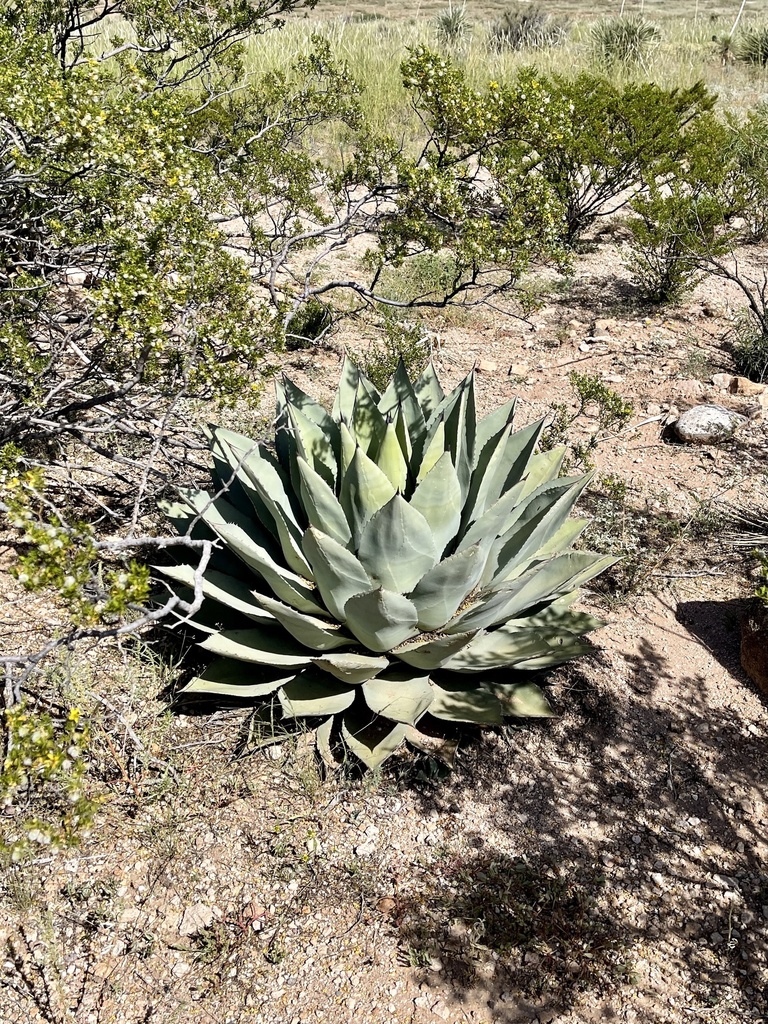
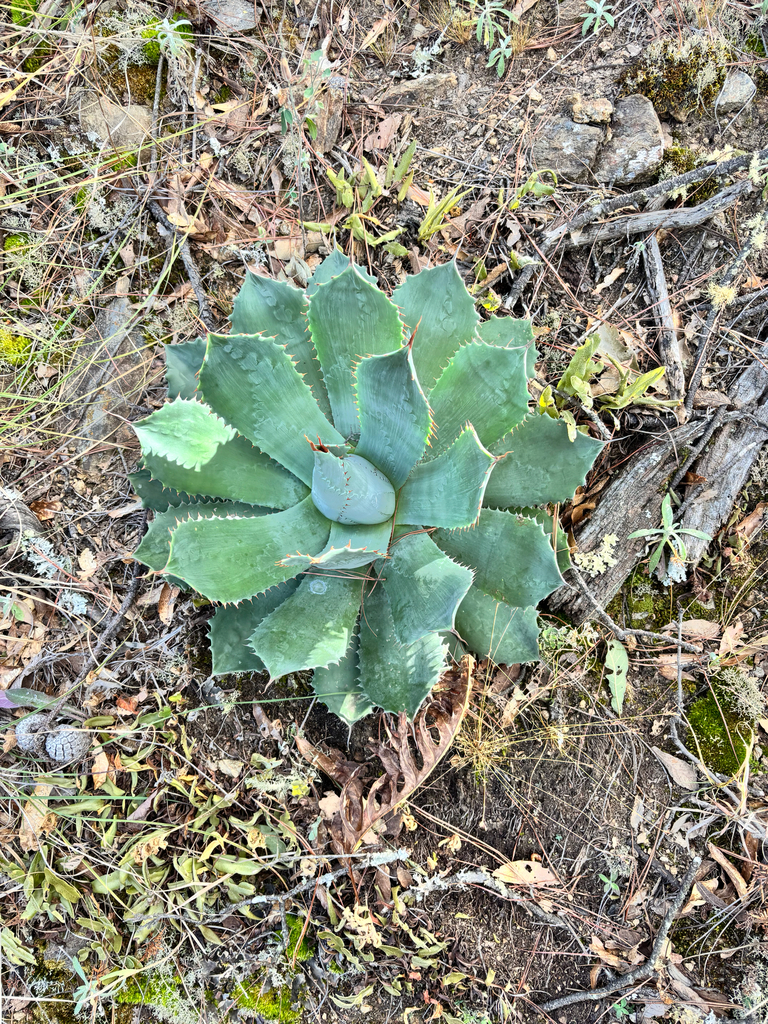
A medium-sized Agave from the limestone cliffs around Rancho Tambor in the Tehuacán–Cuicatlán Valley of northern Oaxaca, Mexico, described by Howard Scott Gentry in Agaves of Continental North America (1982). The defining look — chalky blue-white leaves, large irregular marginal teeth, and a long terminal spine — comes from a life spent clinging to bare carbonate rock under hard sun. From seed it germinates quickly and grows at a steadier tempo than most caudiciforms, which makes it a forgiving entry point into the genus. In horticulture, named selections such as ‘White Whale’, ‘Genryu’ and the FO-076 lineage trade at high prices, but those forms have been preserved through vegetative propagation; seed-grown plants of the wild species rarely match a single named clone. The FO-076 lineage in particular was separated as Agave oteroi in 2019, so this page covers the species A. titanota in Gentry's narrow sense.
Native climate
Rain concentrates in the one season, with a distinct dry season. Overall warm, with a wide temperature range.
A broad-scale picture of the native range. Real growing spots — rock crevices, fog belts — can be milder.
Sources: climate & elevation WorldClim 2.1 (1970–2000) · occurrences GBIF · native range POWO · current weather Open-Meteo
Care
Light & Placement

In habitat the plant grows on open limestone faces under unrelenting sun, so in active growth give it full outdoor light all day. Low light stretches the leaves and softens the teeth and terminal spine the species is grown for. In a Japanese midsummer, 20–30% shade and an elevated bench keep leaf-tip burn and stagnant heat in check; a circulating fan helps, since this CAM plant opens its stomata at night and rewards good air movement. Winter requires shelter from frost and cold rain — a bright indoor window kept above 5°C, run on the dry side. The compact rosette, tight leaves and crisp teeth that this species is known for only emerge under genuinely strong light.
Watering
In active growth, water thoroughly once the substrate has dried completely, then let it dry again — that on/off rhythm is the whole game. Prolonged rain and stagnant pots are the main cause of loss. In dormancy, withhold water or give one light splash a month at most.
Substrate
Drainage and aeration first, inorganic-led: Akadama : Kanuma : pumice = 4:3:3. Because the species is a limestone-grower, leaning the mix toward pumice or Hyuga (slightly alkaline-tolerant) causes no problems. Use a deep pot to enforce the wet–dry swing.
Fertilizer & Supplements
A pinch of slow-release at repotting plus a dilute liquid feed once a month in active growth is plenty. Heavy feeding stretches the internodes and dulls the teeth. Restraint produces the tighter form the species is grown for.
Temperature & Overwintering
Active-growth optimum 20–33°C with 5°C as a sensible winter floor. Dry plants reportedly take brief dips close to 0°C, but cold combined with damp substrate rots the crown fast. Overwinter on a bright dry window, sheltered from rain and frost.
Starting from Seed
Where to source seeds
Pre-sowing treatment
Soak seeds for half a day in water mixed with a fungicide (Benlate, Daconil 1000) and a plant tonic (Menedael or similar) at label strength. Floaters tend to be old or empty. Agave seeds are thin flat flakes and lose viability with poor storage, so freshness from the supplier matters more than any treatment.
Substrate
Use a separate fine-grained, near-sterile sowing mix: Akadama fine : Kanuma fine : vermiculite = 1:1:1, pre-sterilised by microwave or boiling water to suppress mould.
Sowing method
Surface-sow with either no cover or the thinnest possible dusting of substrate. The flat seeds overlap easily — set them out individually with tweezers at least 1 cm apart.
Light & temperature
Bright shade, with the substrate held steadily at 22–28°C. Germination takes 5–14 days. Germination depends strongly on seed freshness, but fresh seed tends to come up well.
Watering
Bottom-water with the pot standing in 1–2 cm of water. For the first 2–3 weeks, prioritise keeping the surface moist; once germination is even, lower the water level in steps.
Fertilizer
None for the first weeks. Once the first true leaves expand, a dilute liquid feed (at twice the label dilution or weaker) once or twice a month is enough.
From Germination to Repotting
Germination through true leaves (~1 month)
Keep bottom-watering and bright shade; maintain humidity.
Weaning off bottom watering (1–2 months)
Lower the water level in steps; switch to tray watering.
First repotting (1–2 years)
Move to the standard inorganic mix once roots fill the pot.
Common Pitfalls
Mold & damping-off
- Cause: contaminated substrate, overwatering, poor airflow
- Prevention: sterilise the mix, refresh the bottom water often, and run a fan for air movement
Etiolation
- Cause: insufficient light
- Prevention: bring LEDs close right after germination, or move to bright outdoor shade
Seeds fail to germinate
- Cause: stale seed or low temperature
- Prevention: buy from reliable suppliers and use a heat mat to hold temperature
Seedlings don't match the named selection
- Cause: ‘White Whale’, ‘Genryu’, and FO-076 are selections maintained by vegetative propagation
- Prevention: seed-grown plants show natural variation; if a specific form is the goal, obtain offsets of that clone
Notes
The terminal spine is sharp — handle with care around eyes and hands.