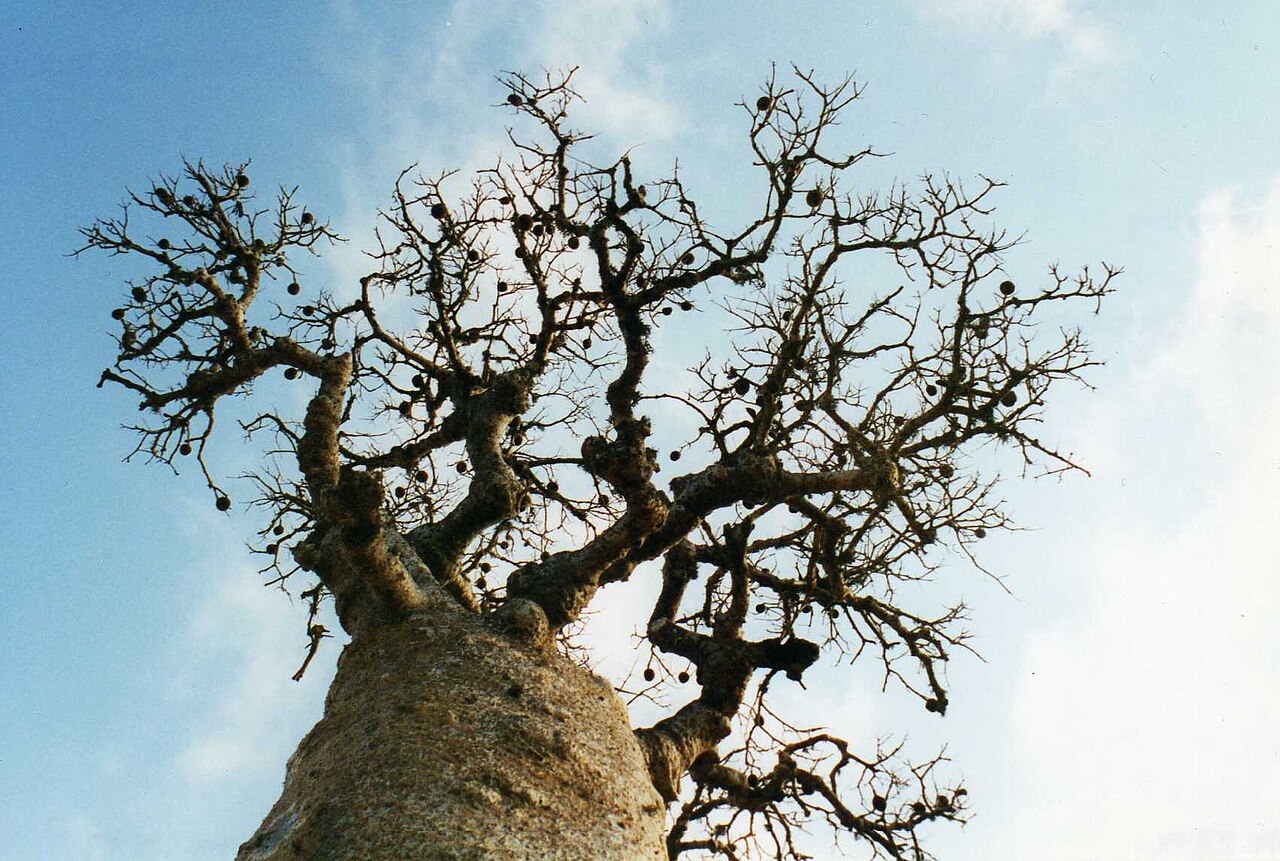
A caudex-forming Moringaceae endemic to Madagascar, with a pale grey bottle-shaped trunk topped by a parasol of bipinnate leaves. Field surveys by Olson & Razafimandimbison (2000) found no surviving wild populations and concluded that the species persists only as a culturally tended tree across western and southwestern Madagascar; the IUCN reflects this as Critically Endangered. Every herbarium specimen since 1880 has come from village plantings rather than wild stands — one of the few succulents whose continued existence depends entirely on human cultivation, and a notable conservation case for seed-growers.
Native climate
Rain concentrates in the warm season, with a dry season of roughly 5 months. Overall a warm climate.
A broad-scale picture of the native range. Real growing spots — rock crevices, fog belts — can be milder.
Sources: climate & elevation WorldClim 2.1 (1970–2000) · occurrences GBIF · native range POWO · current weather Open-Meteo
Care
Light & Placement

Native to the dry deciduous forests and village land of western Madagascar under intense sun, it appreciates a bright position year-round. In active growth, give it full sun outdoors so the caudex stays compact and the canopy holds its parasol form. In Japan's midsummer the combination of strong light and heat can scorch leaves and bleach the red rachis tones, so light shading at around 30% helps; raise the pot on a bench for airflow rather than setting it on the ground. When leaves drop in autumn, move it indoors early to a bright window kept above 8°C. The species is sensitive to the cold-plus-wet combination, so never overwinter outdoors.
Watering
In active growth, water thoroughly once the surface dries — the wet/dry cycle plumps the caudex. After leaf-drop, hold the plant essentially dry through dormancy with at most a monthly misting.
Substrate
Drainage first, inorganic-led. Akadama : Kanuma : pumice = 4:3:3. A taller pot keeps wet–dry cycles clean and protects a fattened caudex from rot.
Fertilizer & Supplements
A diluted liquid feed once or twice a month in active growth, or a pinch of slow-release at repotting. The species grows fast and responds well to modest, balanced feeding.
Temperature & Overwintering
Active growth runs 22–35°C; aim for an 8°C minimum. Overwinter dry on a bright indoor window. Wet substrate combined with temperatures below 10°C is the typical killer, so move the plant under cover before the first cold spell.

Starting from Seed
Where to source seeds
links go directly to the product page; the rest are scientific-name searches. Stock fluctuates — verify availability on the destination site.
Pre-sowing treatment
Soak seeds for about half a day (overnight) in a mix of a registered seed-treatment fungicide (Benlate or Daconil) and a plant tonic (Menedael; outside Japan, SUPERthrive or a chelated iron / seaweed extract works similarly), each diluted per label. Floaters are typically a sign of stale stock. The seeds are large and easy to handle; light scarification with sandpaper on the hard coat helps germination come up evenly.
Substrate
A fine-grained, near-sterile seedling mix: fine Akadama, fine Kanuma, vermiculite in 1:1:1 parts. Sterilize with boiling water or a microwave pass for safety.
Sowing method
Seeds are around 1 cm — large enough to press lightly into the surface and cover with about 5 mm of substrate. Space them at least 2 cm apart.
Light & temperature
Bright shade at a steady 25–30°C. Expect germination in 7–21 days. Germination depends strongly on seed freshness, but fresh seed tends to come up well.
Watering
Bottom-water with the level 1–2 cm up the pot. For the first 2–3 weeks, don't let things dry out, then drop the level gradually as seedlings come up.
Fertilizer
No feeding right after germination. Once true leaves emerge, give a heavily diluted liquid fertilizer once or twice a month — growth is brisk without pushing the dose.
From Germination to Repotting
Germination through true leaves
Continue bottom watering, avoid strong light.
Weaning off bottom watering
Transition gradually over 1–2 months.
First repotting
In the first year, once the plant has become root-bound.
Common Pitfalls
Mold & damping-off
- Cause: excess moisture, contamination, poor air flow
- Prevention: sterilize substrate, change bottom water frequently
Etiolation
- Cause: insufficient light, heat-and-humidity stress
- Prevention: bring LEDs closer right after germination, or move to bright shade outdoors
Seeds fail to germinate
- Cause: stale seed, insufficient warmth
- Prevention: fresh seed and 25–30°C on a heat mat
Notes
Effectively extinct in the wild and IUCN-listed as Critically Endangered, surviving only through village cultivation in Madagascar. Source seed and plants from reputable suppliers, and grow this species with a sense of stewardship — your pot is part of how the lineage continues.