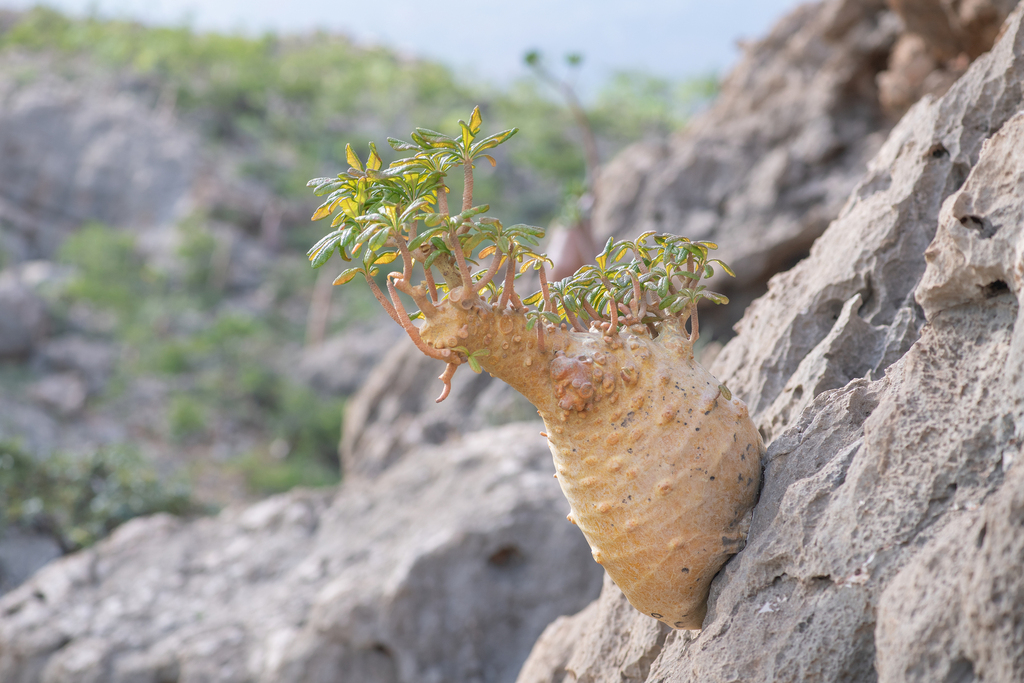
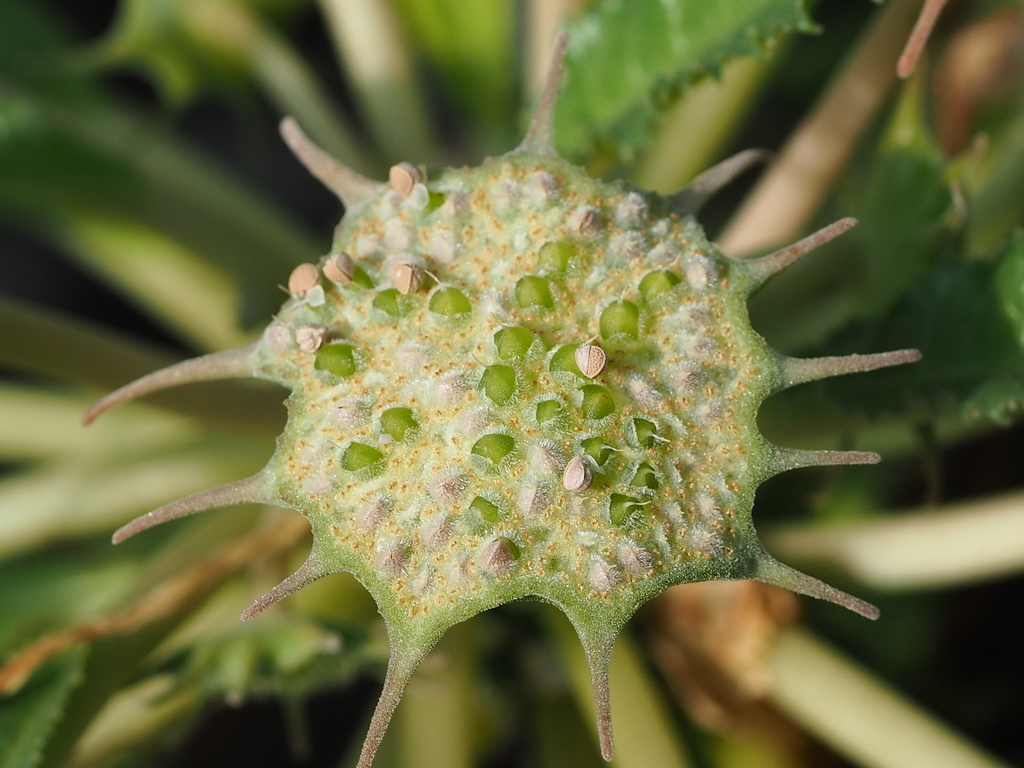
A caudex-forming Moraceae originally described by Forsskål and transferred to Dorstenia by Schweinfurth in 1896, ranging across the southern Arabian Peninsula (Yemen, southwestern Saudi Arabia, Oman), East Africa (Ethiopia, Somalia, Kenya), and the island of Socotra. It carries fleshy leaves on a squat, grey-brown caudex, and its signature feature is the disc-shaped inflorescence — a hypanthodium — that defines the family alongside Ficus. As the seed-bearing fruits ripen, surrounding tissue squeezes them out in a ballistic dispersal that flings seeds well clear of the parent. The plant readily self-pollinates and reseeds itself in neighbouring pots, making it one of the easiest and most rewarding caudex species to start from seed.
Native climate
Rain concentrates in the one season, with a distinct dry season. Overall a warm climate.
A broad-scale picture of the native range. Real growing spots — rock crevices, fog belts — can be milder.
Sources: climate & elevation WorldClim 2.1 (1970–2000) · occurrences GBIF · native range POWO
Care
Light & Placement

From the dry shrublands and rocky slopes of the southern Arabian Peninsula and East Africa, this species grows under intense sun and likes a bright spot. Give it full sun outdoors during the growing season for a tight caudex and short petioles that hold the plant's compact form. In Japan's midsummer, leaves can scorch under the combination of strong light and heat, so light shading at around 30% helps, and raising the pot on a bench keeps airflow generous. The species is cold-sensitive: once autumn temperatures start dropping below 15°C, move it to a bright indoor window and keep it above an 8°C minimum through winter.
Watering
In active growth, water thoroughly once the surface dries — this plumps the caudex. Always empty the saucer. Through winter hold the plant essentially dry, with at most a monthly misting.
Substrate
Drainage first, inorganic-led: Akadama : Kanuma : pumice = 4:3:3. A taller pot with clean wet–dry cycles lets the caudex thicken steadily without rot risk.
Fertilizer & Supplements
A diluted liquid feed once or twice a month in active growth, or a pinch of slow-release at repotting. The species grows fast and responds well to modest feeding, often flowering and setting seed within the same year.
Temperature & Overwintering
Active growth runs 22–32°C; aim for an 8°C minimum. The plant is cold-sensitive — exposure below 5°C damages the caudex — so move it indoors before the autumn chill and overwinter dry on a bright window.

Starting from Seed
Where to source seeds
links go directly to the product page; the rest are scientific-name searches. Stock fluctuates — verify availability on the destination site.
Pre-sowing treatment
Soak seeds for about half a day (overnight) in a mix of a registered seed-treatment fungicide (Benlate or Daconil) and a plant tonic (Menedael; outside Japan, SUPERthrive or a chelated iron / seaweed extract works similarly), each diluted per label. Freshness is everything — sow as soon after harvest as possible, since older seed germinates poorly.
Substrate
A fine-grained, near-sterile seedling mix: fine Akadama, fine Kanuma, vermiculite in 1:1:1 parts. Sterilize with boiling water or a microwave pass to head off damping-off.
Sowing method
Seeds are tiny, around 1–2 mm. Sow with no covering, or only the thinnest dusting so the seeds remain partly visible, and space them at least 1 cm apart.
Light & temperature
Bright shade or under LEDs at a steady 25–30°C. Expect germination in 7–21 days. Germination depends strongly on seed freshness, but fresh seed tends to come up well.
Watering
Bottom-water with the level 1–2 cm up the pot. For the first 2–3 weeks, don't let the substrate dry out, then drop the level gradually as seedlings come up.
Fertilizer
No feeding right after germination. Once true leaves emerge, give a heavily diluted liquid fertilizer once or twice a month — growth is brisk without pushing the dose.
From Germination to Repotting
Germination through true leaves
Continue bottom watering, avoid strong light.
Weaning off bottom watering
Transition gradually over 1–2 months.
First repotting
In the first year, once the plant has become root-bound.
Common Pitfalls
Mold & damping-off
- Cause: excess moisture, contamination, poor air flow
- Prevention: sterilize substrate, change bottom water frequently
Etiolation
- Cause: insufficient light
- Prevention: bring LEDs closer right after germination, or move to bright shade outdoors
Seeds fail to germinate
- Cause: stale seed, insufficient warmth
- Prevention: freshly harvested seed and 25–30°C on a heat mat
Notes
The sap is mildly toxic.