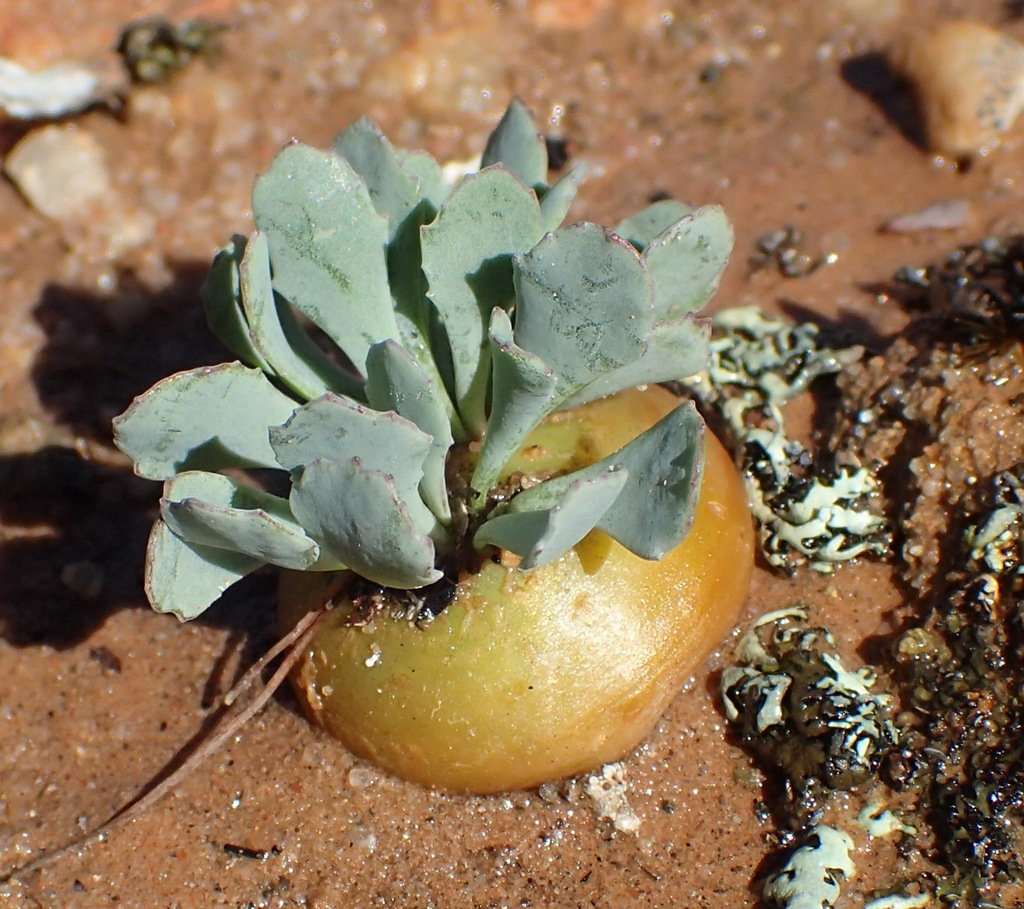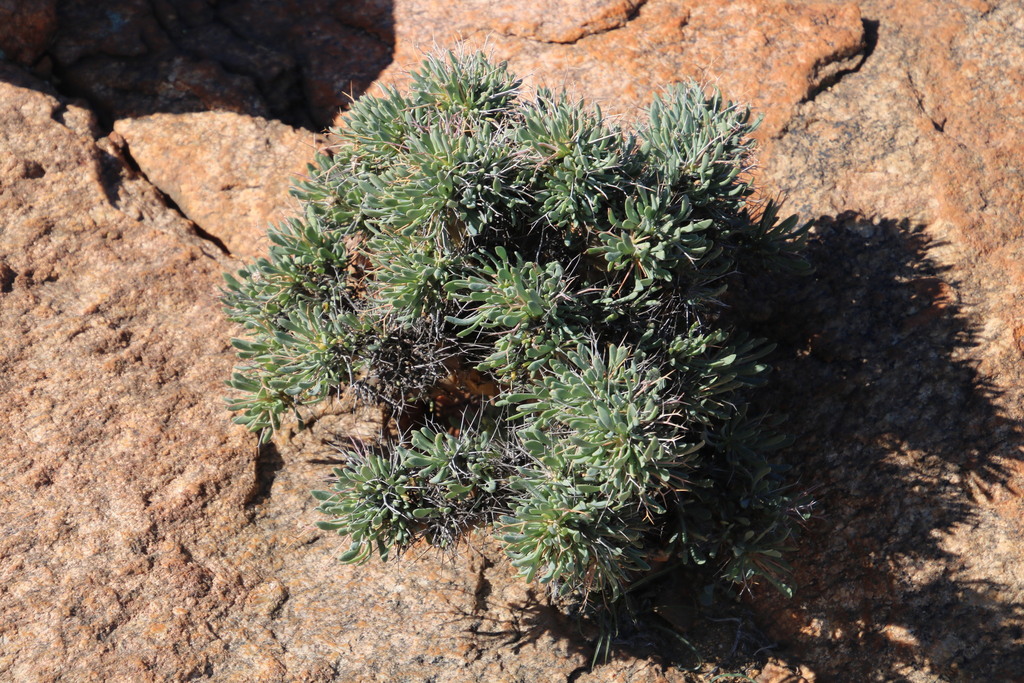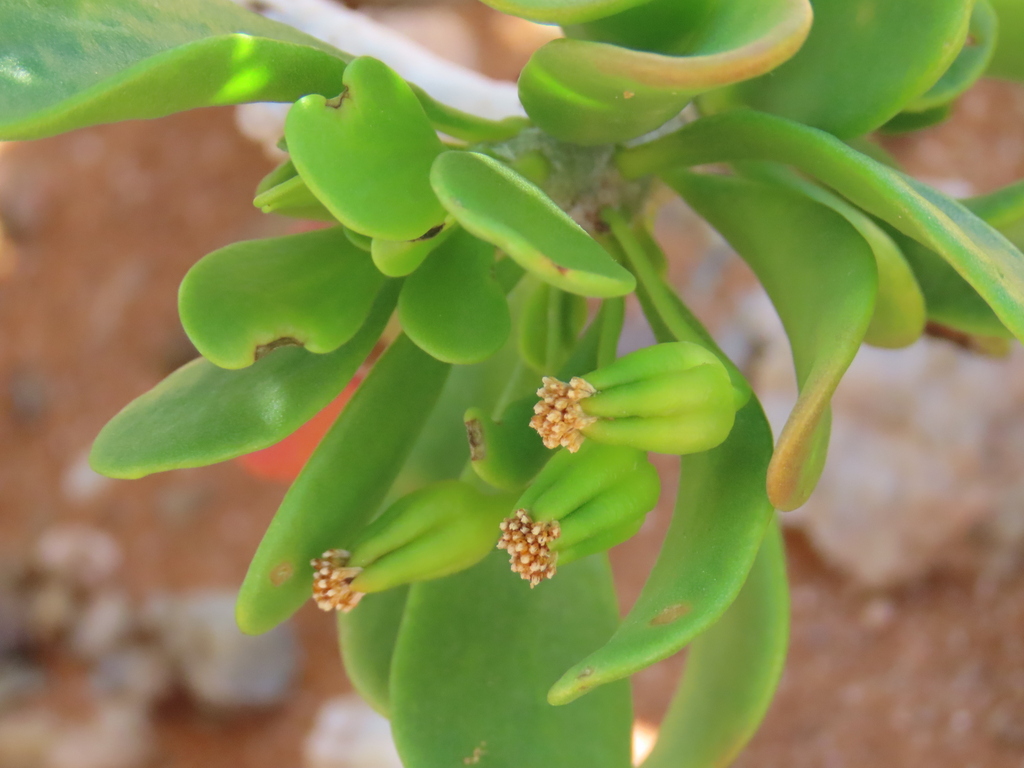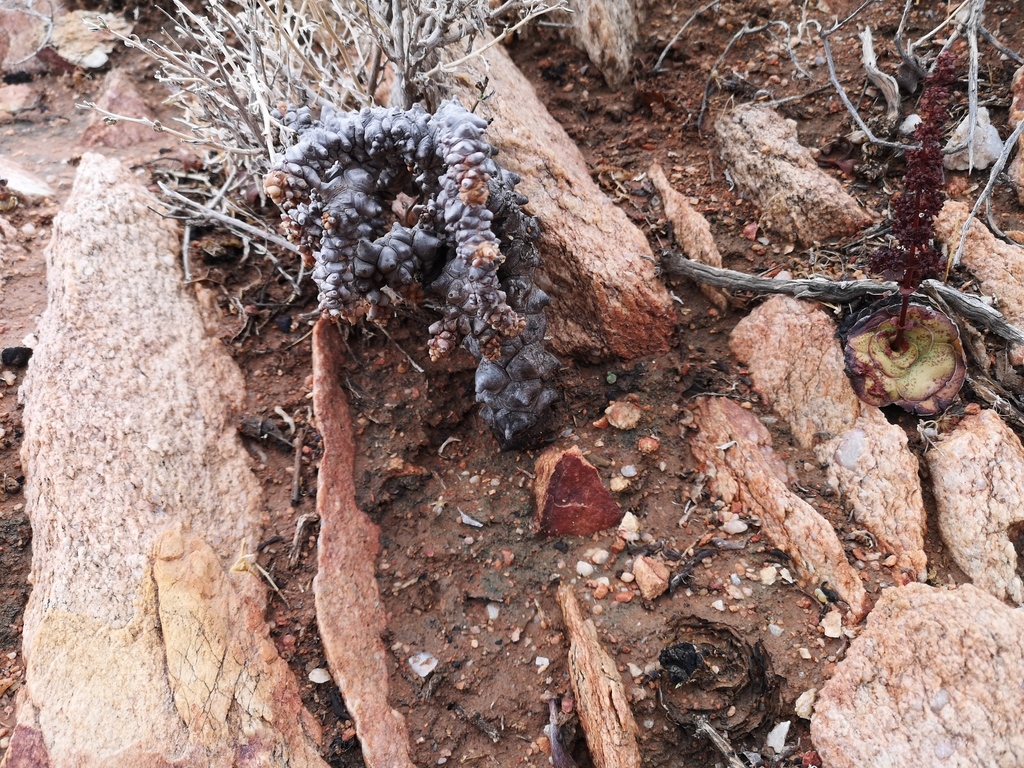
A small, slow-growing caudex from a handful of localities in the central mountain ranges of the Richtersveld, in South Africa's Northern Cape. Described by Pillans in 1934 and named for Hans Herre — the "Mesemb Father", curator of the Stellenbosch Botanic Garden for 35 years. The pale grey trunk is sparingly branched, with persistent leaf bases hardening into knobby tubercles that give the entire stem its distinctive cobbled texture. In autumn through spring it pushes out narrow, undulate succulent leaves and small yellow daisy heads; through summer it drops everything and rests completely. Winter-growing. Listed as Vulnerable by SANBI, with only four known wild localities, and threatened by collecting from the wild. Seed reaches the trade in modest quantities, and among caudex enthusiasts it is firmly a collector's piece.
Native climate
Rain concentrates in the warm season, with a dry season of roughly 6 months. Overall mild, with a wide temperature range.
* Accurate distribution data is scarce for this species, so these values are taken from the climate near the approximate center of its native range instead.
Sources: climate & elevation WorldClim 2.1 (1970–2000) · occurrences GBIF · native range POWO · current weather Open-Meteo
Care
Light & Placement

The Richtersveld receives only ~100 mm of rainfall a year, almost all in winter, and O. herrei tucks itself into rock crevices, under boulders, and on south to southeast slopes over quartz gravel. SANBI specifically recommends "morning sun or bright shade" — even in habitat the species is not a full-sun plant. Through the autumn-to-spring growing season give it as much of the weak winter sun as you can to firm up leaves and trunk, but don't push it into harsh direct light. The hard problem is summer placement for a winter-growing species: the priority is keeping the pot as cool and well-ventilated as possible. Move the pot to bright shade out of direct sun (north-facing eaves or about 50% shade cloth), raise it on a bench, and run a circulation fan. Winter indoors above 5°C on a bright window.
Watering
In autumn (September–October), once nighttime lows drop below ~20°C and leaves begin to move, restart with light watering. Through the active season, water deeply about once every two weeks. Stop when leaves yellow and drop in spring — keep the plant fully dry through summer. Watering in summer because "the soil looks dry" is the single most reliable way to kill this species.
Substrate
Drainage first, inorganic-led. Akadama : Kanuma : pumice = 3:3:4, with pumice tuned higher to dry faster. The native quartz-gravel substrate is worth keeping in mind — a thin coarse-sand topping helps reduce stagnant moisture around the trunk.
Fertilizer & Supplements
Liquid feed at double dilution once a month through the active season, or a pinch of slow-release at repotting. The species is genuinely slow; pushing fertilizer dulls the texture of the knobby tubercles.
Temperature & Overwintering
Optimal 15–25°C; above ~30°C the plant slides into dormancy. Aim for a 5°C minimum — damp soil under cold is fatal. Hot, humid summers are harder to manage than the cold months: from June through September, prioritize shade, ventilation, and dry soil.

Starting from Seed
Where to source seeds
links go directly to the product page; the rest are scientific-name searches. Stock fluctuates — verify availability on the destination site.
Pre-sowing treatment
Soak seeds for about half a day (overnight) in a mix of a registered seed-treatment fungicide (Benlate or Daconil) and a plant tonic (Menedael; outside Japan, SUPERthrive or a chelated iron / seaweed extract works similarly), each diluted per label. Anything still on the surface is probably past its prime. The seeds are small, plumed achenes, and their viability depends on how they have been stored.
Substrate
A separate seedling mix, fine-grained and near-sterile: fine Akadama, fine Kanuma, and vermiculite in 1:1:1, sterilized with boiling water or a microwave pass. A thin topping of fine river sand helps anchor the plumed seed and keeps the surface ventilated.
Sowing method
Sow with no covering, or only the thinnest dusting so the seeds remain partly visible. The cottony pappus catches the wind, so place the seed carefully on a pre-moistened surface.
Light & temperature
Bright shade, 15–22°C. Heating to 25–30°C disrupts germination in this winter-grower. In Japan, the standard window is autumn sowing in September through November. Germination starts in 10–30 days and continues unevenly over the following one or two months.
Watering
Bottom-water 1–2 cm up the pot. For the first 2–3 weeks, prioritize not letting things dry out; drop the level gradually once seedlings are established.
Fertilizer
None right after germination. Once true leaves emerge, a heavily diluted liquid feed once or twice a month — keep it light.
From Germination to Repotting
Germination through true leaves
Continue bottom watering, in bright shade.
Weaning off bottom watering
Phase out gradually over 1–2 months.
First repotting
In the first or second year, once root-bound, in autumn.
Common Pitfalls
Mold & damping-off
- Cause: excess moisture, contamination, poor airflow
- Prevention: sterilize the substrate, refresh the bottom-water, run a circulation fan
Etiolation
- Cause: insufficient light. The active winter season runs through low-sun months
- Prevention: run an LED close indoors, or move to bright shade outdoors on clear days
Seeds fail to germinate
- Cause: stale seed, temperatures too high
- Prevention: use fresh seed at room temperature (15–22°C) without a heat mat — 25–30°C actively suppresses germination
Summer stall and rot
- Cause: watering during summer dormancy, or sitting in hot, humid, poorly-ventilated spots
- Prevention: cut water once leaves yellow in spring; through summer prioritize shade and ventilation, and consider an air-conditioned room
Notes
Wild-collected plants are a real risk in trade — choose seed-grown stock as SANBI recommends.