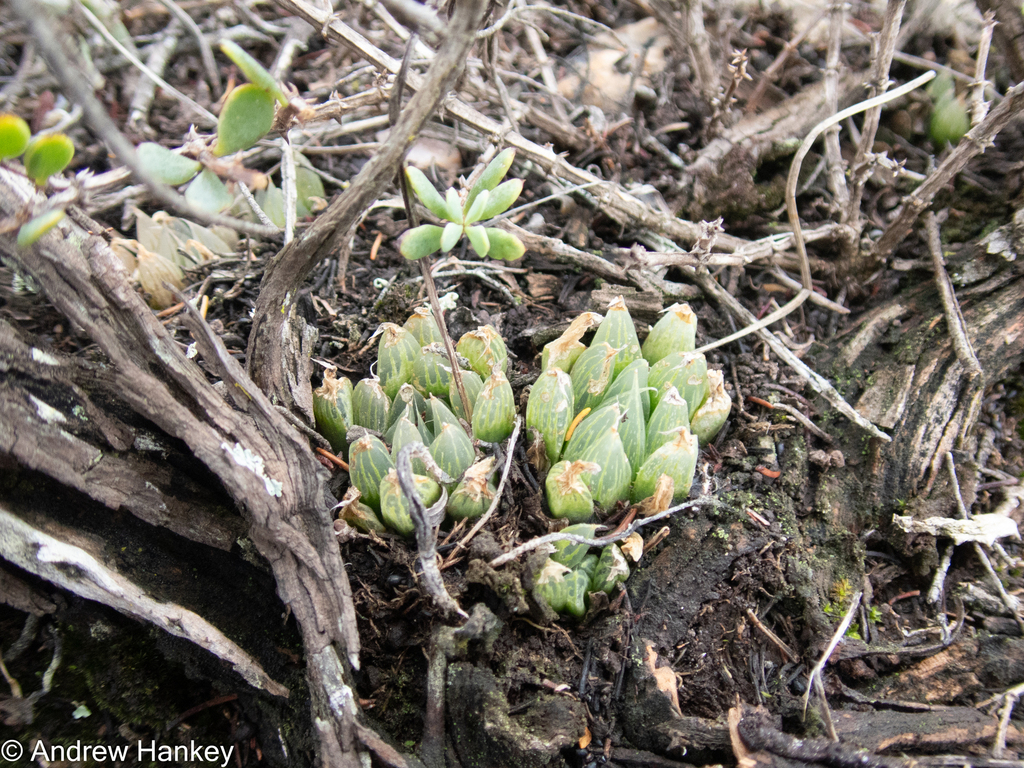
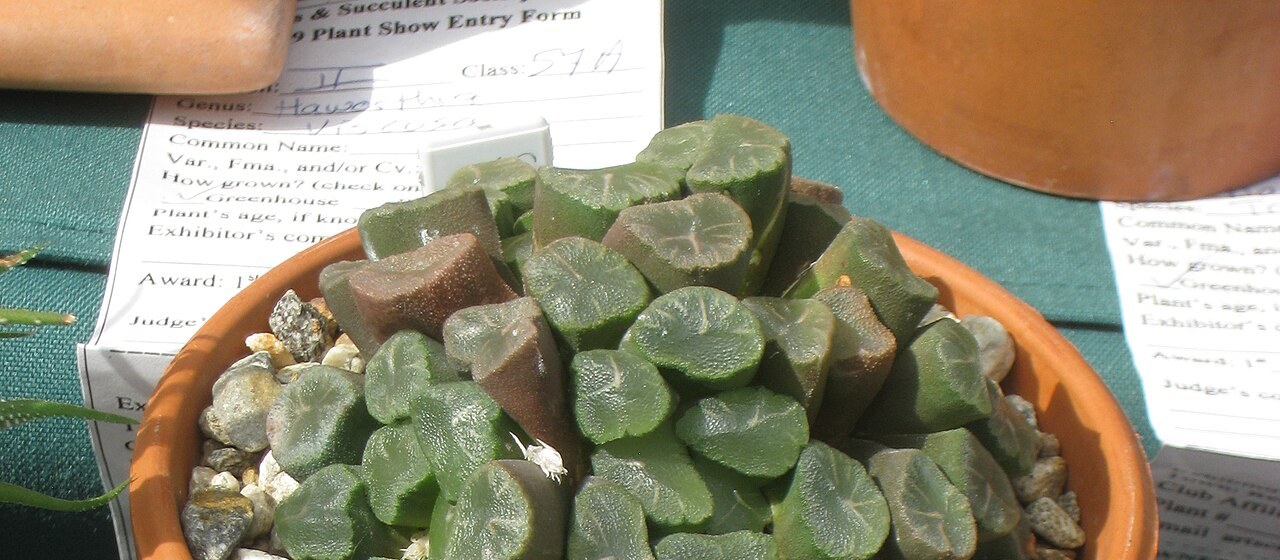
A compact soft-leaved Haworthia native to the clayey hillsides around Mossel Bay and George in the Western Cape of South Africa — roughly 60 km east of the Riversdale area where its close relative H. retusa (Kotobuki) grows. What sets it apart is the dense covering of papillae — small, rounded projections — on the upper leaf surface: rather than the smooth window of most soft-leaved Haworthias, each triangular leaf is studded with pearl-like bumps that give an almost granular shimmer. The variety crystallina carries this further still. Rosettes stay small at 4–6 cm across, with leaf color shifting from dark green to red-purple. A spring/autumn grower, it slows to semi-dormancy above 30°C. The IUCN lists it as Vulnerable owing to its restricted range.
Native climate
Rainfall is spread fairly evenly across the year. Overall a mild climate.
A broad-scale picture of the native range. Real growing spots — rock crevices, fog belts — can be milder.
Sources: climate & elevation WorldClim 2.1 (1970–2000) · occurrences GBIF · native range POWO · current weather Open-Meteo
Care
Light & Placement

In habitat it grows among quartz pebbles on clayey slopes, partially sheltered by low shrubs and rocks. Like most soft-leaved Haworthias it favors diffuse light over direct sun — strong direct exposure not only scorches the papillose upper surface but accumulates damage in the soft leaf tissue. During the spring and autumn growing periods, bright outdoor shade or a bench under 50–60% shade cloth keeps the texture sharp and the color balanced. Above 30°C in midsummer, growth stops and the plant enters semi-dormancy; move it to a cool, well-ventilated shade position. In winter, a bright indoor window above 5°C is sufficient. Year-round air circulation with a small fan is worthwhile.
Watering
Water thoroughly when the soil dries during the growing season. In the summer semi-dormancy, cut back to once or twice a month. In winter, let the soil dry for several days between waterings to avoid cold-and-wet conditions.
Substrate
Drainage is the top priority, with a somewhat fine-grained mix suited to soft-leaved Haworthia. Fine Akadama, fine Kanuma, and small pumice at 4:3:3 works well. A thin layer of decorative gravel on the surface helps limit surface moisture.
Fertilizer & Supplements
A dilute liquid feed once or twice a month during active growth is sufficient. Over-fertilizing causes leaves to stretch and the papillose texture to soften, breaking the compact rosette form. A lean feeding program produces firmer, truer-looking plants.
Temperature & Overwintering
Optimal 15–25°C. Growth pauses above 30°C and the plant enters semi-dormancy, so prioritize cool conditions through midsummer. It holds its leaves down to about 5°C in winter. Cold wet soil is the single biggest risk factor — keep it on the dry side through the cold months.
Starting from Seed
Where to source seeds
Pre-sowing treatment
Seeds are fine and dry out quickly — keep them sealed until sowing. Mix a fungicide (Benlate, Daconil, or similar) with a plant tonic (Menedael; SUPERthrive or chelated iron/seaweed extract serves a similar purpose) at the recommended dilutions, and soak the seeds for about half a day to reduce surface microbes before sowing.
Substrate
Use a separate seedling mix that is fine-grained and near-sterile: fine Akadama, fine Kanuma, and vermiculite in 1:1:1 parts. Sterilizing beforehand with boiling water or a microwave pass helps prevent damping-off losses.
Sowing method
Sow on the surface without any covering. Space the seeds at least 5 mm apart and avoid overlap to limit early damping-off.
Light & temperature
Keep the tray in bright shade at 22–28°C. Germination takes 7–21 days and depends strongly on seed freshness — a heat mat supporting warmth from below helps even out emergence.
Watering
Bottom-water with the level 1–2 cm up the pot. For the first month, prioritize not letting things dry out; once seedlings are stable, drop the water level gradually.
Fertilizer
No feeding immediately after germination. Once true leaves emerge, give a heavily diluted liquid fertilizer once or twice a month — go lighter than the bottle suggests, since young seedlings are easily pushed into etiolation.
From Germination to Repotting
Germination through true leaves
Continue bottom watering in bright shade.
Weaning off bottom watering
Phase it out gradually over 1–2 months.
First repotting
In the first or second year, once roots have filled the pot.
Common Pitfalls
Mold & damping-off
- Cause: excess moisture, substrate contamination, poor airflow
- Prevention: sterilize the substrate, change the bottom-water frequently, ensure good air flow with a fan
Sunburn & clouded windows
- Cause: direct strong sun, abrupt environment change
- Prevention: move to 50–60% shade and transition new placements gradually over a week
Seeds fail to germinate
- Cause: stale seeds, insufficient warmth
- Prevention: use fresh seeds from a reliable source and stabilize temperature with a heat mat
Summer rot from heat and moisture
- Cause: high heat with wet substrate, poor airflow
- Prevention: keep it cool and on the dry side through midsummer, with a fan moving air across the bench
Notes
No toxicity has been reported at the genus level.