
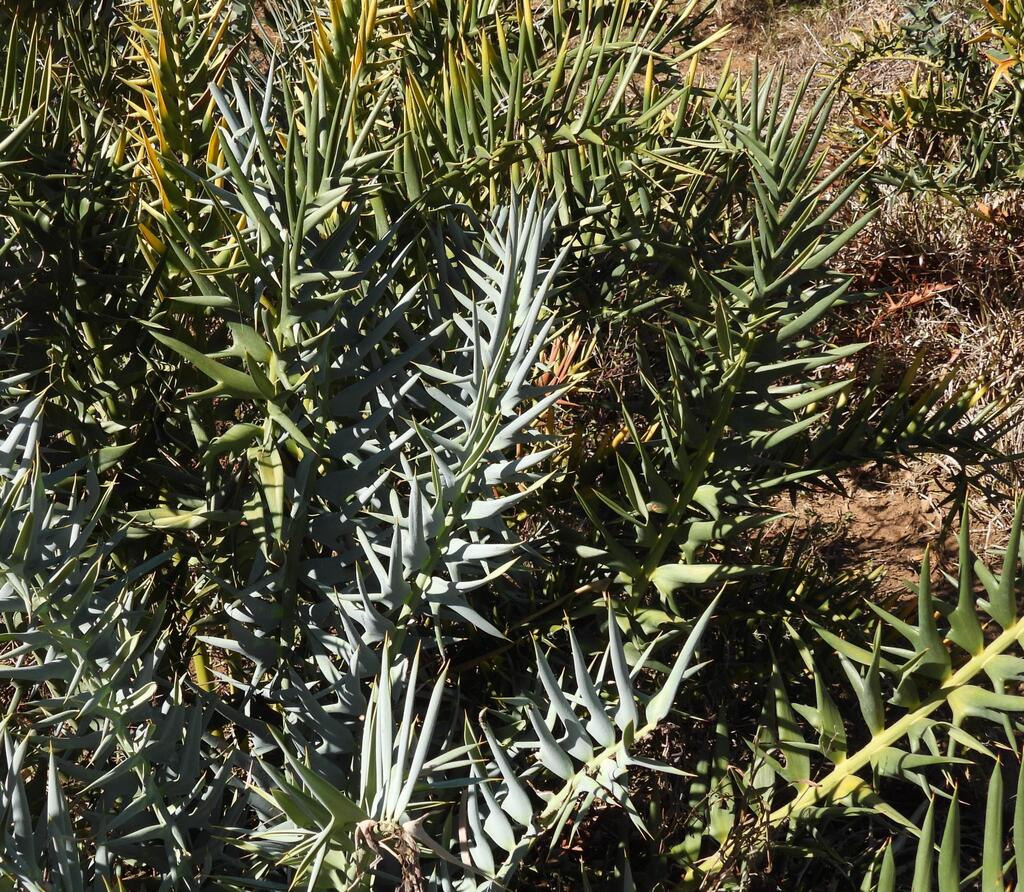
A small, blue-leaved cycad (Zamiaceae, order Cycadales — a gymnosperm, not a flowering plant) endemic to the dry valley bushveld around Port Elizabeth (Gqeberha) and Uitenhage in South Africa's Eastern Cape. The Japanese trade name is Hime-onisotetsu. Plants reach about 0.9 m, with strongly recurved silver-blue fronds whose leaflets are reduced to one to three rigid spine-tipped lobes — the trait that gives the species its name horridus ("bristly"). Listed on CITES Appendix I and IUCN Endangered, live plants require permits and command very high prices, but the striking blue foliage has made it one of the most coveted cycads in cultivation.
Native climate
Rainfall is spread fairly evenly across the year. Overall mild, with a wide temperature range.
* Accurate distribution data is scarce for this species, so these values are taken from the climate near the approximate center of its native range instead.
Sources: climate & elevation WorldClim 2.1 (1970–2000) · occurrences GBIF · native range POWO · current weather Open-Meteo
Care
Light & Placement
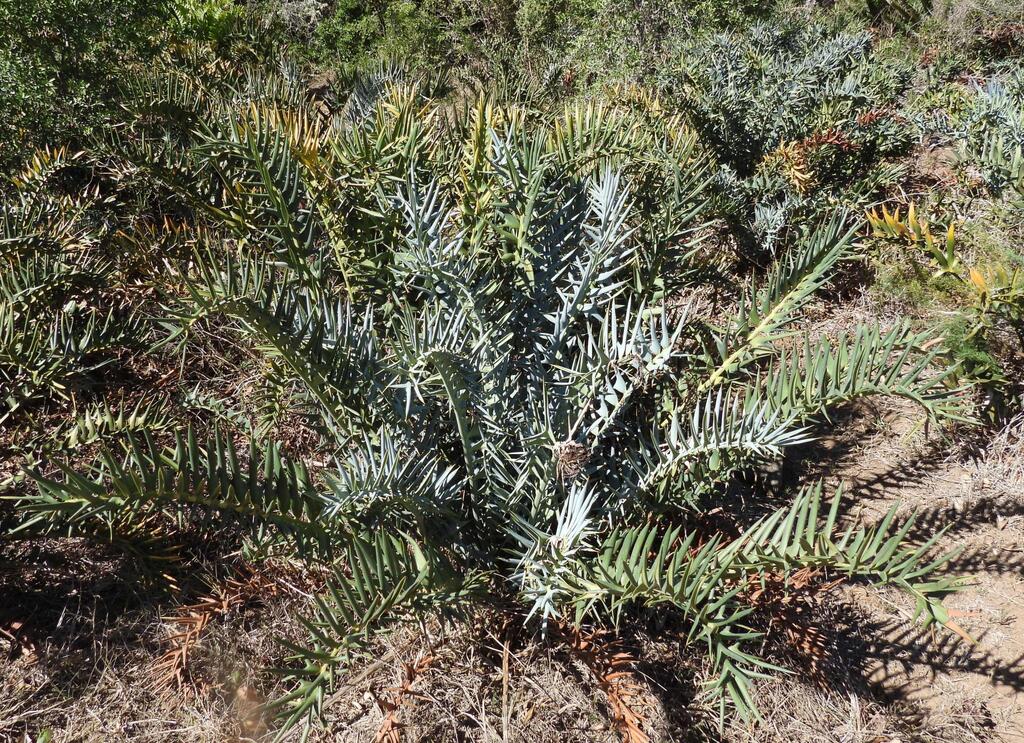
A full-sun plant from open rocky ridges and dry valley bushveld in the Eastern Cape. In active growth, give it as much direct sun as possible — strong light tightens the silver-blue colour and keeps the leaves short and stiff with the spine pattern intact. Shaded plants drift toward dull green and elongated, soft fronds that don't recover well. Even in Japan's midsummer keep shading under 30 percent. Raise the pot off the ground for airflow, since trapped humidity around the crown is the main risk. In winter move it to a bright indoor window out of rain — think low-activity rather than full dormancy.
Watering
In active growth, water deeply once the substrate has fully dried, and never leave water in the saucer. Taper through autumn and water sparingly in winter, perhaps once or twice a month. Cold and wet soil together rot the caudex fast.
Substrate
Drainage first, inorganic-led: Akadama : Kanuma : pumice = 3:3:4. The species is taprooted, so use a deep pot to let the root run straight down — this stabilises growth.
Fertilizer & Supplements
A diluted liquid feed once a month in active growth, or a small pinch of slow-release at repotting. Growth is genuinely slow and overfeeding does not speed it up — it only causes etiolation and root damage.
Temperature & Overwintering
Optimal 22–32°C, minimum 5°C. Habitat winters include brief light frosts, and dry plants tolerate short dips to around 0–5°C. Wet soil under cold is fatal — keep it on the dry side and overwinter on a bright indoor window.
Starting from Seed
Where to source seeds
Pre-sowing treatment
The red fleshy seed coat (sarcotesta) invites rot — soak briefly to soften and remove it before sowing. Soak seeds for about half a day (overnight) in a mix of a registered seed-treatment fungicide (Benlate or Daconil) and a plant tonic (Menedael; outside Japan, SUPERthrive or a chelated iron / seaweed extract works similarly), each diluted per label. Floaters tend to be old or infertile. Germination requires steady warmth of 25–32°C.
Substrate
Lean toward straight inorganic — pumice fines as the base, or fine Akadama with pumice at 1:2. Always use a deep pot for the taproot, and sterilise the mix with boiling water or a microwave pass beforehand.
Sowing method
Lay the seed on its side — orientating the seam vertically distorts the emerging root. Cover only thinly so the upper half of the seed remains visible.
Light & temperature
Bright shade with a steady 25–30°C — a heat mat is essentially required. Germination is slow and uneven, taking 1–6 months. Don't discard a tray after three quiet months.
Watering
Bottom-water with the level 1–2 cm up the pot, refreshing the water often to keep rot risk down. Drop the level gradually as seedlings emerge.
Fertilizer
No feeding right after germination. Once the first pinnate leaf opens, give a heavily diluted liquid fertilizer once a month — growth is slow, so do not push the dose.
From Germination to Repotting
Germination through true leaves
Cotyledon first, then a pinnate leaf.
Weaning off bottom watering
Phase out over 3–6 months.
First repotting
In year two or three, into a deep pot.
Common Pitfalls
Mold & damping-off
- Cause: residual sarcotesta, excess moisture, contamination
- Prevention: clean off the fleshy coat completely, sterilise the substrate, refresh bottom-water often, and run a circulation fan
Etiolation
- Cause: insufficient light
- Prevention: harden off into strong light right after germination — full sun outdoors or high-output LEDs are needed to bring out the silver-blue colour and stiff spines
Seeds fail to germinate
- Cause: stale seed, insufficient warmth, giving up too early
- Prevention: source fresh seed, hold 25–30°C steady on a heat mat, and keep the tray for at least six months
Notes
CITES Appendix I; in Japan the species is regulated under the Act on Conservation of Endangered Species, with live-plant transfers requiring a registration certificate. Plants raised from seed fall under the same regulations once mature. The leaf spines are sharp — keep leather gloves on hand. The seeds are highly toxic; keep them out of reach of children and pets.


