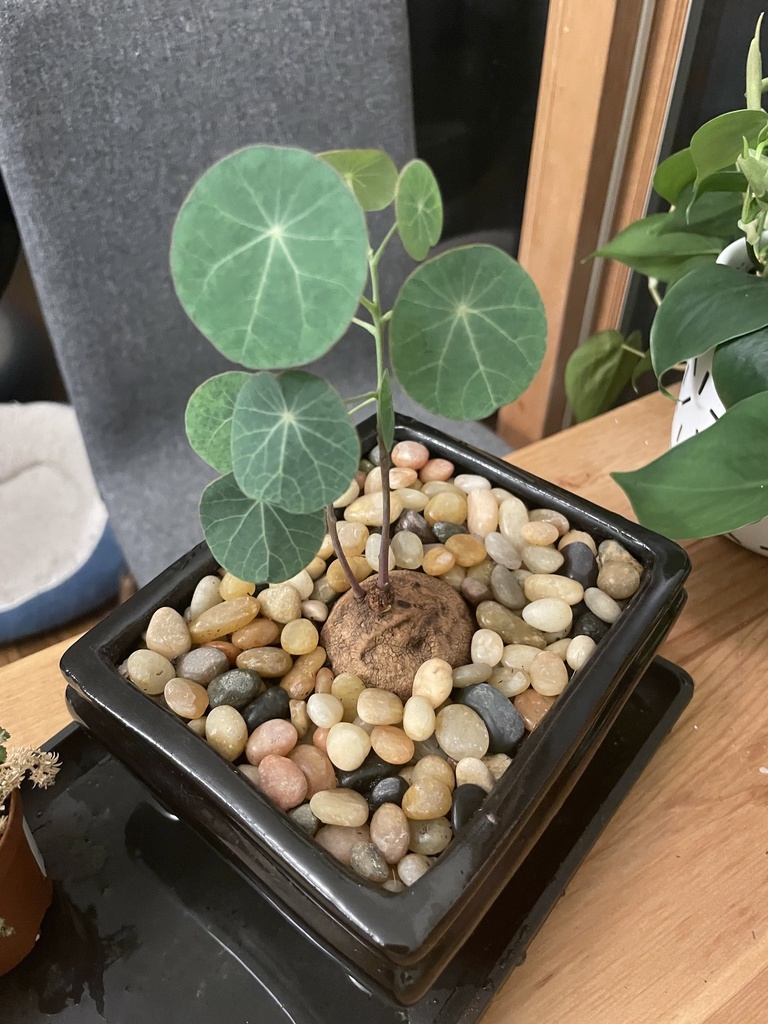
A caudex-forming climber in the Menispermaceae, described by Spreng. in 1827 and ranging widely from Thailand and Indochina across the Malay Peninsula into the islands of Indonesia. Its centerpiece is a large, exposed grey-brown globose tuber (typically 20–40 cm across, sometimes approaching a meter), from which annual herbaceous stems extend several meters during the growing season. The leaves are circular to ovate and peltate — the petiole attached near the center of the blade — and the species carries the most striking flowers in the genus, small umbel-like inflorescences in orange-red to reddish-purple. The tuber contains cepharanthine and a suite of related alkaloids, and the species has long been used in Thai traditional medicine — a mid-level caudex plant that combines an arresting tuber with a vigorous summer canopy of vines.
Native climate
Rainfall is spread fairly evenly across the year. Overall a warm climate.
A broad-scale picture of the native range. Real growing spots — rock crevices, fog belts — can be milder.
Sources: climate & elevation WorldClim 2.1 (1970–2000) · occurrences GBIF · native range POWO
Care
Light & Placement

Native to seasonal deciduous forest and limestone hills across Thailand and the Malay Peninsula, this species prefers bright shade rather than full direct sun. During active growth, give it a half-shaded position outdoors or about 30–50% shade — its thin, papery leaves wilt under harsh midday sun. Keep airflow generous on a raised bench. Through winter dormancy, after the leaves drop, move it to a bright sunny window indoors kept above 8°C and hold the tuber dry.
Watering
In active growth, water thoroughly when the surface dries — this fuels the energetic flush of vines from the tuber. Empty the saucer. Taper off as leaves yellow in autumn; through dormancy, hold the plant completely dry.
Substrate
Drainage and aeration first, with an inorganic-led mix: Akadama : Kanuma : pumice = 4:3:3. Plant the tuber raised above the soil line to avoid rot at the crown. A taller pot encourages clean wet-dry cycles.
Fertilizer & Supplements
A dilute liquid feed once or twice a month in active growth, or a pinch of slow-release at repotting. The species grows quickly when fed appropriately, but overfeeding causes leggy vines and rot risk.
Temperature & Overwintering
Optimal 22–32°C, 8°C minimum. Among the more cold-tolerant tropical caudex plants, but damp soil under cold quickly rots the tuber. Move indoors early in autumn for a dry overwintering on a bright window. A soft spot in the center of the tuber is the warning sign of rot.

Starting from Seed
Where to source seeds
Pre-sowing treatment
Soak seeds for about half a day (overnight) in a mix of a registered seed-treatment fungicide (Benlate or Daconil) and a plant tonic (Menedael; outside Japan, SUPERthrive or a chelated iron / seaweed extract works similarly), each diluted per label. Any that don't sink are typically no longer viable. Seed circulation is limited and fresh stock is hard to come by — sow promptly once you can get hold of it.
Substrate
A fine-grained, near-sterile seedling mix: fine Akadama, fine Kanuma, vermiculite in 1:1:1 parts. Sterilize with boiling water or a microwave pass — damping-off is the main risk.
Sowing method
Press seeds in lightly with only the thinnest dusting of substrate so they remain partly visible. Space at least 1 cm apart and avoid clumping.
Light & temperature
Bright shade at a steady 25–30°C. Germination ranges from two weeks to two months — a heat mat keeps temperatures consistent and helps the flush even out. Germination depends heavily on seed freshness, and even fresh seed stays on the lower side.
Watering
Bottom-water with the level 1–2 cm up the pot. For the first 2–3 weeks, prioritize not letting things dry out, then drop the water level gradually as germination evens out.
Fertilizer
No feeding right after germination. Once true leaves emerge, give heavily diluted liquid fertilizer once or twice a month. The species grows quickly, so there's no need to push the dose.
From Germination to Repotting
Germination through true leaves
Continue bottom watering, avoid strong light.
Weaning off bottom watering
Transition gradually over 1–2 months.
First repotting
In the first or second year, once root-bound.
Common Pitfalls
Mold & damping-off
- Cause: excess moisture, contamination, poor air flow
- Prevention: sterilize substrate, change bottom water frequently
Etiolation
- Cause: insufficient light
- Prevention: keep in bright shade and bring LEDs closer; train the vines on a stake
Seeds fail to germinate
- Cause: stale seed, insufficient warmth
- Prevention: fresh seed, 25–30°C on a heat mat
Notes
The whole tuber contains cepharanthine and related alkaloids — never ingest. Keep the plant bone-dry through dormancy, since damp soil at low temperatures rapidly rots the caudex.