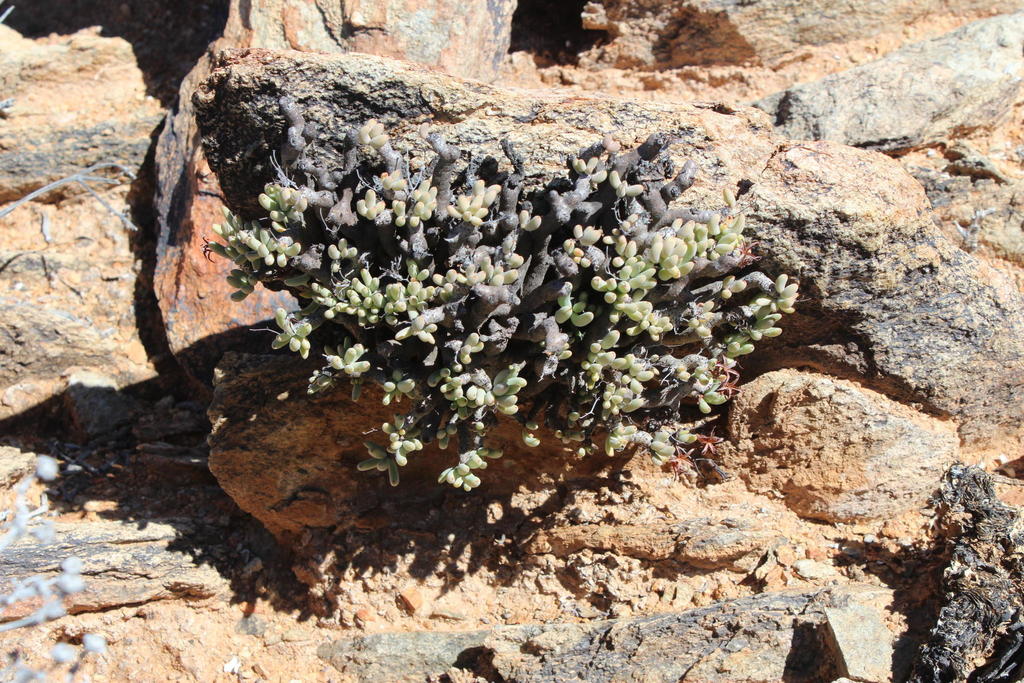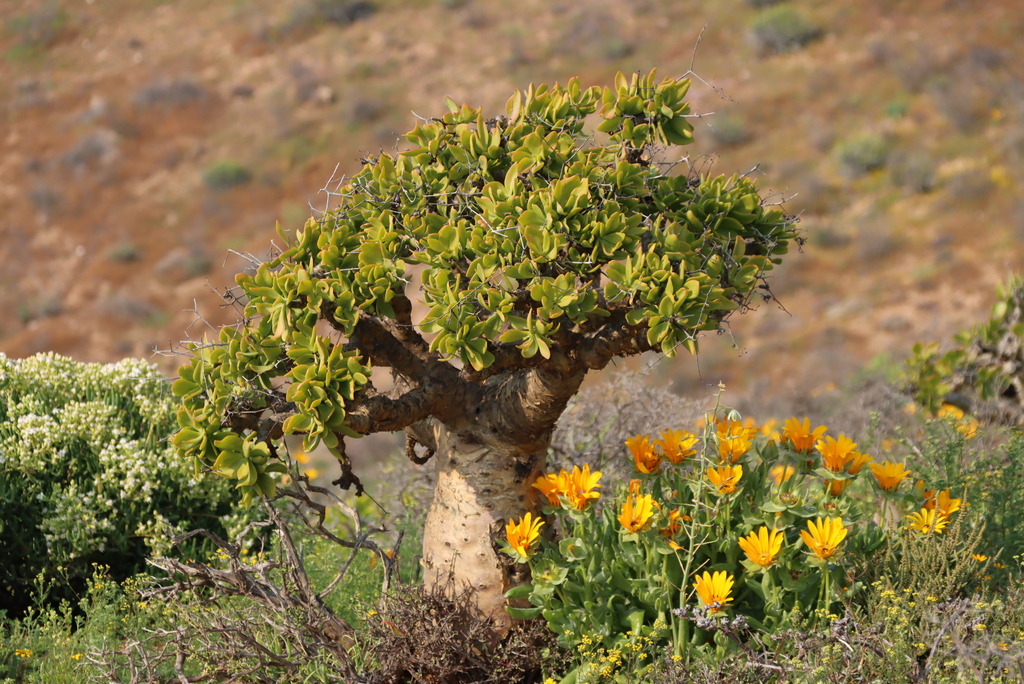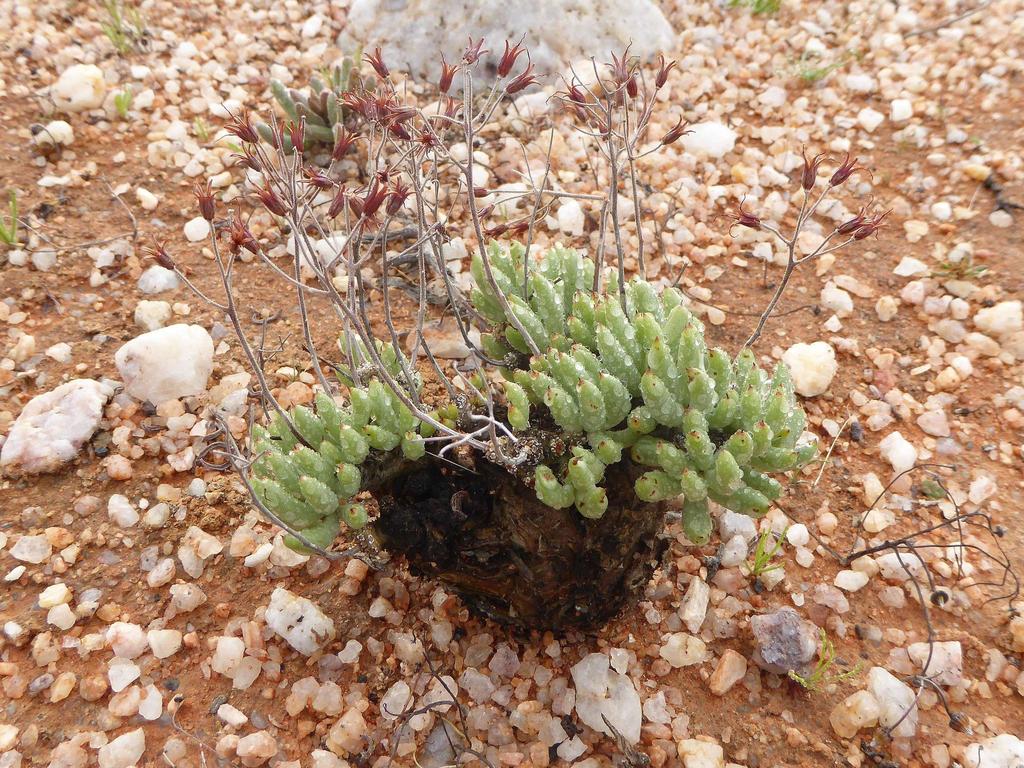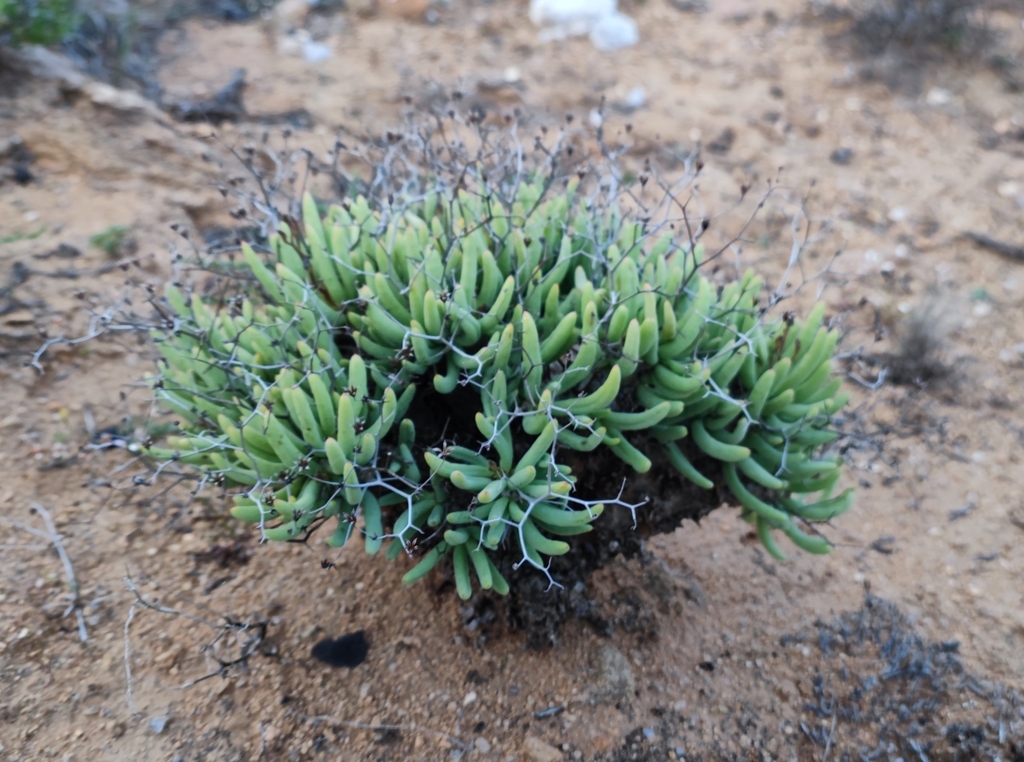
A small caudex-forming succulent of the winter-rainfall belt of South Africa and southern Namibia (Namaqualand and the Knersvlakte), fondly known in Japan as banbutsu-sō — "the form of all things". Described by (L.f.) Toelken, the epithet reticulatus means "net-like" and refers to the dried flower stalks that persist on the branch tips year after year, gradually weaving the crown into a wire-sculpture lattice unlike anything else in the genus. Leaves emerge in autumn and drop as early summer heat arrives, leaving the plant dormant through summer — a winter-grower with the seasons inverted. Among Tylecodon, the species with the most distinctive sculptural presence, rewarding to grow slowly from seed.
Native climate
Rain concentrates in the cool season, with a distinct dry season. Overall mild, with a wide temperature range.
A broad-scale picture of the native range. Real growing spots — rock crevices, fog belts — can be milder.
Sources: climate & elevation WorldClim 2.1 (1970–2000) · occurrences GBIF · native range POWO · current weather Open-Meteo
Care
Light & Placement

As a winter-grower, the active season is autumn through spring — give it as much full direct sun as possible while leaves are out. Through Japan's summer the species is dormant and leafless, so move it somewhere as cool, shaded and well-ventilated as you can manage, sheltered from rain. Raise the pot off the ground on a bench and run a circulation fan. In winter, place it under a frost-free eave or a bright indoor window kept above 5°C.
Watering
Resume in autumn once temperatures drop and new leaves push, then water thoroughly through the active season once the surface dries. When early summer pushes past 25°C and leaves yellow and drop, cut water — keep essentially dry through summer with at most one light misting per month. Japan's rainy season and humid summer heat are the single biggest risk factor.
Substrate
Drainage first, inorganic-led. Akadama : Kanuma : pumice = 3:3:4 — the higher pumice fraction makes a real difference through summer. Generous drainage holes are non-negotiable.
Fertilizer & Supplements
A dilute liquid feed at double dilution or weaker once a month through the active season, or a pinch of slow-release at repotting. Nothing during summer dormancy. Overfeeding blurs the reticulated crown of dried flower stems.
Temperature & Overwintering
Optimal 15–25°C with a 5°C minimum. Bone-dry plants tolerate brief drops near 0°C, but it's safer to bring indoors. The hardest season is summer, not winter. Taper water as temperatures rise above 25°C, and through tropical-night spells above 35°C lean hard on shade and airflow.

Starting from Seed
Where to source seeds
Pre-sowing treatment
Soak seeds for about half a day (overnight) in a mix of a registered seed-treatment fungicide (Benlate or Daconil) and a plant tonic (Menedael; outside Japan, SUPERthrive or a chelated iron / seaweed extract works similarly), each diluted per label. Floaters often indicate stale stock. Seeds are very small — work carefully.
Substrate
A separate seedling mix, fine-grained and near-sterile: fine Akadama, fine Kanuma, and vermiculite in 1:1:1, sterilized with boiling water or a microwave pass. The longer cool-season germination window leaves ample time for damping-off if hygiene slips.
Sowing method
Sow with no covering, or only the thinnest dusting of substrate. Space seeds at least 1 cm apart.
Light & temperature
Bright shade at a cool 15–22°C. Autumn sowing in Japan (September–November) lines up with the natural rhythm. A heat mat is unnecessary and arguably counterproductive. Germination in 1–3 weeks.
Watering
Bottom-water 1–2 cm up the pot. Don't let things dry out for the first 2–3 weeks, then drop the level gradually.
Fertilizer
None right after germination. Once true leaves emerge, a dilute liquid feed once or twice a month through the active season. Nothing during summer dormancy.
From Germination to Repotting
Germination through true leaves
Continue bottom watering, keep in bright shade.
Weaning off bottom watering
Phase out gradually over 1–2 months.
First repotting
In the first or second year, once root-bound, just before the autumn growing season.
Common Pitfalls
Mold & damping-off
- Cause: excess moisture, contamination, prolonged bottom watering at low temperatures
- Prevention: sterilize the substrate, refresh the bottom-water, run a fan. Substrate dries more slowly at winter temperatures — don't carry over a summer-grower watering instinct
Etiolation
- Cause: insufficient light, indoor heating producing warm-but-dim conditions
- Prevention: move LEDs closer, or shift to bright shade outdoors. Don't park on a heated windowsill for long
Seeds fail to germinate
- Cause: stale seeds, temperature too high
- Prevention: use fresh seed. Don't sow in summer — wait for autumn
Summer stall and rot
- Cause: summer heat and humidity, especially with a pot not properly weaned dry before the rainy season
- Prevention: start tapering in early June; move somewhere as cool, shaded and ventilated as possible. Never let it sit in rain. Most Tylecodon losses happen here
Notes
All Tylecodon are strongly toxic; leaves, flowers and sap contain cumulative neurotoxic bufadienolides (cotyledoside, tyledosides). Cause of livestock krimpsiekte ("shrinking sickness"). Wear gloves and keep away from children and pets.