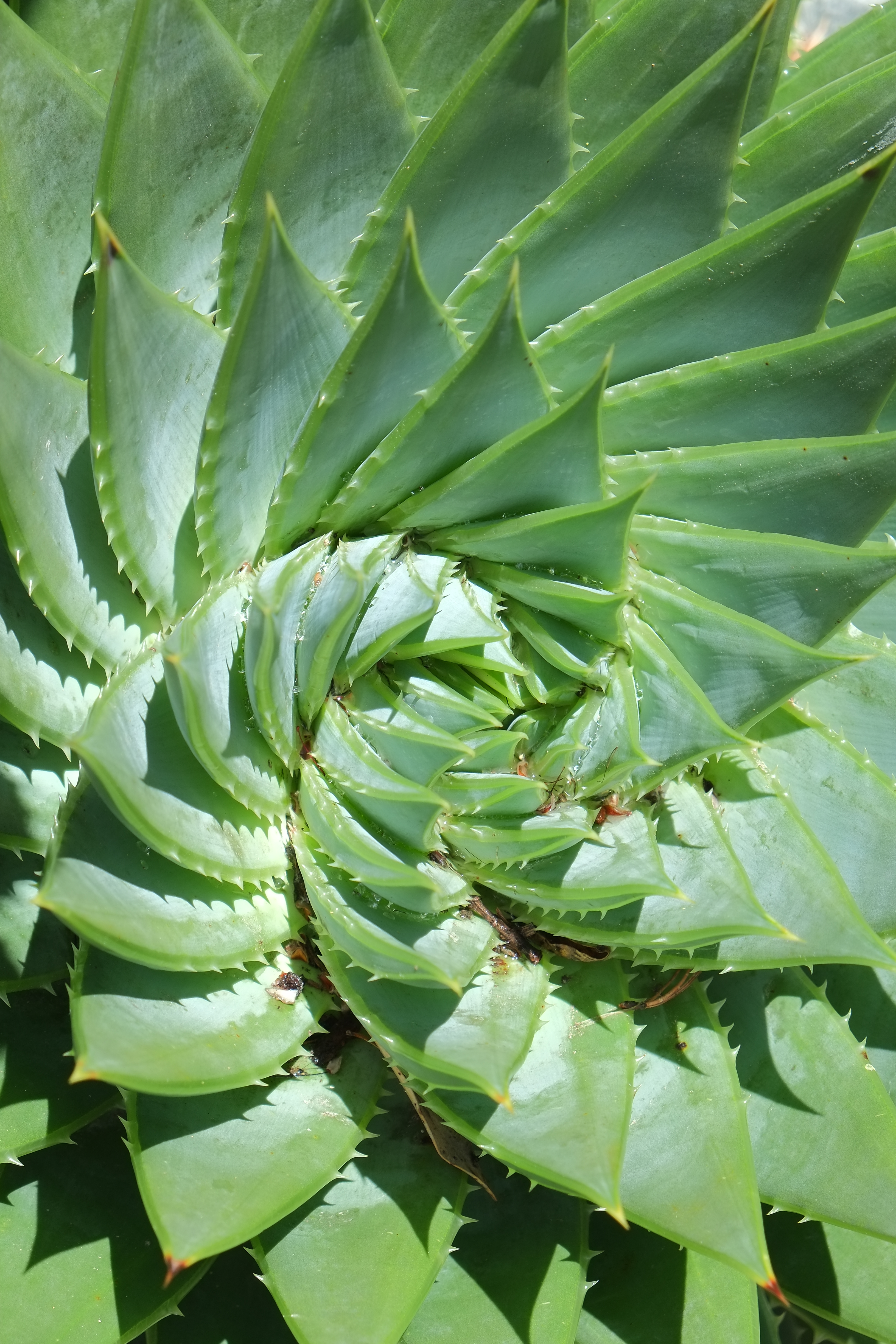
A high-altitude aloe endemic to the Kingdom of Lesotho, known worldwide for the extraordinary geometric symmetry of its rosette. Grey-green leaves spiral outward in a strict pentagonal arrangement, reaching a diameter of 50–80 cm. Spirals can run clockwise or counter-clockwise, and the two directions occur at roughly equal frequency. In habitat, the plant grows on basalt rock ledges along the Drakensberg at 2,000–2,800 m elevation, enduring temperatures of −10 to −20°C and snowfall each winter. The POWO accepted name is Aloe polyphylla Schönland ex Pillans (1934). The IUCN rates it Endangered; it is one of the few aloe species listed on CITES Appendix I due to its restricted range and heavy poaching pressure. In cultivation, flowering is rare. The name "Spiral Aloe" is widely used in English-speaking hobbyist circles, and スパイラルアロエ (supaiararu arōe) in Japan.
Native climate
Rainfall is spread fairly evenly across the year. Overall cool, at high elevation, with a wide temperature range, and cold winters.
A broad-scale picture of the native range. Real growing spots — rock crevices, fog belts — can be milder.
Sources: climate & elevation WorldClim 2.1 (1970–2000) · occurrences GBIF · native range POWO · current weather Open-Meteo
Care
Light & Placement

Adapted to the cool, high-altitude conditions of the Drakensberg, this species finds Japan's lowland summers genuinely difficult. During the growing seasons (spring and autumn), place outside in good light on a raised bench with unobstructed airflow. Through midsummer (July–August), 30–40% shade cloth combined with a circulator helps moderate temperature and humidity. Night temperatures above 25°C, common in lowland Japan, put the plant under stress; growers in cooler regions or at elevation have a clear advantage. In winter the plant tolerates hard frost — down to about −10°C when kept dry — and rests without needing any special protection beyond keeping the roots dry.
Watering
During the active growing seasons of spring and autumn, water thoroughly once the substrate has dried, then allow it to dry fully again. Through midsummer and deep winter, hold back almost entirely — once or twice a month, the smallest amount.
Substrate
Drainage is the first priority. A primarily inorganic mix of small-grain Akadama : small-grain Kanuma : pumice = 4:3:3 works well. Because the rosette spreads wide, a broad and relatively shallow pot suits the root system better than a deep one.
Fertilizer & Supplements
A dilute liquid fertiliser once a month during spring and autumn. Overfeeding causes leaves to elongate and the tight spiral geometry to loosen. Keep feeding minimal.
Temperature & Overwintering
Optimal growing temperature 10–24°C. In habitat, the plant endures −10 to −20°C with snow; in cultivation, a well-dried plant can tolerate around −10°C. The upper threshold is more limiting than the lower: sustained heat above 25°C, especially with humidity, is the primary challenge in lowland Japan.

Starting from Seed
Where to source seeds
Pre-sowing treatment
Mix a registered fungicide (Benlate or Daconil 1000 at label dilution) with a plant tonic such as Menedael, and soak seeds for around half a day. Seeds that float tend to have lower viability due to storage-related decline. Sowing as soon as possible after receipt gives the best chance.
Substrate
Prepare a fine-grained, near-sterile mix specifically for seedlings: fine Akadama : fine Kanuma : vermiculite = 1:1:1. Sterilise with boiling water or a microwave pass before use.
Sowing method
No covering, or the lightest possible dusting so seeds are barely visible. Space seeds at least 1 cm apart; avoid crowding.
Light & temperature
Maintain bright shade at a steady 18–24°C. Germination typically takes 14–30 days. Germination depends on seed freshness, but with fresh seed it is reasonably steady.
Watering
Bottom-water at 1–2 cm up the pot. For the first two to three weeks, maintaining moisture is the priority; once germination is well under way, gradually reduce the water level.
Fertilizer
No feeding immediately after germination. Once true leaves develop, a heavily diluted liquid fertiliser once or twice a month is the approach — far below the label rate.
From Germination to Repotting
Germination through true leaves
Continue bottom watering; keep in bright shade.
Weaning off bottom watering
Reduce the water level gradually; transition to watering by hand.
First repotting
Once roots reach the bottom of the pot, move into a standard inorganic mix.
Common Pitfalls
Mold & damping-off
- Cause: soil contamination, excess moisture, poor airflow
- Prevention: sterilise substrate; change bottom water frequently; run a circulator
Summer decline or rot
- Cause: high temperature and humidity, warm nights
- Prevention: 30–40% shade cloth, unobstructed airflow, minimal watering through midsummer
Seeds fail to germinate
- Cause: old or poorly stored seeds, temperature too high
- Prevention: choose fresh seed from reputable sources; maintain 18–24°C
Rosette loosening or etiolation
- Cause: insufficient light, overfeeding, heat
- Prevention: adequate light and air; keep feeding minimal
Notes
Listed on CITES Appendix I — international trade in wild plants is prohibited.

