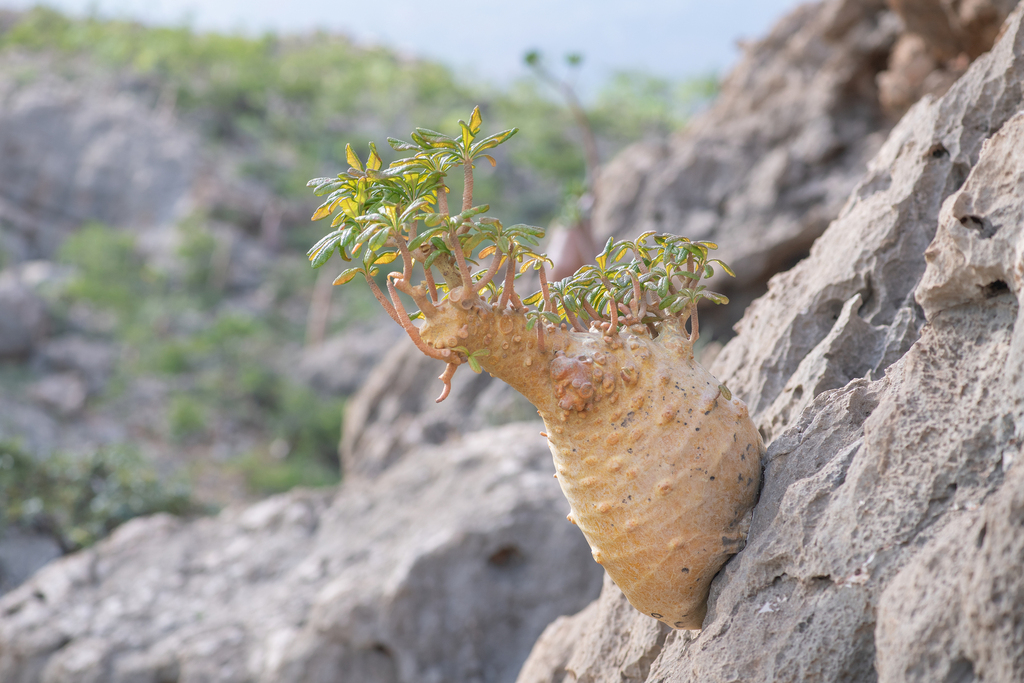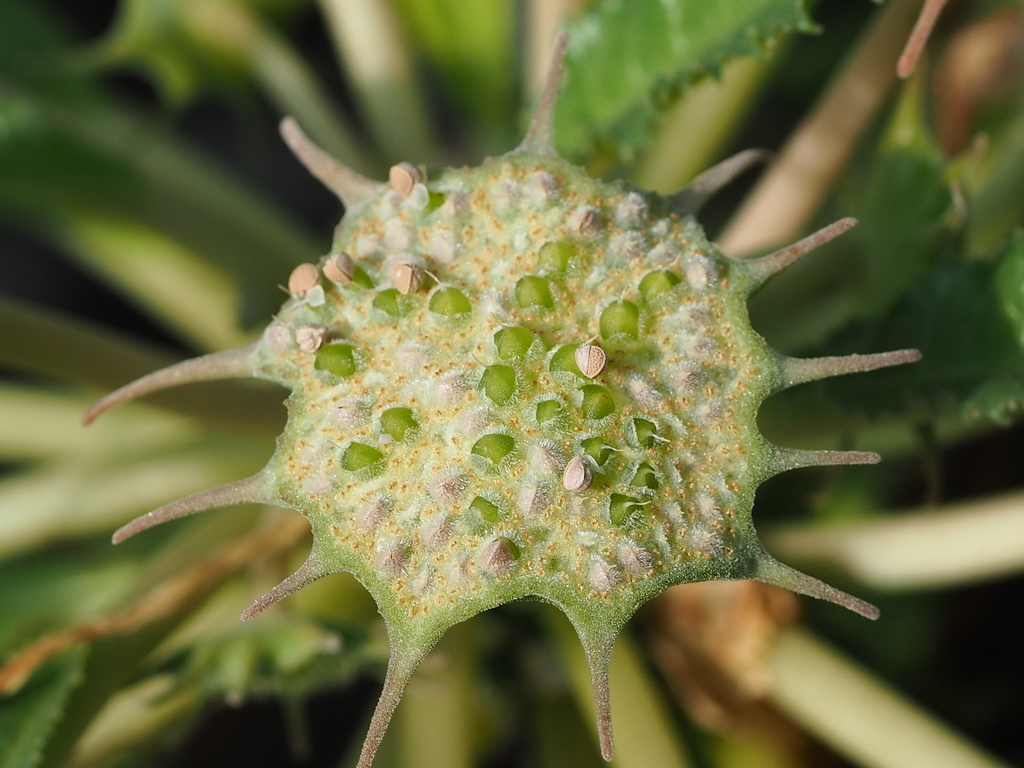
A rare Dorstenia restricted to a small pocket of the Tabia Gorge, north of Erigavo in the Cal Madow range of northern Somalia. Discovered by the plant explorer John J. Lavranos in 1973 and finally described in 2008 by T.A. McCoy and M. Massara, who honoured him with the epithet. Slender, wax-like succulent stems clump up into a small "grove," each topped with a rosette of crisped leaves — a silhouette unlike anything else in the genus. It is also the only known dioecious Dorstenia, so seed only sets when both a male and a female plant are around. That, combined with the small wild range, keeps it firmly in collector territory.
Native climate
Very little rain falls all year — an arid setting. Overall a warm climate.
* Accurate distribution data is scarce for this species, so these values are taken from the climate near the approximate center of its native range instead.
Sources: climate & elevation WorldClim 2.1 (1970–2000) · occurrences GBIF · native range POWO · current weather Open-Meteo
Care
Light & Placement

In habitat the species roots in moss-filled cracks of shaded limestone cliffs — partial shade, not full sun. During growth, give it filtered light at 30–50% shade outdoors, or a bright window/LED indoors. Unfiltered Japanese midsummer sun scorches the leaves and locks the crisped margins into a brown, curled state. Habitat altitude ranges from 100 to 1,750 m, but the climate is dependably misty and humid year-round, so harsh dryness or strong sun stresses the plant rather than tightening it. Bring it inside well before autumn temperatures fall.
Watering
In active growth, water thoroughly once the pot has dried at the surface, but don't let it bake out completely — steady supply matters more than dramatic dry/wet swings. In winter cut back, watering lightly on a sunny morning once or twice a month so the roots stay intact.
Substrate
Balance drainage with a touch of moisture retention: an inorganic base lightly cut with a water-holding component. Akadama : Kanuma : pumice = 4:3:3, in a deeper pot to give the root system room as it would have in a rocky crevice.
Fertilizer & Supplements
Growth is slow, so feed sparingly. Diluted liquid fertilizer once a month in season, or a pinch of slow-release at repotting. Heavier feeding doesn't fatten the stems — it just elongates them and burns the roots.
Temperature & Overwintering
Optimal 22–32°C, minimum 10°C. As a Somali species it has no real cold tolerance and stems begin to suffer below 10°C. Keep it indoors in a bright spot above 12–15°C through winter, and don't let it dry out completely either.

Starting from Seed
Where to source seeds
Pre-sowing treatment
Soak seeds for about half a day (overnight) in a mix of a registered seed-treatment fungicide (Benlate or Daconil) and a plant tonic (Menedael; outside Japan, SUPERthrive or a chelated iron / seaweed extract works similarly), each diluted per label. Freshness is everything — because the species is dioecious and supply is thin, older seed loses viability fast.
Substrate
Fine-grained, near-sterile seedling mix: fine Akadama, fine Kanuma, vermiculite in 1:1:1 parts. Sterilize with boiling water or a microwave pass to head off damping-off.
Sowing method
Seeds are small. Sow with no covering, or only a dusting fine enough that the seeds remain partly visible. Space at least 1 cm apart.
Light & temperature
Bright shade or under LED, 25–30°C steady. Expect germination in 10–30 days. Germination depends on seed freshness, but with fresh seed it is reasonably steady; output drops sharply if the temperature dips.
Watering
Bottom-water with the level 1–2 cm up the pot. This species hates drying out, so keep bottom watering going for the full first one to two months and only step the level down after true leaves emerge.
Fertilizer
Skip feeding right after germination. Once true leaves appear, give heavily diluted liquid fertilizer once or twice a month. Growth is slow — don't push the dose.
From Germination to Repotting
Germination through true leaves
Continue bottom watering, half-shade.
Weaning off bottom watering
Phase out over 2–3 months.
First repotting
In the first or second year, once root-bound.
Common Pitfalls
Mold & damping-off
- Cause: excess moisture and poor airflow, contamination
- Prevention: pre-sterilize the substrate and refresh the bottom-watering tray often
Etiolation
- Cause: insufficient light
- Prevention: bring LEDs closer, or move to bright shade outdoors — but no direct strong sun
Seeds fail to germinate
- Cause: stale seed, insufficient warmth
- Prevention: sow immediately on receipt; hold 25–30°C with a heat mat
Notes
The sap is mildly toxic.