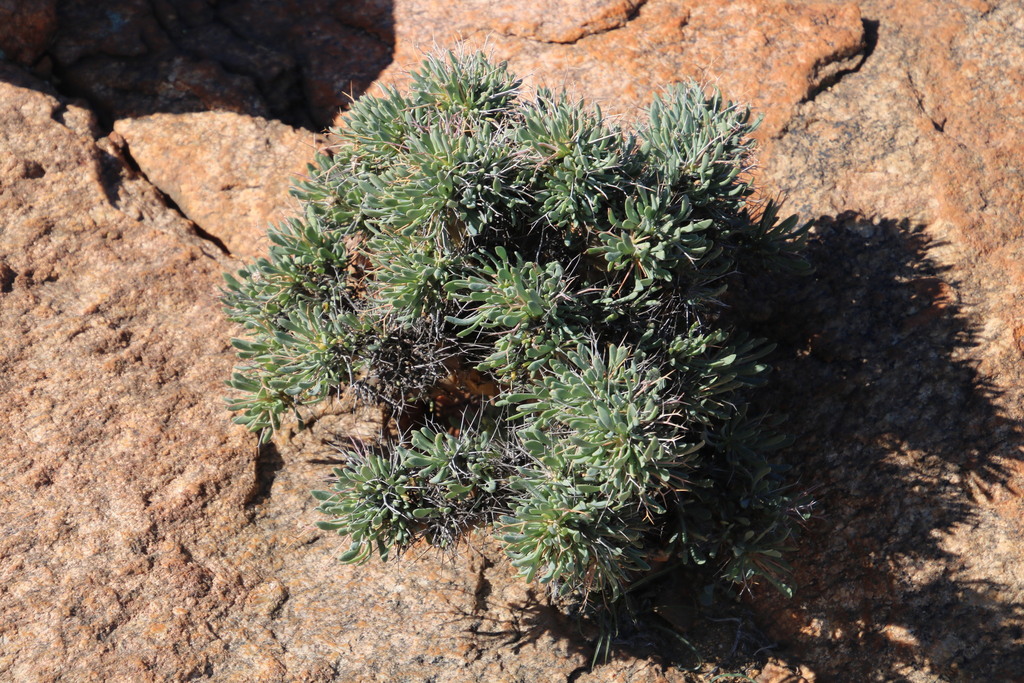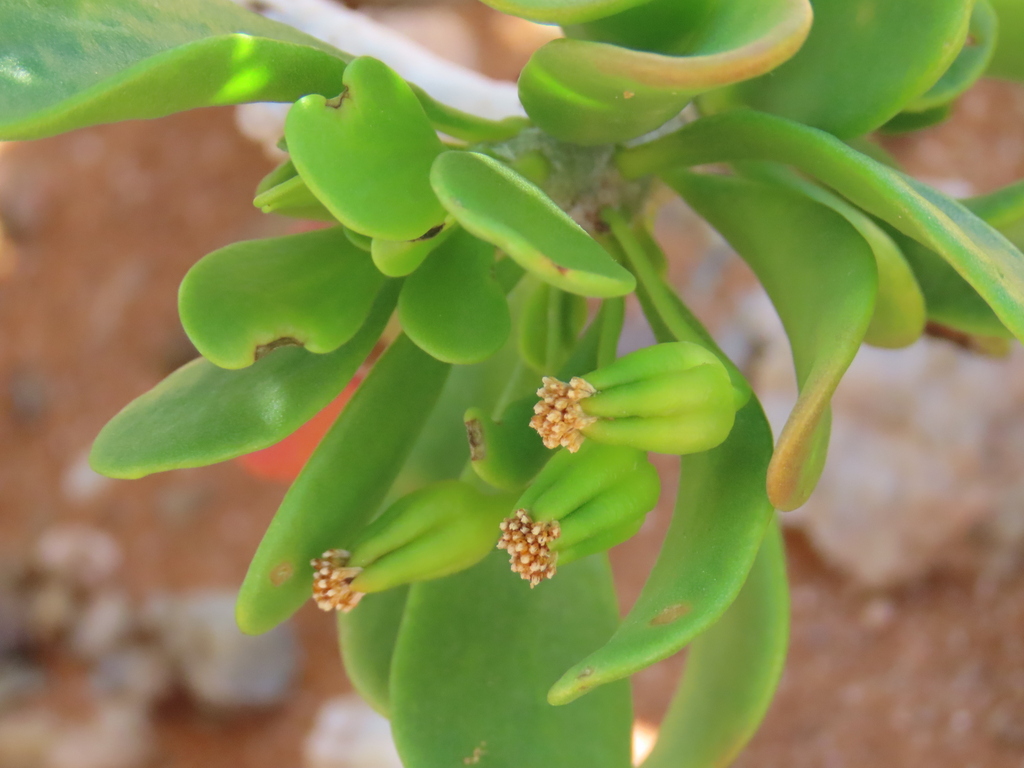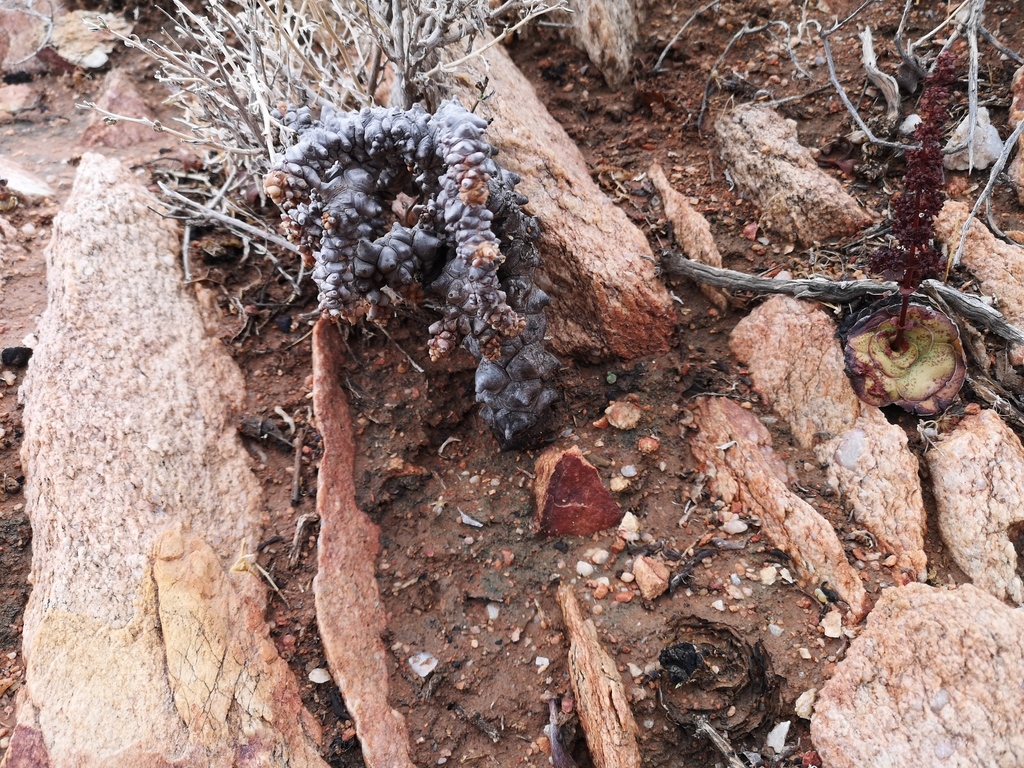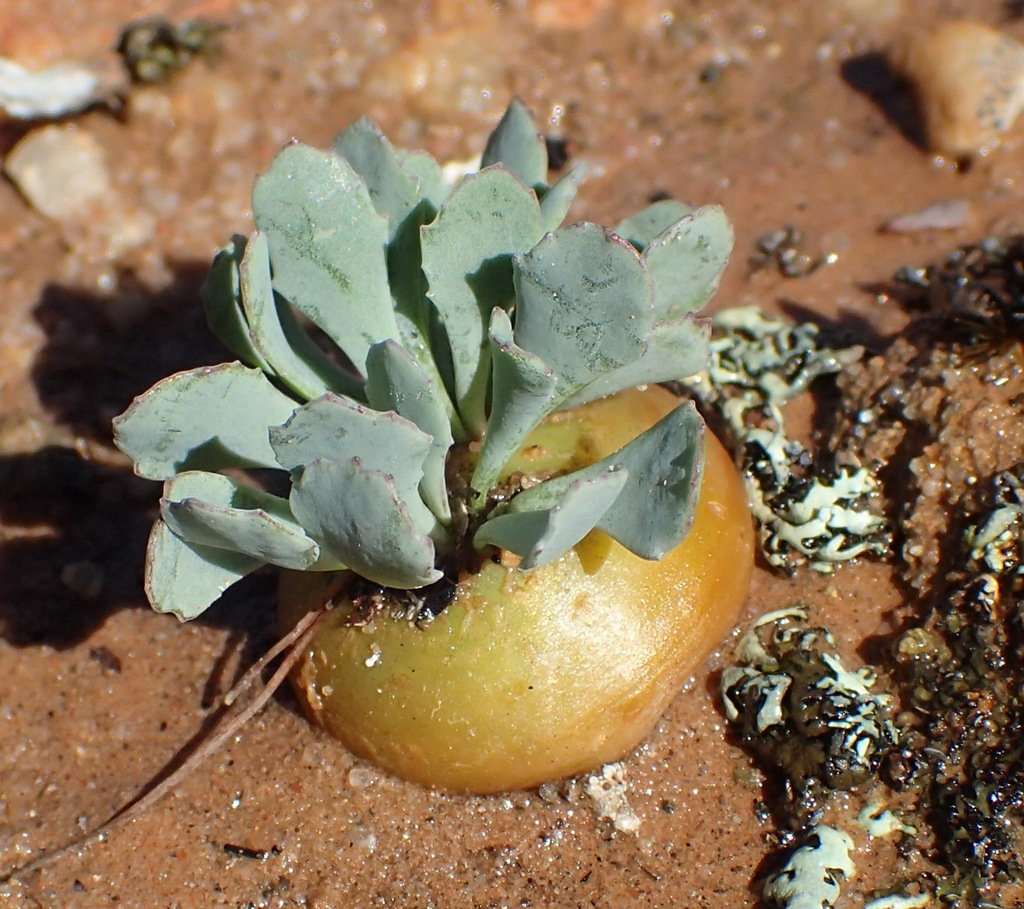
A dwarf winter-growing succulent of the daisy family from the Bokkeveld Escarpment and Gifberg in South Africa's Western and Northern Cape, with outliers in southern Namibia. Described by the younger Linnaeus (L.f.) in Supplementum Plantarum in 1782 — among the earliest described species of Othonna — and recently transferred by Nordenstam (2012) to the new genus Crassothonna. In habitat the plant sits in shallow gritty pockets on Table Mountain Sandstone pavement, with a half-buried tuberous caudex (typically 7–8 cm across at most), small spatulate succulent leaves and tiny yellow daisy-like flowers from autumn through spring. Growth is famously slow — multi-headed specimens take decades — and the species is regarded as one of the more demanding members of the genus, sought after by collectors.
Native climate
Rain concentrates in the cool season, with a dry season of roughly 6 months. Overall mild, with a wide temperature range.
* Accurate distribution data is scarce for this species, so these values are taken from the climate near the approximate center of its native range instead.
Sources: climate & elevation WorldClim 2.1 (1970–2000) · occurrences GBIF · native range POWO · current weather Open-Meteo
Care
Light & Placement

The native Bokkeveld escarpment sits at 800–1,400 m with about 350 mm of mostly winter rainfall, and the plant clings to wind-scoured rock pavement. Through the autumn-to-spring growing season, give it as much direct sun as possible outdoors, but the leaves are softer than in many Othonna, so avoid the harshest cold winds and sudden midday glare — a bright window or light shade suits it. Summer dormancy is the hard part: prioritize shade and ventilation. Move to bright shade out of direct sun (north-facing eaves or 50–70% shade cloth) and run a circulation fan continuously. Stagnant heat at the soil surface is the single most common cause of loss.
Watering
Restart with light watering once autumn temperatures drop and the leaves begin to move; once true growth resumes, water thoroughly when the surface dries. Stop when leaves yellow in late spring and hold completely dry through summer dormancy.
Substrate
Sharply draining, inorganic-led: Akadama : Kanuma : pumice = 3:3:4. The caudex spreads shallowly rather than deep, so a flat shallow pot suits it better than a tall one.
Fertilizer & Supplements
A heavily diluted liquid feed once a month through the active season, very lightly. The species is naturally extremely slow; pushing fertilizer encourages etiolation and rot.
Temperature & Overwintering
Optimal 15–25°C; above 25°C the plant slides into dormancy. Aim for a 5°C minimum — damp soil under cold is fatal. Overwinter on the dry side near a bright window. Summering is harder than overwintering for this species.

Starting from Seed
Where to source seeds
links go directly to the product page; the rest are scientific-name searches. Stock fluctuates — verify availability on the destination site.
Pre-sowing treatment
Soak seeds for about half a day (overnight) in a mix of a registered seed-treatment fungicide (Benlate or Daconil) and a plant tonic (Menedael; outside Japan, SUPERthrive or a chelated iron / seaweed extract works similarly), each diluted per label. Achenes that fail to sink are typically past their prime. They are tiny and pappus-bearing, and their viability depends on how they have been stored.
Substrate
A fine-grained, near-sterile seedling mix: fine Akadama, fine Kanuma, vermiculite in 1:1:1, sterilized with boiling water or a microwave pass. A thin top dressing of coarse sand helps anchor the dust-fine seed.
Sowing method
Cover only with the lightest dusting of substrate, or not at all. The pappus catches air and seed lifts easily, so press it gently into the pre-moistened surface.
Light & temperature
Bright shade, 15–22°C. Heating to 25°C or above suppresses germination in this winter-grower. In Japan, the standard window is autumn sowing in September through November. Germination in 10–30 days.
Watering
Bottom-water 1–2 cm up the side of the pot — the seeds are too small for top-watering. Keep the surface from drying for the first few weeks.
Fertilizer
None right after germination. Once true leaves emerge, a heavily diluted liquid feed once or twice a month. A 2 cm caudex takes three to four years to develop, so there is no point pushing the dose.
From Germination to Repotting
Germination through true leaves
Continue bottom watering, in bright shade.
Weaning off bottom watering
Phase out gradually over 1–2 months.
First repotting
In the second year or later, in autumn, once roots have filled the pot.
Common Pitfalls
Mold & damping-off
- Cause: excess moisture, contamination, poor airflow
- Prevention: sterilize the substrate, refresh the bottom-water, keep a circulation fan running
Etiolation
- Cause: insufficient light. The active winter season runs through low-sun months
- Prevention: run an LED close indoors, or move to bright shade outdoors on clear days
Seeds fail to germinate
- Cause: stale seed, temperatures too high
- Prevention: use fresh seed at 15–22°C without a heat mat — anything over 25°C actively suppresses germination
Summer stall and rot
- Cause: watering during summer dormancy, or sitting in hot, humid, poorly-ventilated spots
- Prevention: cut water once leaves yellow in late spring; through summer prioritize shade, ventilation and dry soil. An air-conditioned room is a fair option
Notes
Listed on CITES Appendix III at South Africa's request — source from legitimate channels.