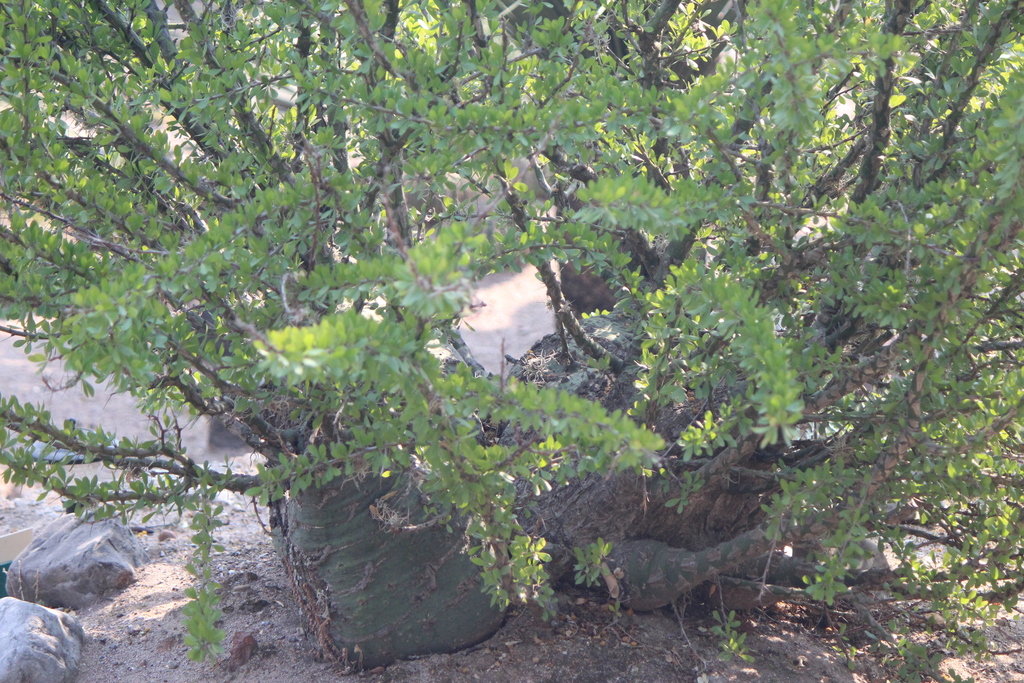
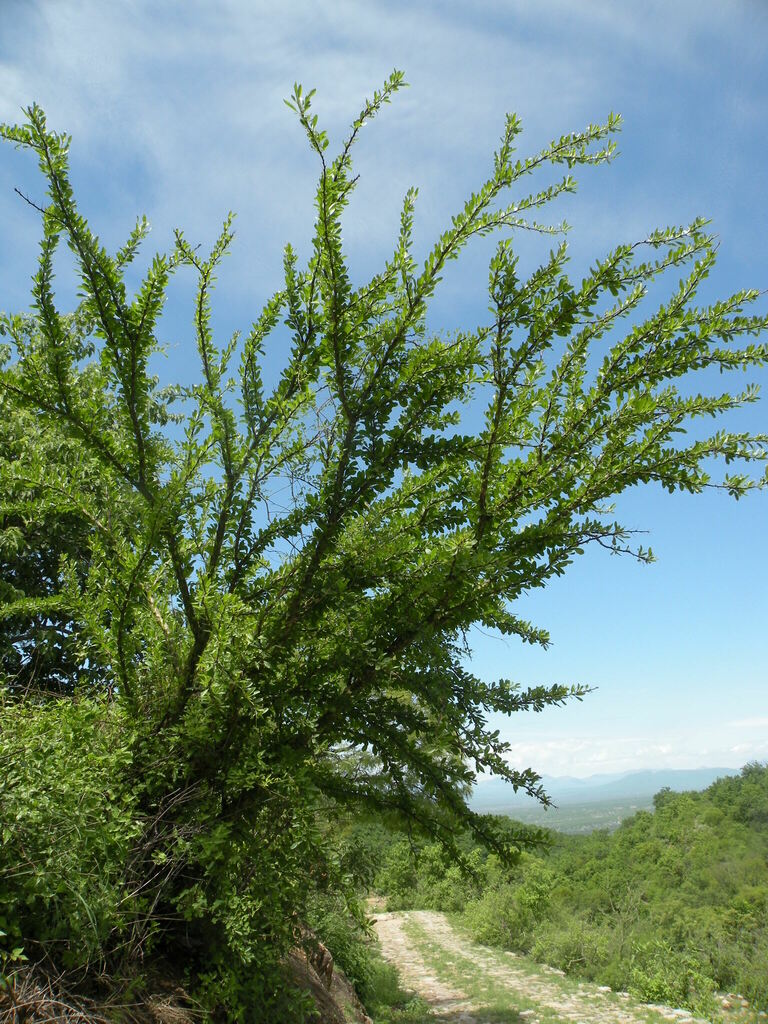
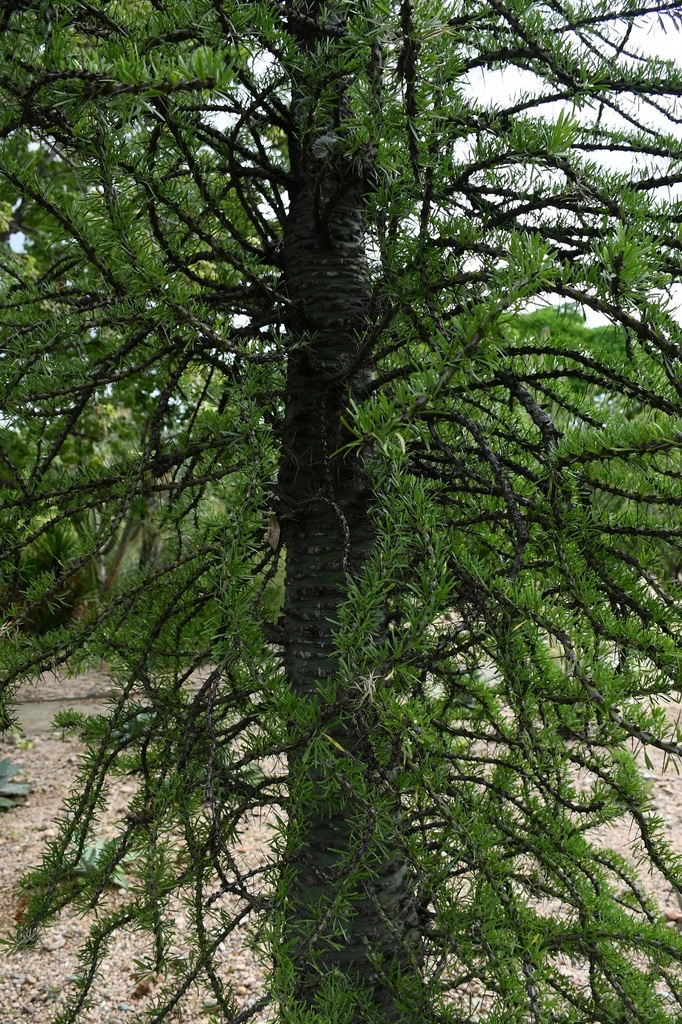
The iconic "Ocotillo." Distributed across the Sonoran Desert from the southwestern US into northern Mexico, its long, whip-like branches that radiate outward from ground level form one of the most recognizable silhouettes in desert imagery. The wand-like stems are lined with sharp thorns, and the plant flushes a cloud of small green leaves all at once after rain before dropping them cleanly in the dry season — a textbook deciduous Fouquieria. Toward the end of the growing season the branch tips erupt with brilliant scarlet tubular flowers like flaming torches, drawing hummingbirds. Cold-hardy and doesn't form a caudex, but grows fairly obligingly from seed, making it beginner-friendly.
Native climate
Rainfall is spread fairly evenly across the year. Overall mild, with a wide temperature range.
A broad-scale picture of the native range. Real growing spots — rock crevices, fog belts — can be milder.
Sources: climate & elevation WorldClim 2.1 (1970–2000) · occurrences GBIF · native range POWO · current weather Open-Meteo
Care
Light & Placement

The Sonoran Desert icon — the most sun- and dry-air-loving of the Fouquierias. Give it full direct sun outdoors through the growing season; shade is essentially unnecessary. Allow plenty of horizontal space for the long radiating canes, and keep airflow generous on a raised shelf. Genuinely cold-hardy and can overwinter under eaves in milder zones, but in colder regions move to a bright indoor window, out of rain.
Watering
In active growth, water thoroughly after the substrate has fully dried, then let it dry again — that wet-dry rhythm tightens the canes. Prolonged rain is a no-go, so shelter under eaves. After dry-season leaf drop, just mist once or twice a month.
Substrate
Drainage above all, in an inorganic mix. Small-grain Akadama : Kanuma : pumice = 4:3:3 is a reliable baseline. A pinch of slow-release such as Magamp K helps early growth, and a taller pot improves wet-dry cycling and reduces rot.
Fertilizer & Supplements
A small amount of slow-release during active growth, plus a monthly dilute liquid feed (around twice the label dilution). Faster-growing than most Fouquieria, but overfeeding etiolates the canes, blurs the radiating form, and leads to rot.
Temperature & Overwintering
Optimal 20–32°C and hardy down to -5°C — one of the toughest in the genus. A textbook deciduous Fouquieria, flushing leaves after rain and dropping them in the dry season. Overwinter fully dry; even with its cold tolerance, damp soil at low temperatures is off-limits.

Starting from Seed
Where to source seeds
links go directly to the product page; the rest are scientific-name searches. Stock fluctuates — verify availability on the destination site.
Pre-sowing treatment
Soak seeds for about half a day (overnight) in a mix of a registered seed-treatment fungicide (Benlate or Daconil) and a plant tonic (Menedael; outside Japan, SUPERthrive or a chelated iron / seaweed extract works similarly), each diluted per label. Seeds left floating are likely past their prime. The seeds have winged margins and are easy to handle.
Substrate
Use a separate seedling mix that's fine-grained and near-sterile: fine Akadama, fine Kanuma, and vermiculite in equal 1:1:1 parts. Sterilize the mix with boiling water or a quick microwave pass.
Sowing method
Sow with no covering, or only the thinnest dusting enough to hide the wings. Space them at least 1 cm apart so they don't clump or overlap on the surface.
Light & temperature
Keep the tray in bright shade at a steady 25–30°C. Expect germination in 5–14 days. Germination depends strongly on seed freshness, but fresh seed tends to come up well.
Watering
Bottom-water with the level 1–2 cm up the pot. For the first 2–3 weeks, prioritize not letting things dry at all, then drop the level in steady stages once the seedlings have come up.
Fertilizer
No feeding right after germination. Once the true leaves emerge, give a heavily diluted liquid fertilizer once or twice a month — go lighter than the label suggests for safety.
From Germination to Repotting
Germination through true leaves
Continue bottom watering and avoid strong light.
Weaning off bottom watering
Wean off gradually over 1–2 months.
First repotting
In year 1 or 2, once the plant becomes root-bound.
Common Pitfalls
Mold & damping-off
- Cause: Excess moisture, contamination
- Prevention: Sterilize substrate, ensure ventilation
Etiolation
- Cause: Insufficient light
- Prevention: Manage light levels
Seeds fail to germinate
- Cause: Stale seeds, insufficient temperature
- Prevention: Use fresh seeds, provide warmth
Notes
Long, whip-like branches lined with sharp thorns. Cold-hardy for the genus, but wet soil during cold spells is still a no.