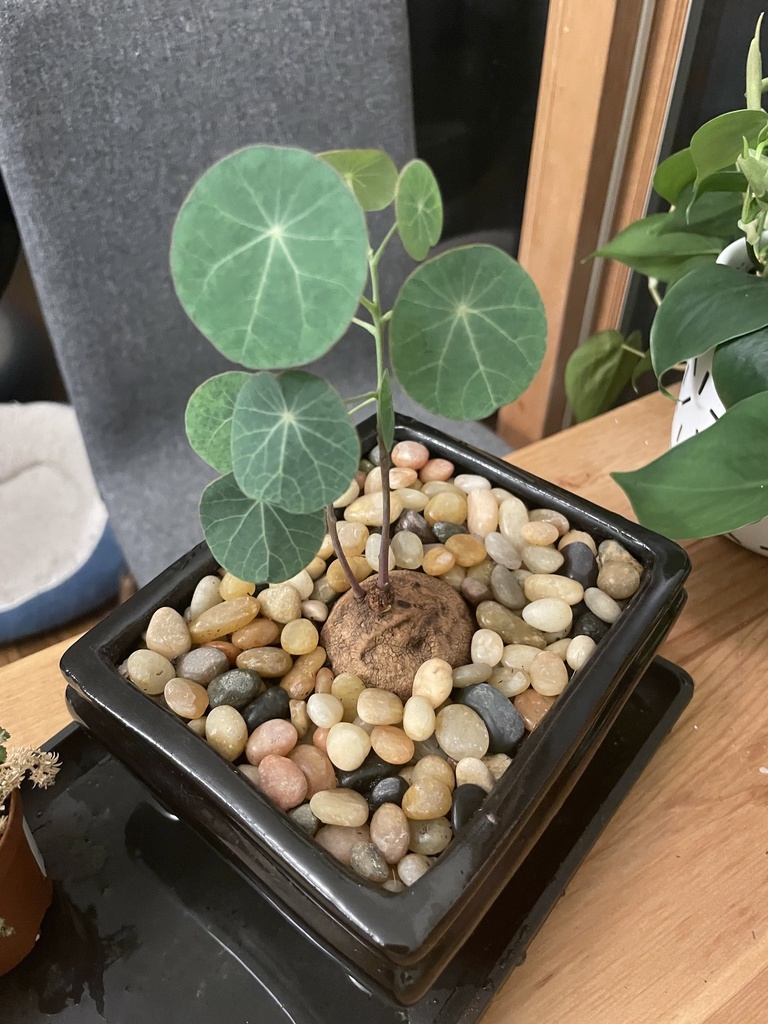
A tuberous, vining Menispermaceae described as Stephania cephalantha by Bunzō Hayata in 1913 from his Taiwanese flora studies — the spelling cepharantha is the trade-standard variant and is also the form used in Japanese pharmacology, where the alkaloid cepharanthine is named after it. Known in Japanese as Tamazaki-tsuzurafuji (玉咲蔓藤), it ranges across Taiwan, southern China, and northern Vietnam, with records reported from the southern Ryukyus. A globose to flattened grey-brown caudex sends up slender twining stems that carry circular, peltate leaves; small yellow-green umbel flowers in summer give way to red drupes on dioecious plants. Its tuber is the source of cepharanthine — an anti-inflammatory and antiviral agent licensed in Japan since 1942 and recently studied as an anti-COVID-19 candidate.
Native climate
Rainfall is spread fairly evenly across the year. Overall mild, with a wide temperature range.
A broad-scale picture of the native range. Real growing spots — rock crevices, fog belts — can be milder.
Sources: climate & elevation WorldClim 2.1 (1970–2000) · occurrences GBIF · native range POWO · current weather Open-Meteo
Care
Light & Placement
In Taiwanese and southern Chinese karst landscapes the species climbs through the half-shade of forest edges and limestone slopes. During active growth, give it bright partial shade outdoors, or gentle morning sun — strong direct sun makes the leaves harden and curl. In Japanese midsummer, light shading at 30–50% with the pot raised on a bench keeps leaves clean and airflow good. Train the vines on a stake or hoop to keep the form tidy; left alone they will tumble over the rim. Once the plant defoliates in autumn, move it under cover near a bright window for the dormancy.
Watering
In active growth, wait for the surface to dry, then water until it runs through. Never leave water in the saucer. As leaves drop in autumn, taper off; through dormancy hold dry, with at most a light monthly misting.
Substrate
Drainage and aeration first, inorganic-led: Akadama : Kanuma : pumice = 4:3:3. Plant with the upper half of the caudex exposed to keep it from sweating into wet soil.
Fertilizer & Supplements
A dilute liquid feed once a month in active growth, or a pinch of slow-release at repotting. Overfeeding stretches the vines and slows caudex thickening — keep doses light.
Temperature & Overwintering
Active growth runs 22–32°C; aim for a 5°C winter minimum. More cold-tolerant than S. erecta; bone-dry plants tolerate brief 3–5°C, but damp soil under cold rots the caudex fast. Overwinter dry on a bright indoor window.

Starting from Seed
Where to source seeds
Pre-sowing treatment
Soak seeds for about half a day (overnight) in a mix of a registered seed-treatment fungicide (Benlate or Daconil) and a plant tonic (Menedael; outside Japan, SUPERthrive or a chelated iron / seaweed extract works similarly), each diluted per label. Floaters are a fair indicator of stale stock; seed loses viability quickly.
Substrate
A fine-grained, near-sterile seedling mix: fine Akadama, fine Kanuma, vermiculite in 1:1:1 parts. Sterilize with boiling water or a microwave pass for peace of mind.
Sowing method
Sow with no covering, or only the thinnest dusting so seeds remain partly visible. Space at least 1 cm apart, and avoid clumping.
Light & temperature
Bright shade or low LED at 22–28°C. Germination is slow and uneven — some break ground in two weeks, others take one to two months. Hold steady warmth on a heat mat and stay patient with stragglers.
Watering
Bottom-water with the level 1–2 cm up the pot. For the first 2–3 weeks, prioritize not letting the substrate dry out, then drop the water level gradually as germination evens up.
Fertilizer
No feeding right after germination. Once true leaves emerge, give heavily diluted liquid fertilizer once or twice a month — go very light at this stage.
From Germination to Repotting
Germination through true leaves
Continue bottom watering, avoid strong light.
Weaning off bottom watering
Transition gradually over 1–2 months.
First repotting
In the first or second year, once the plant has become root-bound.
Common Pitfalls
Mold & damping-off
- Cause: excess moisture, contamination, poor air flow
- Prevention: sterilize substrate, change bottom-water regularly, raise the tray for airflow
Etiolation
- Cause: insufficient light
- Prevention: bring LEDs closer or move to bright shade outdoors. As a vining species, weak light will quickly produce thin, stretched stems
Seeds fail to germinate
- Cause: stale seed, insufficient warmth
- Prevention: sow fresh seed as soon as you receive it; keep 22–28°C on a heat mat
Notes
All parts contain bisbenzylisoquinoline alkaloids (including cepharanthine); ingestion is unsafe, so wear gloves when pruning or repotting and keep away from mouth and eyes. The dormant caudex rots easily under wet conditions, so discipline the dry-down through winter.