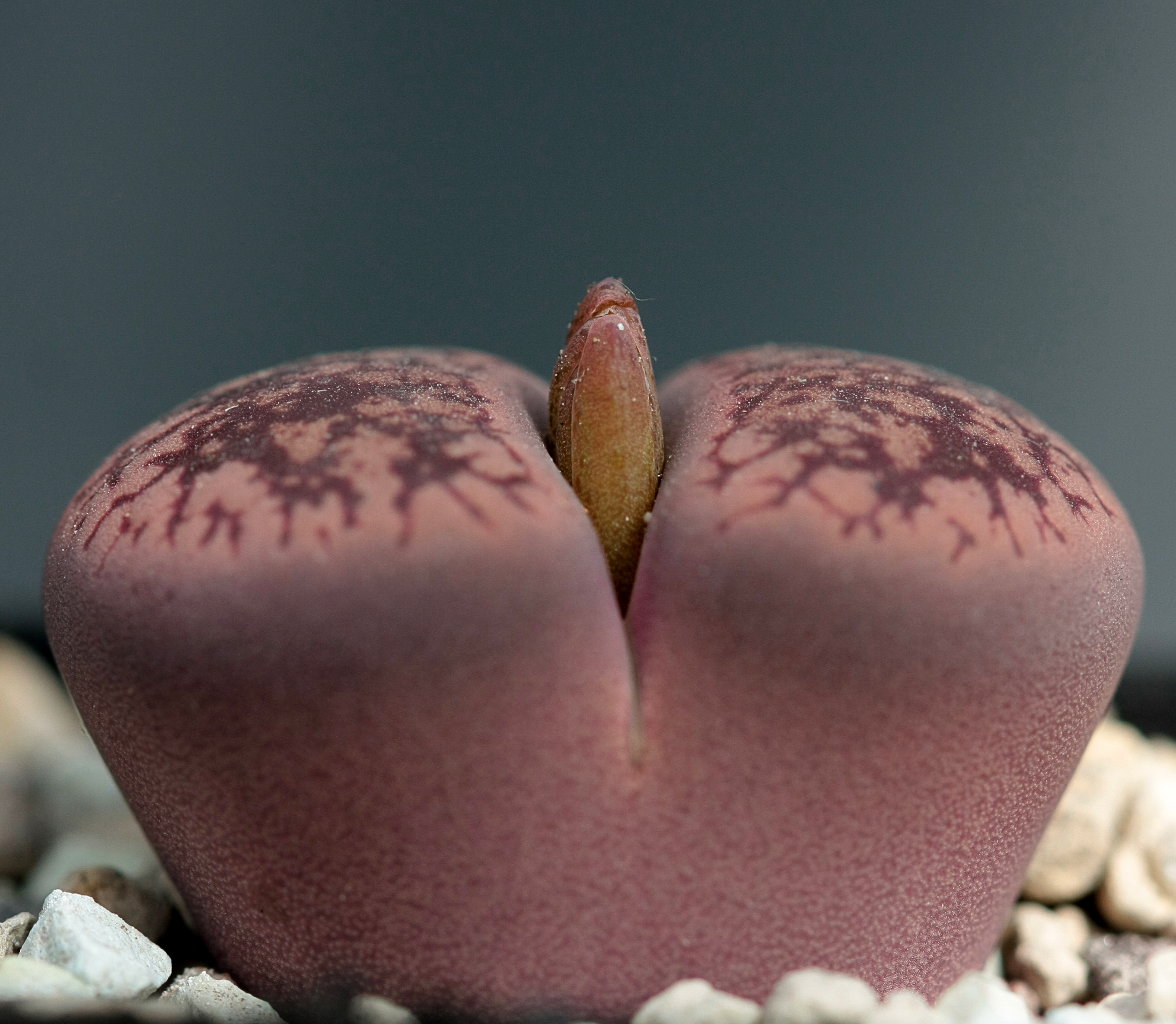
A flagship species of the Aizoaceae family, native to calcrete and dolerite outcrops in the Northern Cape Province of South Africa near Kuruman, at elevations of 1,000–1,400 m. The paired leaves — 2–4 cm across — grow almost flush with the ground, and the semi-transparent windows and orange-brown reticulate patterning on the leaf surface blend so convincingly with the surrounding gravel that the plant has earned the vernacular name "living stone." POWO accepted name: Lithops aucampiae L.Bolus, 1932. Not listed under CITES; IUCN status: Least Concern. Successful cultivation comes down to three pillars: a cool-season growth cycle, managed leaf shedding (moulting), and strict summer dormancy.
Native climate
Rain concentrates in the cool season, with a dry season of roughly 6 months. Overall mild, with a wide temperature range.
* Accurate distribution data is scarce for this species, so these values are taken from the climate near the approximate center of its native range instead.
Sources: climate & elevation WorldClim 2.1 (1970–2000) · occurrences GBIF · native range POWO · current weather Open-Meteo
Care
Light & Placement

During the growing season (autumn through spring), provide full sun outdoors or the strongest available south-facing window light. Weak light causes etiolation and dulls the distinctive patterning. In Japan's summer (July–August), the plant is dormant — direct sun is fine, but keep it on a rain-protected shelf so the substrate stays dry. Poor airflow invites rot; a fan or small circulator helps maintain stability. Indoors in winter, aim for at least half a day of direct light to prevent etiolation and clouding of the windows.
Watering
Resume watering in autumn once moulting is complete and the new leaf pair has fully emerged (typically September–October). During the growing season, water thoroughly after the substrate has dried completely, then let it dry again before the next watering. While moulting is in progress — when the old leaves split and the new pair begins to show — withhold water and allow the old leaves to shrink and wither naturally. From spring onward, reduce frequency; suspend watering entirely (or limit to a light misting once a month) through the summer dormancy period (June–August).
Substrate
Prioritise drainage above all else. A predominantly inorganic mix works well: akadama small grade, kanuma small grade, and pumice in a 4:3:3 ratio, with organic content kept at 10–20% at most. Unglazed terracotta pots help prevent waterlogging; a moderately deep pot (rather than a very shallow one) makes it easier to achieve clear wet-dry cycles.
Fertilizer & Supplements
Lithops have low fertiliser needs. If feeding, apply a diluted liquid fertiliser once a month during the growing season only. Over-fertilising promotes etiolation, distorts patterning, and increases the risk of root rot.
Temperature & Overwintering
Optimal growing range: 10–25°C. Move plants indoors to a bright windowsill if temperatures are expected to drop below 5°C. Keeping plants in full sun through winter — even while withholding water — builds compact, well-formed growth. During the summer high-temperature period (above 35°C), allow plants to rest in a ventilated spot with partial shade; avoid combining wet substrate with heat.

Starting from Seed
Where to source seeds
Pre-sowing treatment
Mix a fungicide (Benlate WP, Daconil 1000, or equivalent) with a plant activator (Menedael or similar) at the manufacturer's recommended dilution, and soak seeds for 2–3 hours. Because Lithops seeds are extremely fine, over-soaking makes them harder to handle. Sterilise the sowing medium in advance using a microwave or boiling water to reduce mould risk.
Substrate
Prepare a separate fine, low-organic sowing mix: equal parts fine akadama, fine kanuma, and vermiculite (1:1:1). Adding 10–20% desert sand improves aeration.
Sowing method
Lithops seeds are tiny (0.5–1 mm), so place them individually on the surface using a moistened toothpick or fine brush. Leave them uncovered or apply only the thinnest possible covering — just enough to barely hide the seed. Space seeds at least 1 cm apart to prevent crowding. Mist the entire tray, then cover with cling film or a glass pane to maintain humidity.
Light & temperature
Keep in bright indirect light (no direct sun) at a stable 18–22°C until germination. Germination typically occurs within 3–14 days. Fresh seed germinates readily under these conditions.
Watering
Maintain 1–2 cm of bottom watering (standing water in a tray) to keep the substrate consistently moist. Once germination is complete, gradually reduce the water level and transition to bottom feeding by the second month.
Fertilizer
Not needed immediately after germination. Once seedlings have produced 2–3 leaf pairs, a highly diluted liquid feed once a month is sufficient.
From Germination to Repotting
Germination through true leaves (up to 1 month)
Continue bottom watering while gradually increasing light exposure. Keep the enclosure sealed for the first two weeks, then introduce ventilation in small increments.
Weaning off bottom watering (1–3 months)
Once roots reach the bottom of the tray, remove the standing water and transition to watering only when the surface has dried. Allow two weeks for the transition to avoid sudden desiccation stress.
First repotting (1–2 years)
Repot when roots fill the container or plants crowd each other. Lithops recover slowly from root damage — move them with the root ball as intact as possible.
Common Pitfalls
Mold & damping-off
- Cause: Pathogens in the substrate, excess moisture post-germination, poor airflow
- Prevention: Sterilise sowing medium before use; change bottom water regularly; use a fan to improve air circulation
Etiolation
- Cause: Insufficient light, over-fertilising
- Prevention: Move seedlings closer to an LED grow light or into bright indirect outdoor light promptly after germination; keep feeding minimal
Seeds fail to germinate
- Cause: Reduced seed viability (affected by storage conditions), temperatures below 18°C, sowing outside the autumn window
- Prevention: Source from a reliable supplier; sow in autumn (September–November); use a heat mat to hold 18–22°C consistently
Summer stall and rot
- Cause: Incomplete summer dormancy — residual watering combined with high heat and humidity
- Prevention: From June through August, withhold water entirely or limit to a monthly light misting; rest plants in a ventilated, partially shaded spot
Notes
Withhold water during moulting — it prevents the new leaf pair from absorbing the old leaves.
