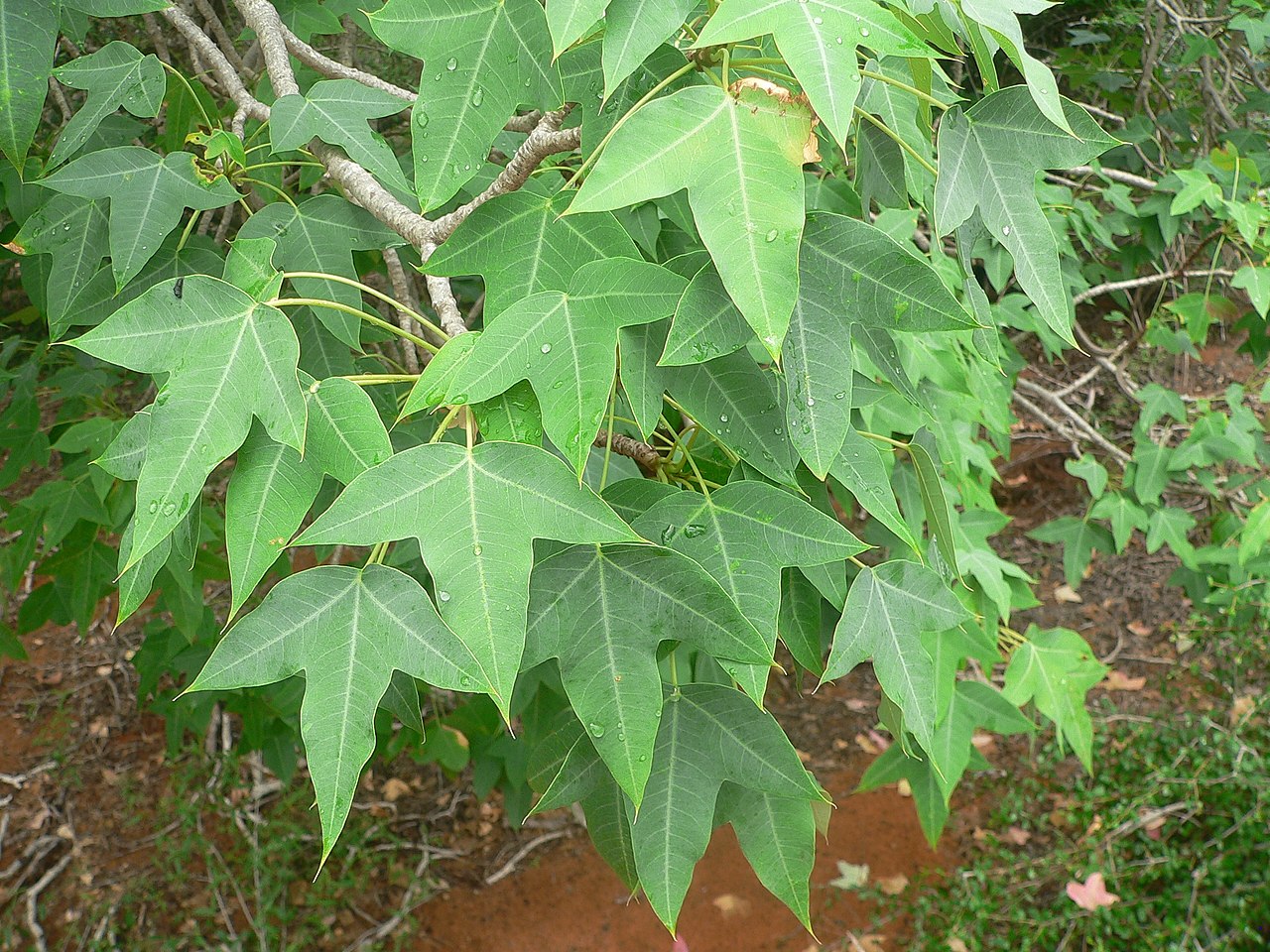
The only Madagascar-endemic species of Jatropha, native to the spiny forest on the Mahafaly Plateau of southwestern Madagascar. Described in 1909 by Jumelle and H. Perrier, the epithet honours the Mahafaly highlands at the heart of its range. Reaching 2–6 m in habitat, it forms a stout, pale grey caudex-like trunk that thickens into thick, short branches, glossy palmately-three-lobed leaves, and small creamy-white to pale-yellow summer flowers veined with red on the inner throat. Around Reniala and Mangily it shares the limestone spiny-forest canopy with Alluaudia and Didiereaceae companions. Like the rest of Euphorbiaceae, every part bleeds toxic white latex — a striking caudex tree that demands respectful handling.
Native climate
Rain concentrates in the warm season, with a distinct dry season. Overall a warm climate.
A broad-scale picture of the native range. Real growing spots — rock crevices, fog belts — can be milder.
Sources: climate & elevation WorldClim 2.1 (1970–2000) · occurrences GBIF · native range POWO · current weather Open-Meteo
Care
Light & Placement
On the limestone spiny forest of the Mahafaly Plateau in southwestern Madagascar, this species grows in unrelenting full sun. Give it as much direct light as possible during active growth — strong sun keeps the caudex tight and the branches short and woody. Through Japan's midsummer, light shading at 20–30% with the pot raised on a bench for airflow avoids the afternoon-sun-plus-stagnant-heat combination. It is on the cold-sensitive side for a Madagascan species, so overwinter on a bright sunny window above 8°C and bone-dry. Stagnant pot moisture is the main killer.
Watering
In active growth, water deeply once the surface dries, then dry out fully again — clear wet/dry cycles. Adapted to dry country and easily rotted by overwatering. Taper through autumn and go fully dry through winter for a clean dormancy.
Substrate
Drainage first, inorganic-led: Akadama : Kanuma : pumice = 4:3:3. A deeper pot lets the caudex sit cleanly and the roots run straight down, supporting steady trunk thickening.
Fertilizer & Supplements
Diluted liquid feed once a month in active growth, or a pinch of slow-release at repotting. Pushing too hard stretches internodes and softens the branch architecture of the caudex form.
Temperature & Overwintering
Optimal 22–35°C, 8°C minimum. Cold-sensitive for a Madagascan caudex — damp soil under 10°C will rot the trunk fast. Go fully dry before bringing indoors and overwinter on a bright sunny window.

Starting from Seed
Where to source seeds
Pre-sowing treatment
Soak seeds for about half a day (overnight) in a mix of a registered seed-treatment fungicide (Benlate or Daconil) and a plant tonic (Menedael; outside Japan, SUPERthrive or a chelated iron / seaweed extract works similarly), each diluted per label. Any that stay afloat are usually past their prime; the seed coat is moderately hard, so warm water steadies imbibition.
Substrate
Use a separate fine-grained, near-sterile seedling mix: fine Akadama, fine Kanuma, vermiculite in 1:1:1 parts. Sterilize beforehand with boiling water or a microwave pass to reduce damping-off.
Sowing method
Sow with no covering, or only the thinnest dusting of substrate so the seeds remain partly visible. Space seeds at least 1 cm apart so they don't clump or overlap on the surface.
Light & temperature
Bright shade or under low-intensity LED at a steady 25–30°C. Expect germination in 7–21 days. Germination depends on seed freshness, but with fresh seed it is reasonably steady; heat-mat warmth gives the most consistent flush.
Watering
Bottom-water with the level 1–2 cm up the pot. For the first 2–3 weeks, prioritize not letting things dry out, then drop the level gradually as seedlings stabilize.
Fertilizer
No feeding right after germination. Once true leaves emerge, give a heavily diluted liquid fertilizer once or twice a month — go lighter than the bottle suggests.
From Germination to Repotting
Germination through true leaves
Continue bottom watering and avoid strong light.
Weaning off bottom watering
Phase out gradually over 1–2 months.
First repotting
In the first or second year, once roots have filled the pot.
Common Pitfalls
Mold & damping-off
- Cause: excess moisture, contamination, poor air flow
- Prevention: sterilize the substrate, refresh the bottom-water often, and use a circulation fan
Etiolation
- Cause: insufficient light
- Prevention: bring LEDs closer right after germination, or move the tray to bright shade outdoors
Seeds fail to germinate
- Cause: stale seed, insufficient warmth
- Prevention: source fresh seed from a reputable seller and hold 25–30°C steady on a heat mat
Notes
The seeds are toxic; keep them out of reach of children and pets.