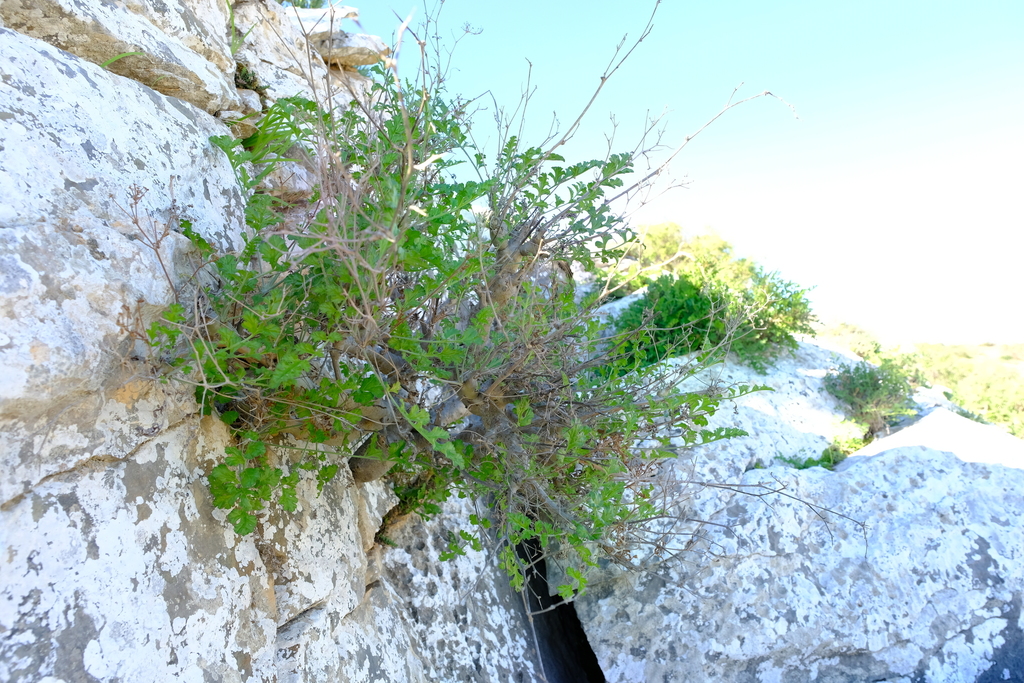
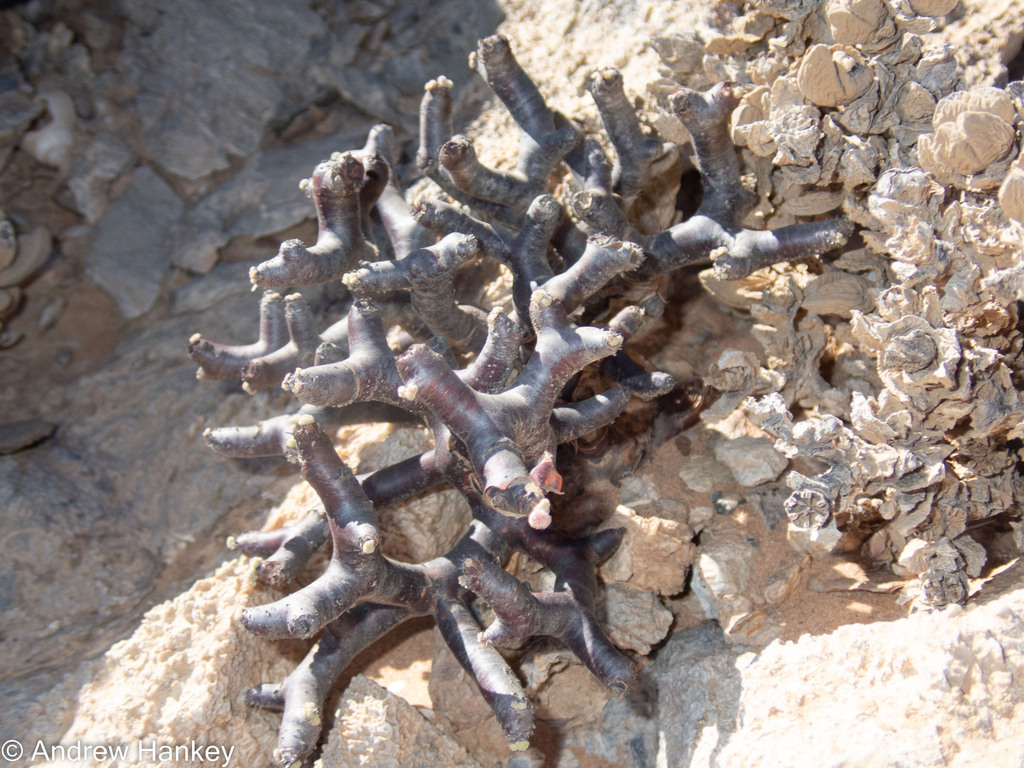
A semi-succulent shrublet from the winter-rainfall arid belt of southern Africa — Richtersveld and Namaqualand in South Africa's Northern Cape, into the Western Cape, the western Karoo, and southern Namibia. Authority is Sm. (James Edward Smith, 1793); the epithet crithmifolium refers to a leaf shape recalling Crithmum (samphire, Apiaceae). The diagnostic features are the knobby, fleshy, greenish-yellow stems with peeling bark that photosynthesizes on its own, the pinnately divided leaves clustered at the branch tips and smelling of ginger and nutmeg when crushed, and the dried old flower stalks that harden in place into spine-like persistent stubs. Alongside P. carnosum, it is one of the standard "succulent Pelargoniums" — a slow, sculptural winter-grower.
Native climate
Rain concentrates in the cool season, with a dry season of roughly 6 months. Overall mild, with a wide temperature range.
A broad-scale picture of the native range. Real growing spots — rock crevices, fog belts — can be milder.
Sources: climate & elevation WorldClim 2.1 (1970–2000) · occurrences GBIF · native range POWO · current weather Open-Meteo
Care
Light & Placement

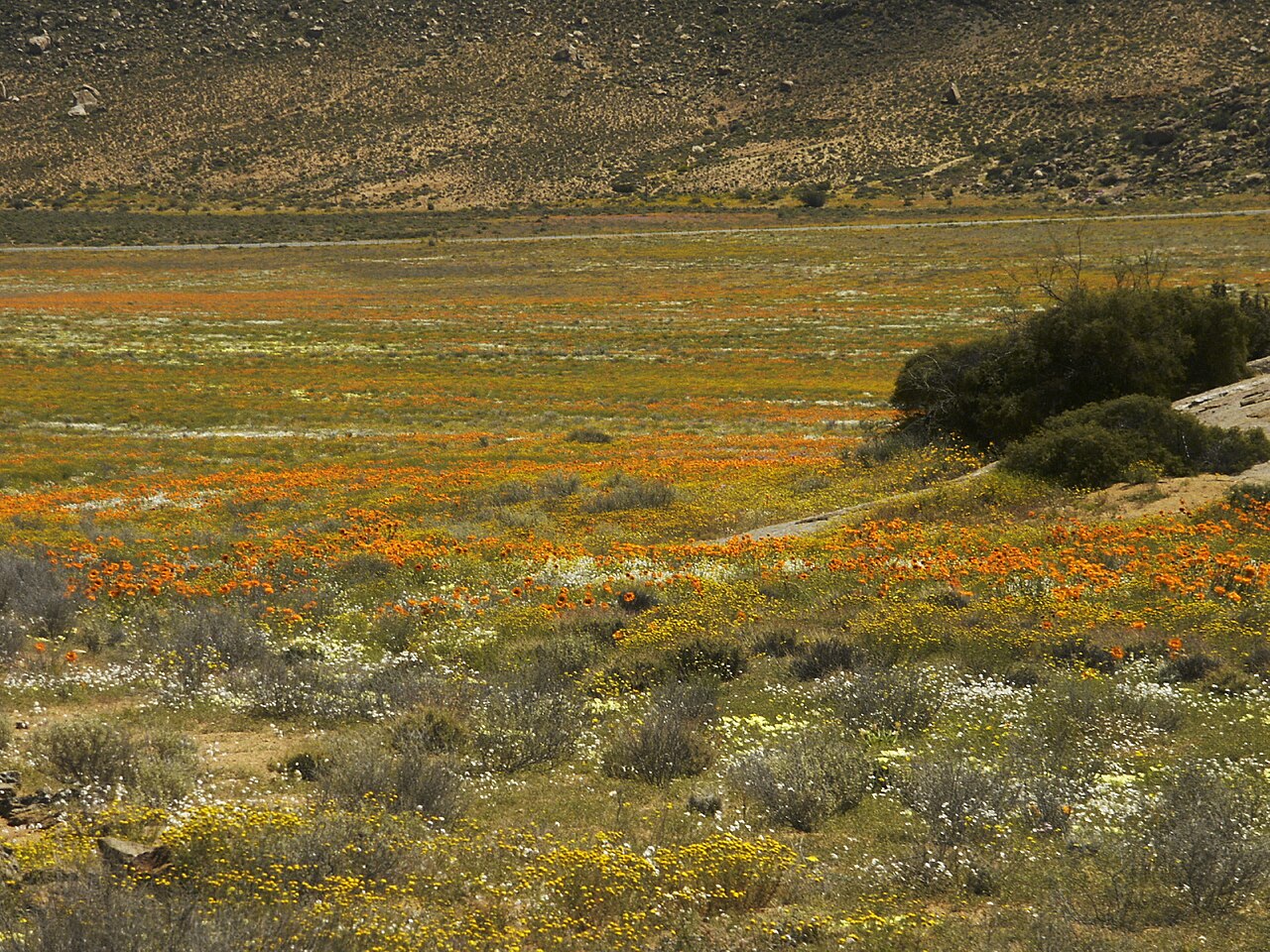
Habitat in Namaqualand and the Richtersveld receives roughly 80 mm of rain a year, almost all in winter, with strong sun against cool air; plants wedge into shallow rock cracks. During the autumn-to-spring active season in Japan, give it as much bright outdoor or windowsill light as possible — strong light keeps internodes tight and the bark a clean greenish yellow. The dangerous season is the rainy season into midsummer: shift to bright shade out of direct sun (50–70% shade cloth), raise the pot on a bench, and run a circulation fan. Winter indoors above 5°C on a bright window is straightforward, and SANBI notes the plant tolerates brief cold close to −4°C when dry.
Watering
Restart in small amounts from September into October, then water properly once leaves emerge — soak when the substrate has fully dried. Cut water in April–May once leaves yellow and drop, and keep dry through summer. Watering in summer because the plant looks "too dry" is the single most reliable way to lose it.
Substrate
Drainage first, inorganic-led. Akadama : Kanuma : pumice = 3:3:4, leaning on pumice to dry faster. Habitat is a shallow rock crack, so a shallow pot that dries from the surface down works better than a deep one.
Fertilizer & Supplements
Liquid feed at heavy dilution once a month through the active season, or a pinch of slow-release at repotting. Native soils are extremely poor; pushing fertilizer elongates branches and dulls the greenish-yellow bark. Nothing through summer.
Temperature & Overwintering
Optimal 15–25°C; minimum around 5°C. SANBI notes tolerance close to −4°C when fully dry, but damp soil under cold is fatal. Summering is harder than overwintering: tropical nights above 35°C combined with humidity will collapse the branch tips. Through summer, prioritize shade, ventilation and complete dryness; an air-conditioned room is a legitimate retreat.
Starting from Seed
Where to source seeds
Pre-sowing treatment
Soak seeds for about half a day (overnight) in a mix of a registered seed-treatment fungicide (Benlate or Daconil) and a plant tonic (Menedael; outside Japan, SUPERthrive or a chelated iron / seaweed extract works similarly), each diluted per label. Seeds remaining on the surface are likely no longer viable. The seeds carry a long feathered awn and viability drops fast with age.
Substrate
A separate seedling mix, fine-grained and near-sterile: fine Akadama, fine Kanuma, and vermiculite in 1:1:1, sterilized with boiling water or a microwave pass. A thin topping of coarse sand helps anchor the awned seed.
Sowing method
Insert each seed point-down with the awn standing up, just barely buried. Make a shallow hole and slot it in. Thin clumps after germination.
Light & temperature
Bright shade, 15–22°C. As a winter-grower, heating above 25°C actually suppresses germination. September through November is the right window in Japan; germination takes 10 days to about a month.
Watering
Bottom-water 1–2 cm up the pot. Don't let things dry out for the first 2–3 weeks, then drop the level gradually. Avoid cold water; room-temperature is preferable.
Fertilizer
None right after germination. Once true leaves emerge, a heavily diluted liquid feed once or twice a month. Growth is very slow — SANBI records up to five years to reach 1 m, so patience is part of the plant.
From Germination to Repotting
Germination through true leaves
Continue bottom watering, keep in bright shade.
Weaning off bottom watering
Phase out gradually over 1–2 months.
First repotting
In the second or third year, in autumn, into a shallow pot.
Common Pitfalls
Mold & damping-off
- Cause: excess moisture, contamination, poor airflow
- Prevention: sterilize the substrate, refresh the bottom-water, run a circulation fan
Etiolation
- Cause: insufficient light. The active winter season runs through low-sun months
- Prevention: run an LED close indoors, or move to bright shade outdoors on clear days
Seeds fail to germinate
- Cause: stale seed, temperatures too high
- Prevention: sow as soon as a batch arrives. Skip the heat mat — keep room temperature 15–22°C
Summer stall and rot
- Cause: heat and humidity during summer dormancy, or watering in summer. The single biggest risk for this species
- Prevention: taper water from April–May and go fully dry before the rainy season; through summer hold under shade with airflow in the coolest spot, with an air-conditioned room as a legitimate option
Notes
Sap is sticky and contact dermatitis has been reported; wash hands after handling.