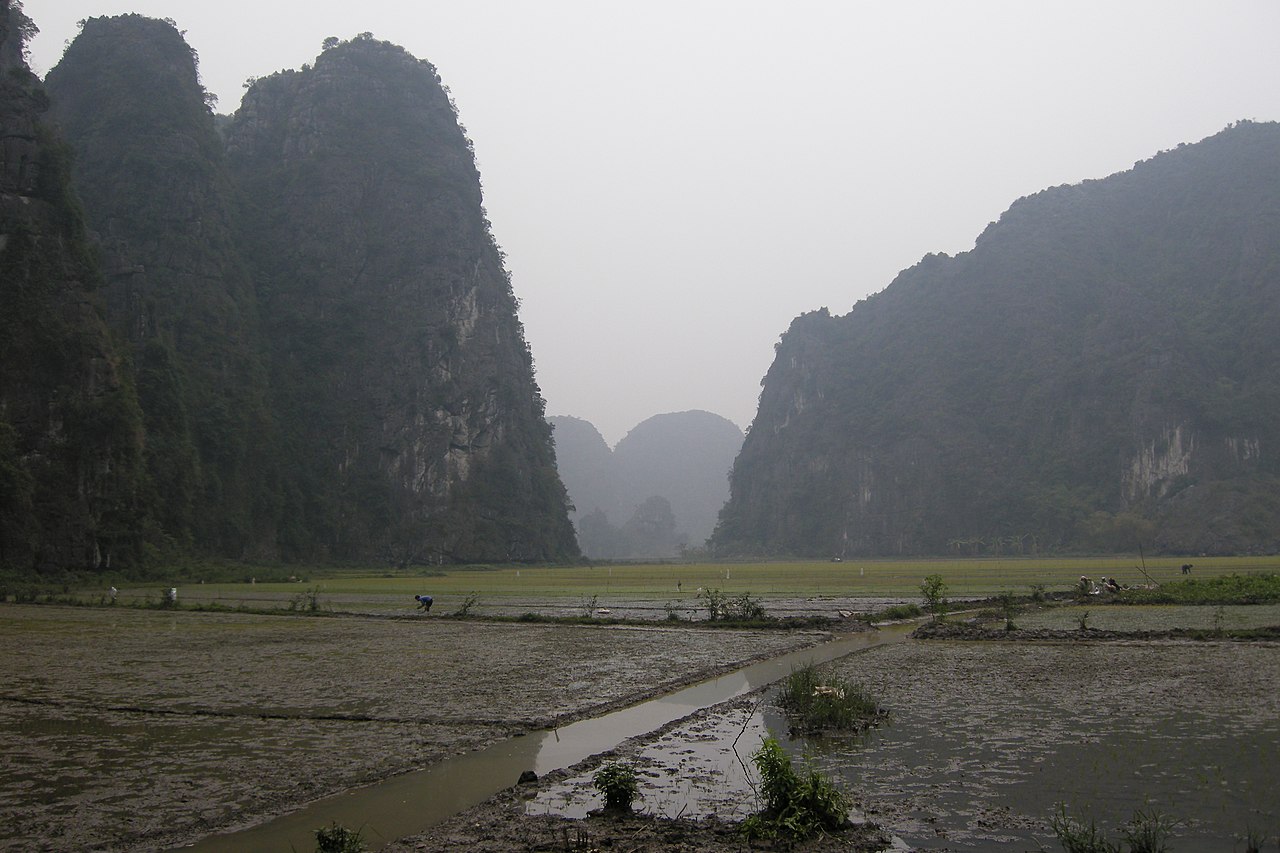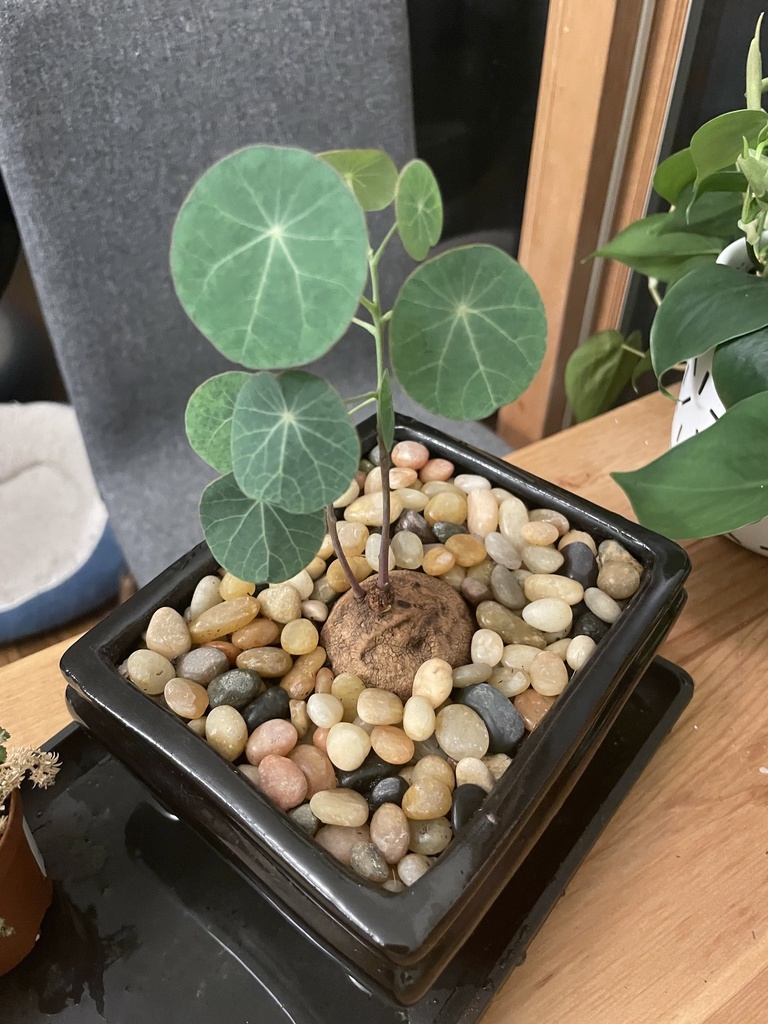
Described in 1922 by W. G. Craib as Stephania erecta, this caudiciform vine of the Menispermaceae ranges across northern and northeastern Thailand into Laos, Cambodia, and Vietnam. A grey-brown spherical caudex (5–25 cm across) sits on the surface, and from its crown a slender vine climbs upward, unfurling thin, peltate (shield-shaped) round leaves whose petiole attaches near the back centre. Tubers are exported from Thailand by the thousand as bare, dormant balls that buyers coax into leaf — a "souvenir plant" pipeline that helped drive Japan's recent caudex boom. The plant goes leafless in winter, the bare tuber resting like an object on the shelf. The currently accepted name in POWO is the earlier Stephania pierrei Diels (1910), but in caudex horticulture "Stephania erecta" is the established convention and is used on this site.
Native climate
Rainfall is spread fairly evenly across the year. Overall a hot climate.
* Accurate distribution data is scarce for this species, so these values are taken from the climate near the approximate center of its native range instead.
Sources: climate & elevation WorldClim 2.1 (1970–2000) · occurrences GBIF · native range POWO · current weather Open-Meteo
Care
Light & Placement

In the limestone karst hills and dry deciduous forests of northern Thailand, the plant grows wedged into rock cracks and tolerates anything from full sun to dappled shade. In active growth, give it bright but soft light — a sunny windowsill or a sheltered outdoor spot — to keep the vine compact and the leaves a deep green. Through Japan's midsummer, 30–50% shade with airflow guards against leaf burn and stem rot; raise the pot off the ground so the caudex doesn't bake or stew. Move it back to a bright indoor window once the leaves drop.
Watering
In active growth, water thoroughly once the topsoil is dry and never leave standing water in the saucer. Taper as the leaves yellow, then go fully dry through dormancy. Wet soil in winter is the single biggest killer of this species.
Substrate
Drainage first, inorganic-led. Akadama : Kanuma : pumice = 4:3:3. The caudex grows large and heavy, so anchor it in a deeper pot with generous drainage holes.
Fertilizer & Supplements
A monthly diluted liquid feed in growth, or a pinch of slow-release at repotting. Overfeeding stretches the vine and softens the tuber.
Temperature & Overwintering
Optimal 22–32°C, 8°C minimum. After leaf drop, overwinter bone-dry on a bright window. Damp soil plus cold rots the tuber fast — winter watering is this species' primary failure mode.

Starting from Seed
Where to source seeds
Pre-sowing treatment
Soak seeds for about half a day (overnight) in a mix of a registered seed-treatment fungicide (Benlate or Daconil) and a plant tonic (Menedael; outside Japan, SUPERthrive or a chelated iron / seaweed extract works similarly), each diluted per label. Floaters are usually past their prime; seed loses viability quickly.
Substrate
A fine-grained, near-sterile seedling mix: fine Akadama, fine Kanuma, vermiculite in 1:1:1 parts. Sterilize with boiling water or a microwave pass to head off damping-off.
Sowing method
Sow with no covering, or only the thinnest dusting so seeds remain partly visible. Space at least 1 cm apart.
Light & temperature
Bright shade or under LEDs at 25–30°C. Germination is slow and uneven — anywhere from two weeks to two months. A heat mat keeps the temperature steady. Germination depends heavily on seed freshness, and even fresh seed stays on the lower side.
Watering
Bottom-water with the level 1–2 cm up the pot. For the first 2–3 weeks don't let things dry out, then drop the level gradually.
Fertilizer
None right after germination. Once true leaves emerge, give heavily diluted liquid feed once or twice a month. Tuber thickening is slow — don't push the dose.
From Germination to Repotting
Germination through true leaves
Continue bottom watering, avoid strong light.
Weaning off bottom watering
Step down over one to two months.
First repotting
In the first or second year, once root-bound.
Common Pitfalls
Mold & damping-off
- Cause: excess moisture, contamination, poor air flow
- Prevention: sterilize substrate, change bottom-water often, dry off completely in dormancy
Etiolation
- Cause: insufficient light
- Prevention: bring LEDs closer or move outdoors to bright shade
Seeds fail to germinate
- Cause: stale seed, insufficient warmth
- Prevention: fresh seed and 25–30°C on a heat mat. Be patient — give it two months before giving up
Notes
The tuber and vine contain bisbenzylisoquinoline alkaloids (analogues of cepharanthine) and are harmful if ingested. Wet soil during winter dormancy is by far the most common cause of tuber rot — keep the plant bone-dry until spring.