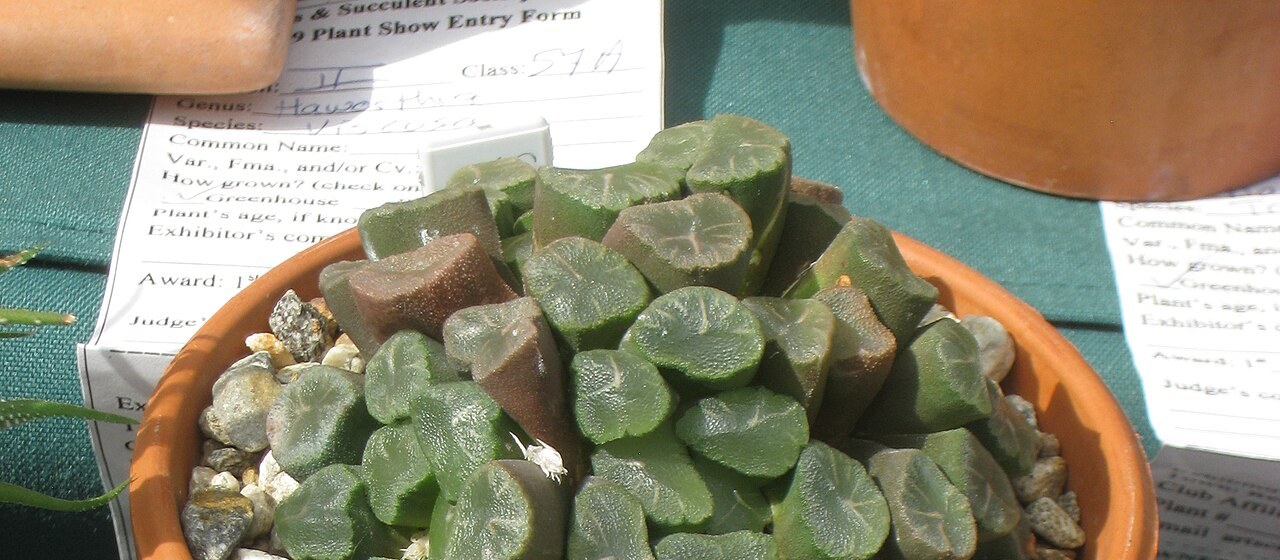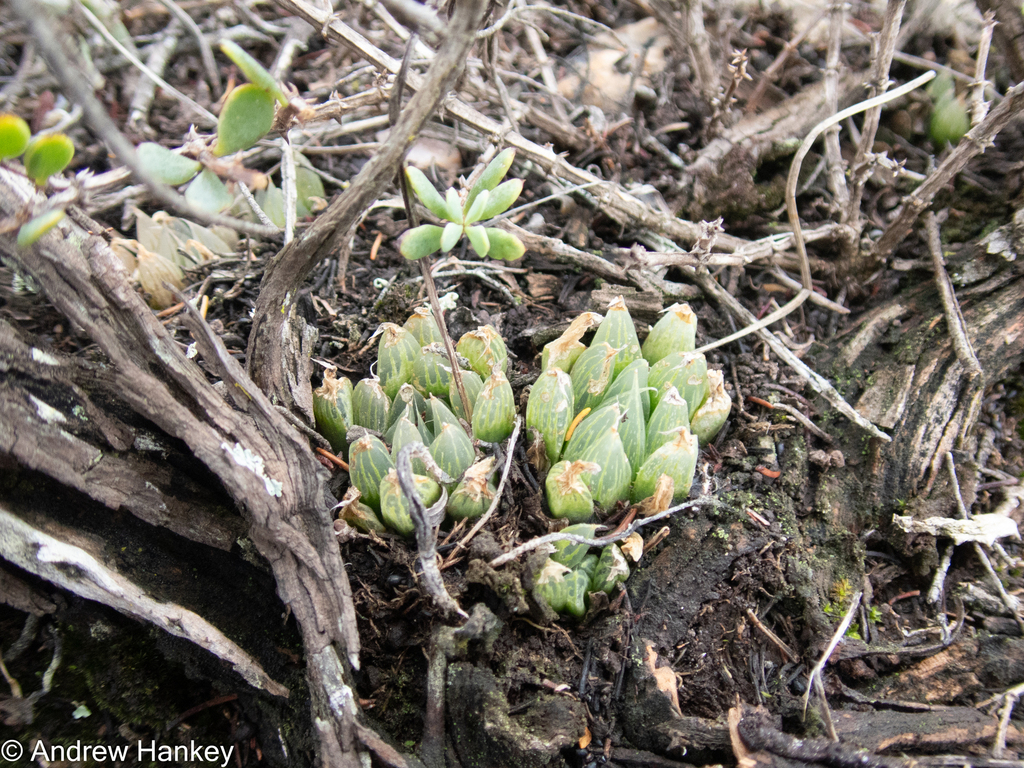
A small rosette species from the semi-arid thickets of South Africa's Eastern Cape, defined by the translucent "windows" at the tips of its leaves. In habitat the plant grows mostly buried in sand and gravel under low shrubs and at the bases of quartzite outcrops, with only the windowed tips exposed to draw light down into the leaf body. Described by Baker in 1870, it sits at the core of the lineage that horticulture has long known as "obtusa." Many varieties (var. truncata, var. pilifera and others) and a wide range of locality forms keep seed-grown plants visually varied. Since the molecular work of Manning et al. (2014) the old broad Haworthia has been split into Haworthia sensu stricto, Haworthiopsis and Tulista; H. cooperi remains in Haworthia in the strict sense.
Native climate
Rainfall is spread fairly evenly across the year. Overall a mild climate.
A broad-scale picture of the native range. Real growing spots — rock crevices, fog belts — can be milder.
Sources: climate & elevation WorldClim 2.1 (1970–2000) · occurrences GBIF · native range POWO · current weather Open-Meteo
Care
Light & Placement

In habitat the plant sits half-buried under shrubs and beside rocks, so unfiltered direct sun is not its native regime. A Japanese midsummer above 30°C pushes it into half-dormancy, and strong light at that point browns the leaves and clouds the windows. Through the spring and autumn growing months (March–May, September–November) keep it under roughly 50% shade with gentle light; in high summer increase the shade or move it to bright shade. Indoors, an east or southeast window behind a lace curtain works well. Outdoor pots benefit from a bench (not the ground) with steady airflow. A bright unheated indoor window is enough for winter.
Watering
In active spring and autumn growth, water thoroughly once the substrate has dried, then repeat on a surface-dry cycle. In the half-dormancy of high summer and deep winter, cut back to one or two light waterings a month.
Substrate
Balance drainage with a little water retention. Akadama fine : Kanuma fine : pumice = 4:3:3, leaning toward smaller particles to match the fine root system. A taller pot enforces the wet–dry swing that keeps the windows clear.
Fertilizer & Supplements
A dilute liquid feed once or twice a month in the growing season, at double or weaker than label dilution, is plenty. Heavy feeding stretches the leaves and dulls colour. A pinch of slow-release at repotting usually removes the need for top-ups.
Temperature & Overwintering
Active-growth optimum 15–28°C with 3°C as a sensible winter floor. Dry plants take brief dips close to 0°C, but cold plus damp substrate rots the roots quickly. Read a Japanese midsummer as half-dormancy and carry it through with shade and airflow; in deep winter, overwinter dry on a bright indoor window.
Starting from Seed
Where to source seeds
Pre-sowing treatment
Soak seeds for half a day in water mixed with a fungicide (Benlate, Daconil 1000) and a plant tonic (Menedael or similar) at label strength. The seeds are very small and handle accordingly. Viability drops quickly: seed older than about a year typically germinates poorly, so sow as soon after harvest as possible.
Substrate
Use a separate fine-grained, near-sterile sowing mix: Akadama fine : Kanuma fine : vermiculite = 1:1:1, pre-sterilised by microwave or boiling water. Level the surface carefully — fine seed sits more evenly on a flat bed.
Sowing method
Essentially surface-sow with no cover. Because the seed is so small and scatters easily, the most controllable method is to place individual seeds with the tip of a damp toothpick, leaving at least 5 mm between them.
Light & temperature
Bright shade, with the substrate held steadily at 22–28°C. Germination takes 7–21 days. Fresh seed germinates in the easy-to-moderate range; old seed drops off sharply, so look for suppliers who note a harvest year.
Watering
Bottom-water with the pot standing in 1–2 cm of water. For the first three to four weeks, prioritise keeping the surface moist; once germination is even, lower the water level in steps.
Fertilizer
None for the first weeks. Once the first true leaves expand, a dilute liquid feed (at twice the label dilution or weaker) once or twice a month is enough.
From Germination to Repotting
Germination through true leaves (~2 months)
Keep bottom-watering and bright shade; maintain humidity.
Weaning off bottom watering (2–4 months)
Lower the water level in steps; switch to tray watering.
First repotting (1–2 years)
Move to a fine-grained inorganic mix once roots fill the pot.
Common Pitfalls
Mold & damping-off
- Cause: contaminated substrate, overwatering, poor airflow
- Prevention: sterilise the mix, refresh the bottom water often, and run a fan for air movement
Leaf scorch & clouded windows
- Cause: strong light, especially overlapping with midsummer heat, or abrupt changes in light
- Prevention: roughly 50% shade in spring and autumn, bright shade in high summer, and step environment changes over about a week
Seeds fail to germinate
- Cause: stale seed or low temperature
- Prevention: buy from suppliers that disclose a harvest year, and use a heat mat to hold 22–28°C
Seedlings don't match the parent
- Cause: most "obtusa"-type plants in trade are clonal selections maintained by leaf cuttings and offsets, and seed-grown wild H. cooperi rarely reproduces those forms
- Prevention: approach seed-grown plants as a study in variety- and locality-level variation; for a specific selection, seek offsets or leaf-grown plants of that named clone
Notes
No notable toxicity is reported for the genus.