
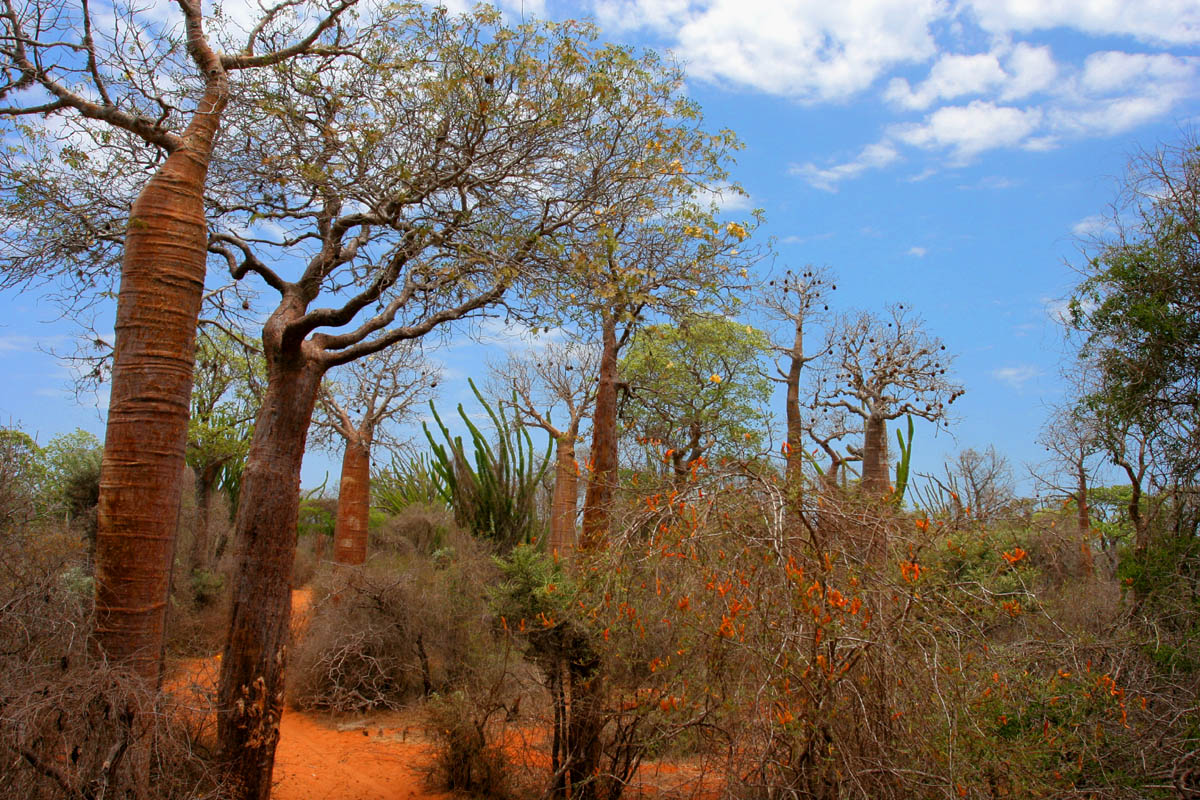
A small tree of the limestone country along coastal southwestern Madagascar. Originally described by Drake as Didierea comosa and later transferred by Drake himself to Alluaudia, this species carries a distinctive silhouette — a short, thick upright trunk branches into a dense crown that flattens out at 2–6 m, occasionally reaching 10 m. It is dioecious, with male and female flowers on separate plants. Grey spines of 1.5–3.5 cm sit individually along the branches, and paired rounded fleshy leaves drop at the start of the dry season. The Didiereaceae are an independent Madagascan lineage that has evolved in parallel with the cacti and ocotillos elsewhere, and A. comosa shows this island-grown form of dry-country tree about as clearly as any. IUCN assessed the species as Vulnerable in 2019, and it remains uncommon in trade.
Native climate
Rain concentrates in the warm season, with a distinct dry season. Overall a warm climate.
A broad-scale picture of the native range. Real growing spots — rock crevices, fog belts — can be milder.
Sources: climate & elevation WorldClim 2.1 (1970–2000) · occurrences GBIF · native range POWO · current weather Open-Meteo
Care
Light & Placement

In the open limestone country of coastal southwestern Madagascar this species grows in strong direct sun, so give it as much full light as possible outdoors in active growth. Insufficient light stretches the shoots and softens the species' characteristic short branching and flat-topped crown. Through Japan's midsummer, light shading at 20–30% with the pot raised on a bench for airflow is the safer setting. Overwinter on a bright sunny window kept above 8°C and dry. Reflecting its coastal origin, it sits among the more tolerant species in the genus when it comes to salt-laden wind and severe dryness.
Watering
In active growth, water deeply once the substrate has dried completely, then dry it out fully again with good airflow. Habitat receives only a few hundred millimeters of rain a year — the plant resents lingering wetness. Taper through autumn and go dry through winter.
Substrate
A sharply draining inorganic mix is essential. Akadama : Kanuma : pumice = 4:3:3. Sift out fines, use a deeper pot, and ensure generous drainage holes.
Fertilizer & Supplements
A diluted liquid fertilizer monthly in active growth, or a small pinch of slow-release at repotting. Excess nitrogen stretches the shoots and erodes the flat-topped crown — keep doses modest and grow it on slowly.
Temperature & Overwintering
Optimal 22–35°C, minimum 8°C. Bone-dry plants tolerate brief drops near 5°C, but damp soil below ~10°C will rot the trunk fast — go fully dry before bringing indoors.
Starting from Seed
Where to source seeds
Pre-sowing treatment
Soak seeds for about half a day (overnight) in a mix of a registered seed-treatment fungicide (Benlate or Daconil) and a plant tonic (Menedael; outside Japan, SUPERthrive or a chelated iron / seaweed extract works similarly), each diluted per label. Floaters are typically past their prime — common with this species, where stock reaches the trade in small batches and is often not freshly harvested.
Substrate
Use a separate seedling mix that's fine-grained and near-sterile: fine Akadama, fine Kanuma, and vermiculite in 1:1:1 parts. A boiling-water or microwave pass beforehand cuts damping-off.
Sowing method
Sow with no covering, or only the thinnest dusting of substrate so the seeds remain partly visible. Space the seeds at least 1 cm apart so they don't clump or overlap on the surface.
Light & temperature
Bright shade, 25–30°C. Germination typically lands within 10–30 days, but stragglers are common — keep the heat steady on a heat mat and stay patient. Germination depends heavily on seed freshness, and even fresh seed stays on the lower side.
Watering
Bottom-water with the level 1–2 cm up the pot. For the first 2–3 weeks prioritize not letting things dry out, then drop the level gradually once seedlings are stable.
Fertilizer
No feeding right after germination. Once true leaves open, give diluted liquid fertilizer at double dilution or weaker, once or twice a month.
From Germination to Repotting
Germination through true leaves
Continue bottom watering, in bright shade.
Weaning off bottom watering
Phase it out gradually over 1–2 months.
First repotting
In the first or second year, once roots have filled the pot.
Common Pitfalls
Mold & damping-off
- Cause: excess moisture, contamination, poor air flow
- Prevention: sterilize the substrate, refresh the bottom-water, and use a circulation fan
Etiolation
- Cause: insufficient light
- Prevention: move LEDs closer right after germination, or shift the tray to bright shade outdoors
Seeds fail to germinate
- Cause: stale seed, insufficient warmth
- Prevention: source from reliable sellers, prioritize fresh seed, and hold 25–30°C steady on a heat mat
Notes
The spines are sharp — use thick leather gloves and tongs when repotting or pruning. Because the species is dioecious, seed set requires cross-pollination between separate individuals. IUCN lists A. comosa as Vulnerable (2019), and the Didiereaceae have been on CITES Appendix II since 1977, so source from reputable, properly documented sellers.


