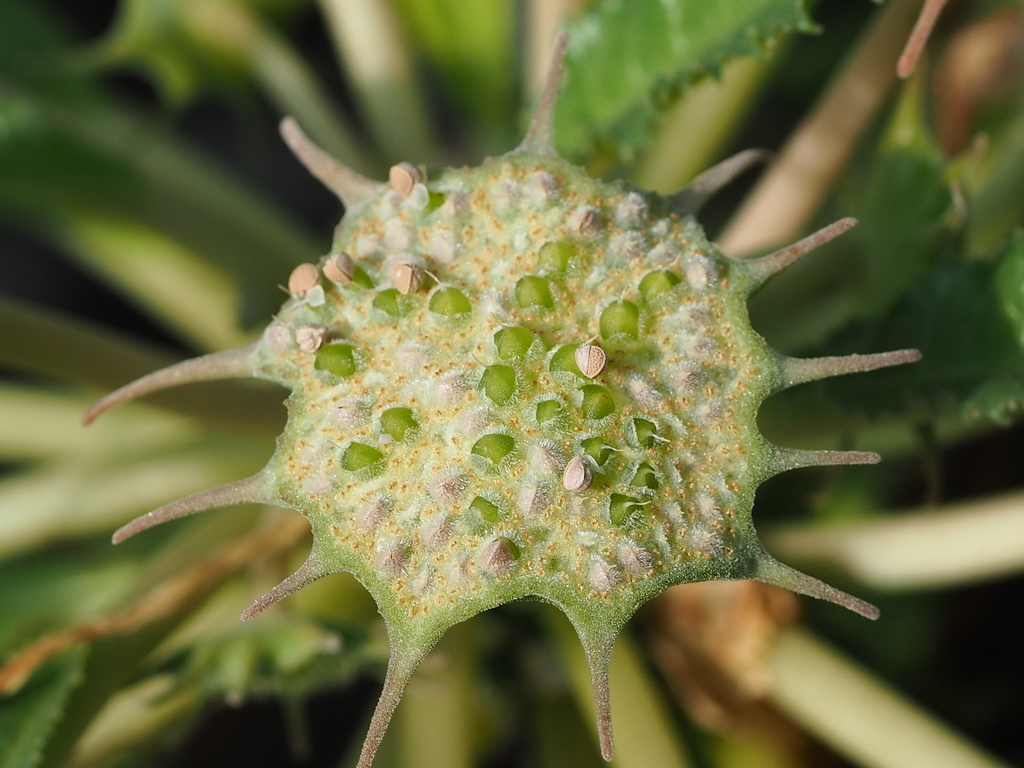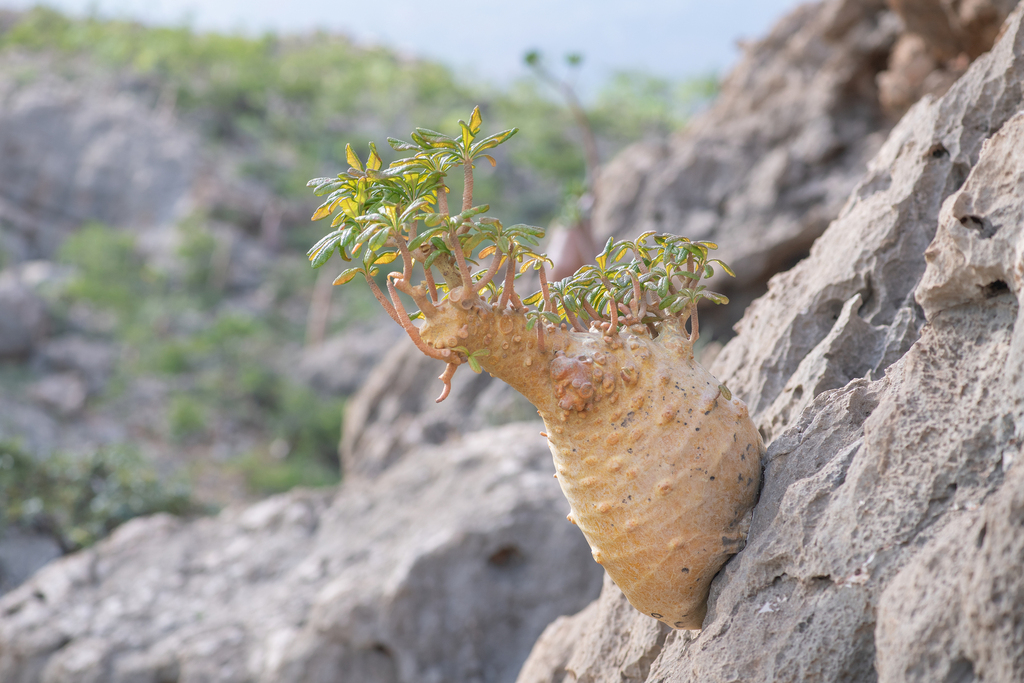
A Moraceae caudex described by Schweinf. ex Balf.f. in 1882, endemic to the island of Socotra (Yemen) in the Indian Ocean. The largest species in its genus, it can reach 5 m in height with a swollen, tree-like grey-white caudex up to a metre across — one of the iconic "bottle trees" that define Socotra's strange flora. From its crown, fleshy oblong leaves emerge alongside the genus's signature hypanthodium: a flat disc-shaped receptacle that, in gigas, is fringed by six to eight horn-like fleshy bracts. Adapted to the dry isolation of an oceanic island, it tolerates drought but not cold, and is one of the most coveted "Socotran" caudex species in cultivation.
Native climate
Very little rain falls all year — an arid setting. Overall warm, with little seasonal swing.
* Accurate distribution data is scarce for this species, so these values are taken from the climate near the approximate center of its native range instead.
Sources: climate & elevation WorldClim 2.1 (1970–2000) · occurrences GBIF · native range POWO · current weather Open-Meteo
Care
Light & Placement

Native to limestone cliffs and rocky ledges in central Socotra at roughly 600–1100 m elevation, where it lives under intense sun broken by frequent sea fog. Give it bright light during active growth — full sun outdoors keeps the trunk tight and the leaves thick rather than stretched. Through Japan's midsummer, light shading at 30–40% with the pot raised on a bench for airflow helps prevent leaf scorch and trapped heat. Move it onto a bright indoor window kept above 10°C well before autumn cools off. The species is genuinely cold-sensitive — never overwinter outdoors, and a single frost can damage the trunk.
Watering
In active growth, water thoroughly once the surface dries — this plumps the trunk. After leaf-drop, hold the plant essentially dry through dormancy with at most a monthly misting or two.
Substrate
Drainage first, inorganic-led. Akadama : Kanuma : pumice = 4:3:3. A taller pot helps keep wet–dry cycles clean, which keeps even a thick tree-like trunk from rotting.
Fertilizer & Supplements
A diluted liquid feed once or twice a month in active growth, or a pinch of slow-release at repotting. Growth is slow, so over-feeding only stretches the plant and risks rot — keep it modest and steady.
Temperature & Overwintering
Active growth runs 22–32°C; aim for a 10°C minimum. Coming from tropical Socotra, the species is genuinely cold-sensitive, and exposure below 5°C frequently damages or kills the trunk. Move it under cover early in autumn and overwinter dry on a bright indoor window.

Starting from Seed
Where to source seeds
Pre-sowing treatment
Soak seeds for about half a day (overnight) in a mix of a registered seed-treatment fungicide (Benlate or Daconil) and a plant tonic (Menedael; outside Japan, SUPERthrive or a chelated iron / seaweed extract works similarly), each diluted per label. The floaters are likely past their prime; seed loses viability quickly in the trade pipeline, so sow as soon after receipt as you can.
Substrate
A fine-grained, near-sterile seedling mix: fine Akadama, fine Kanuma, vermiculite in 1:1:1 parts. Sterilize with boiling water or a microwave pass for safety.
Sowing method
Sow with no covering, or only the thinnest dusting so seeds remain partly visible. Space at least 1 cm apart and avoid overlap.
Light & temperature
Bright shade or under LEDs at a steady 25–30°C. Expect germination in 10–30 days. Germination depends on seed freshness, but with fresh seed it is reasonably steady; a heat mat keeps temperatures stable.
Watering
Bottom-water with the level 1–2 cm up the pot. For the first 2–3 weeks, don't let things dry out, then drop the level gradually as seedlings come up.
Fertilizer
No feeding right after germination. Once true leaves emerge, give a heavily diluted liquid fertilizer once or twice a month — growth is slow, so don't push the dose.
From Germination to Repotting
Germination through true leaves
Continue bottom watering, avoid strong light.
Weaning off bottom watering
Transition gradually over 1–2 months.
First repotting
In the first or second year, once root-bound.
Common Pitfalls
Mold & damping-off
- Cause: excess moisture, contamination, poor air flow
- Prevention: sterilize substrate, change bottom water frequently
Etiolation
- Cause: insufficient light
- Prevention: bring LEDs closer right after germination, or move to bright shade outdoors
Seeds fail to germinate
- Cause: stale seed, insufficient warmth
- Prevention: fresh seed and 25–30°C on a heat mat
Notes
The species is endemic to Socotra and listed as Near Threatened on the IUCN Red List, so source from seed-grown or legitimately traded stock. The sap is mildly toxic.