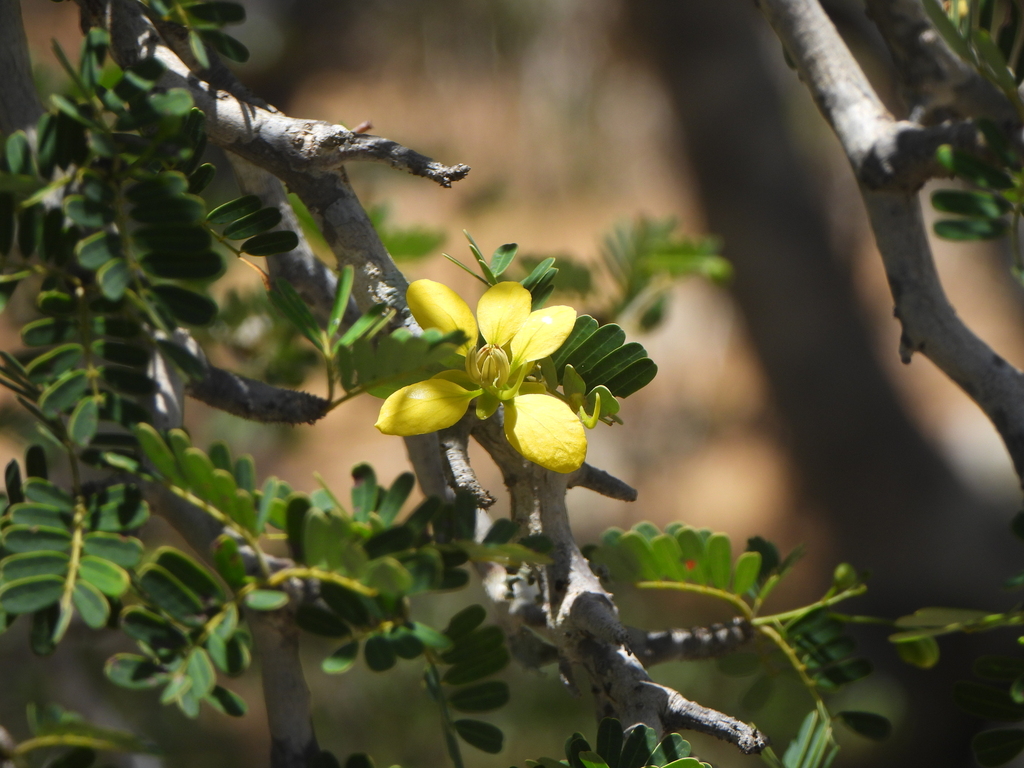
A pachycaul shrub of the spiny forest of southwestern and southern Madagascar — a member of Senna in the bean family. First described as Cassia meridionalis by R.Vigier in 1948 and transferred to Senna by Du Puy in 1995. It reaches 2–4 m, with a stocky pale-grey trunk that swells slowly with stored water, fine even-pinnate leaves, and bright yellow five-petalled symmetric flowers in summer that give way to slender pods. One of the iconic Madagascan caudex trees in cultivation, available in good supply, tough enough to recommend as an entry point for caudex growers starting from seed.
Native climate
Rain concentrates in the warm season, with a dry season of roughly 6 months. Overall a warm climate.
A broad-scale picture of the native range. Real growing spots — rock crevices, fog belts — can be milder.
Sources: climate & elevation WorldClim 2.1 (1970–2000) · occurrences GBIF · native range POWO · current weather Open-Meteo
Care
Light & Placement

In its native range below 500 m on the Mahafaly limestone plateau and the spiny forest around Toliara, this species lives under intense direct sun and a long dry season. Give it as much full sun as possible during active growth — strong light keeps the trunk tight and prevents the petioles from elongating. Through Japan's midsummer, light shading at 20–30% with the pot raised on a bench for airflow keeps it from scorching or stewing. Once leafless in autumn, move it to a bright sunny window protected from rain and keep it warm; sun on the pot through the day matters more than warmth at night.
Watering
In active growth, water deeply once the surface has dried thoroughly, then let it dry out fully. Overwatering produces leggy branches and a soft trunk outline. Once leaves drop, taper to a light monthly soak.
Substrate
A sharply draining, inorganic-led mix. Akadama : Kanuma : pumice = 4:3:3. A deeper pot lets the roots run and supports the wet–dry rhythm that thickens the trunk.
Fertilizer & Supplements
A diluted liquid fertilizer monthly in active growth, or a pinch of slow-release at repotting. As a legume with root-nodule support, the plant doesn't need heavy feeding — keep it modest.
Temperature & Overwintering
Optimal 22–35°C, 8°C minimum. Madagascan in origin and cold-sensitive: below about 10°C it drops all leaves and goes fully dormant. Overwinter on a bright sunny window protected from rain and ideally above 8°C, with daytime sun warming the pot. Damp soil in cold weather is fatal.
Starting from Seed
Where to source seeds
Pre-sowing treatment
As a legume, scarify the seed coat first — gently nick the edge with a nail file or sandpaper to help water uptake. Soak seeds for about half a day (overnight) in a mix of a registered seed-treatment fungicide (Benlate or Daconil) and a plant tonic (Menedael; outside Japan, SUPERthrive or a chelated iron / seaweed extract works similarly), each diluted per label. Seeds that still float after scarification have usually lost viability.
Substrate
A fine-grained, near-sterile seedling mix: fine Akadama, fine Kanuma, vermiculite in 1:1:1 parts. Sterilize with boiling water or a microwave pass to reduce damping-off risk.
Sowing method
Sow with no covering, or only the thinnest dusting so the seeds remain partly visible. Space at least 1 cm apart so they don't clump on the surface.
Light & temperature
Bright shade at a steady 25–30°C. As is typical for legumes, germination is fast — most scarified seeds break ground within one to three weeks. Germination depends strongly on seed freshness, but fresh seed tends to come up well.
Watering
Bottom-water with the level 1–2 cm up the side of the pot. For the first 2–3 weeks, prioritize not letting things dry out, then drop the level gradually once the seedlings are stable.
Fertilizer
No feeding right after germination. Once true leaves emerge, give heavily diluted liquid fertilizer once or twice a month at double dilution or weaker.
From Germination to Repotting
Germination through true leaves
Continue bottom watering, in bright shade.
Weaning off bottom watering
Phase it out gradually over 1–2 months.
First repotting
In the first or second year, once roots have filled the pot.
Common Pitfalls
Mold & damping-off
- Cause: excess moisture, contamination, poor air flow
- Prevention: sterilize the substrate, refresh the bottom-water, and keep a circulation fan running
Etiolation
- Cause: insufficient light
- Prevention: bring LEDs closer right after germination, or move to bright shade outdoors. Weak light stretches branches and erases the stocky character that defines the species
Seeds fail to germinate
- Cause: hard seed coat, insufficient warmth, stale seed
- Prevention: always scarify, hold 25–30°C on a heat mat, and source fresh seed
Notes
Listed on CITES Appendix II — wild-collected plants require a permit to import. Seed and cultivated material are exempt. The sap is mildly toxic.