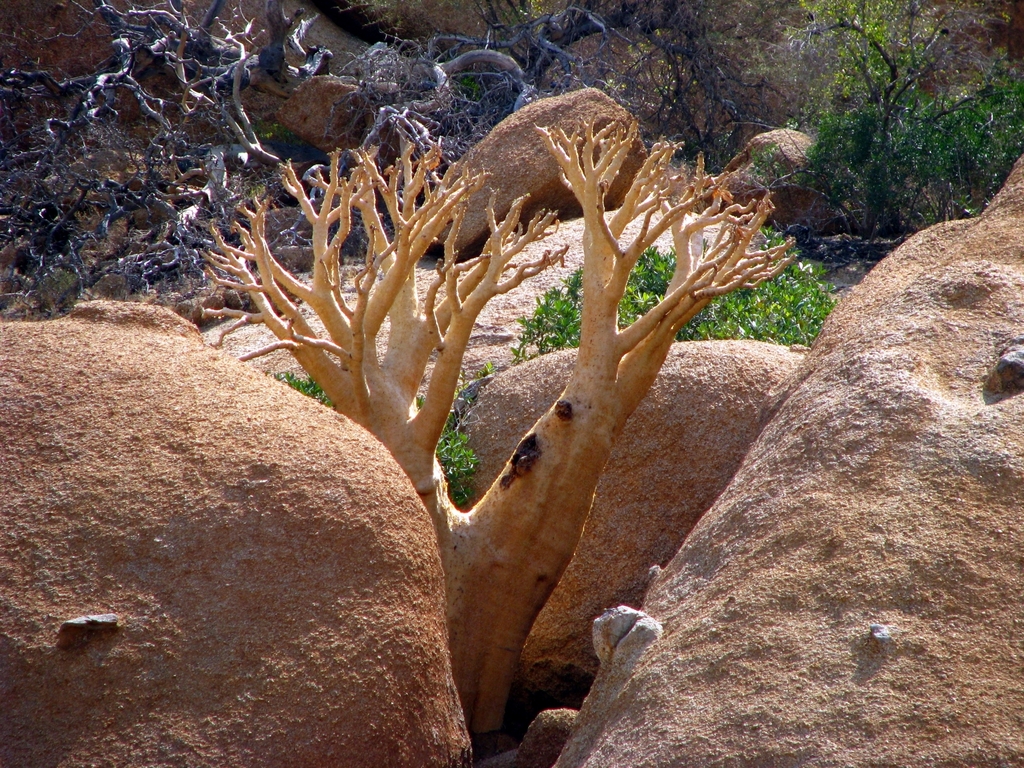
In the world of succulents, a single plant often travels under several names. The large caudiciform grape Cyphostemma currorii is a fine example. In the horticultural trade it is widely known and loved as "macropus" (Cyphostemma macropus), and labels sometimes even read "uter macropus" (Cyphostemma uter var. macropus). Yet under current taxonomy all of these resolve to one and the same species — currorii. Why has a single plant changed names so many times? Behind it lies a long-running difficulty in telling it apart, by leaf, from its close relative uter.
Three leaflets in currorii, five in uter
The first clue is the leaf. In currorii the leaf is usually divided into three leaflets (trifoliolate). Its relative uter, by contrast, is 5-foliolate, with margins said to be more strongly undulate. Both grow on dry rocky ground from southwestern Angola into northwestern Namibia, sending branches out from a swollen, baobab-like trunk — the overall bearing is much alike, but up close, in the leafy season, the number of leaflets and the waviness of the margins set them apart.
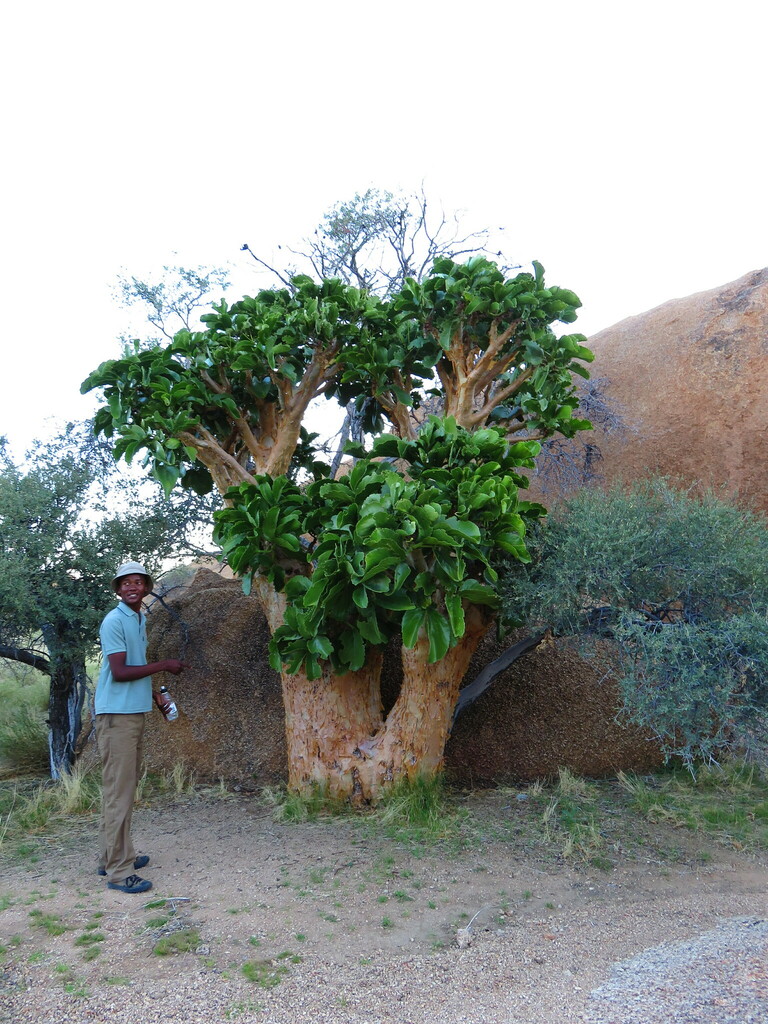
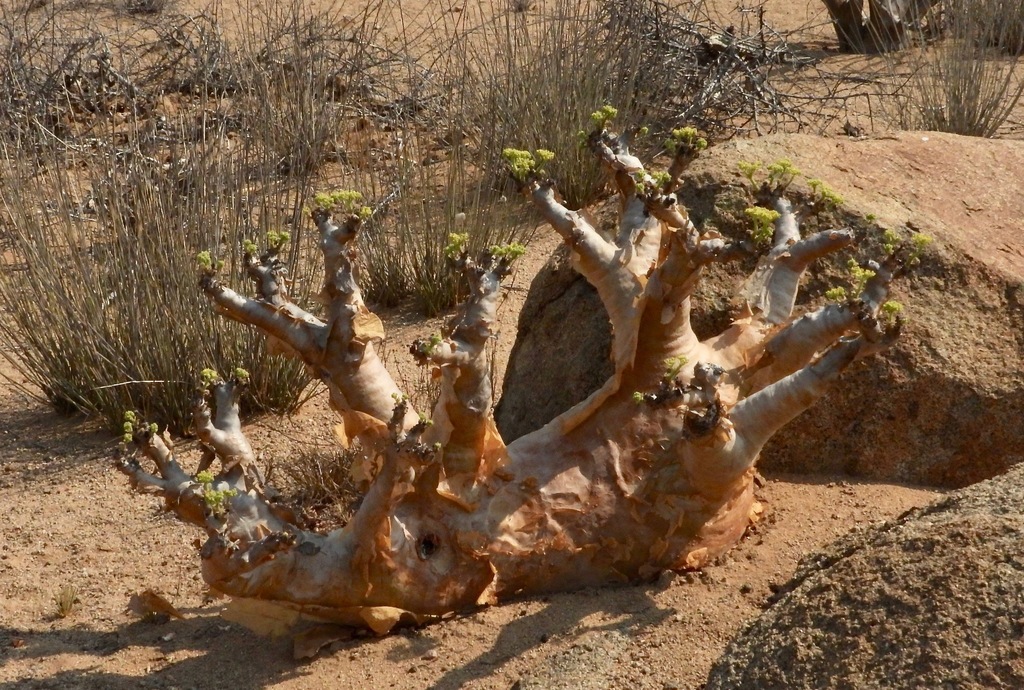
Which one does "macropus" resemble?
Here the trouble begins. The form from around Mossamedes (now Namibe) in Angola stays slimmer and more compact within the range of currorii, and its undulate foliage reads, if anything, closer to uter. When growers remark that "macropus looks more like uter than currorii," the impression is not misplaced. Taxonomists hesitated at exactly the same point, and for a time treated this plant as a variety of uter — uter var. macropus.
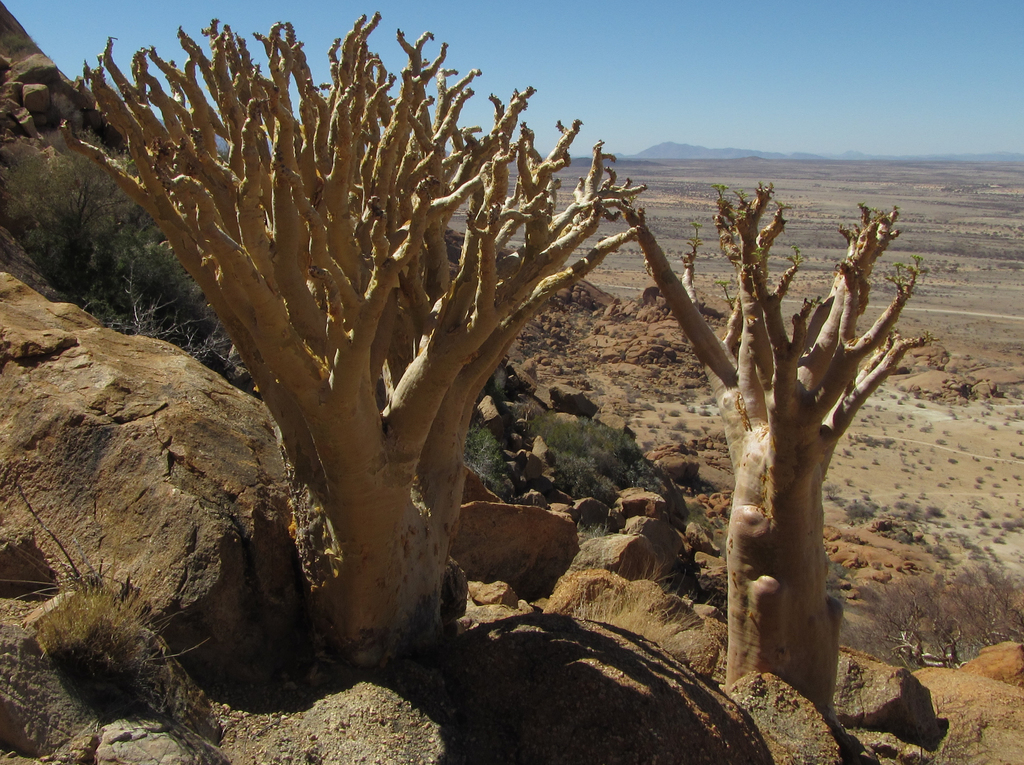
A name reassigned three times
Over some 150 years, the name of macropus has shifted from rank to rank.
- 1865 — Welwitsch describes the Angolan material as Cissus macropus
- Later — a view emerges placing it as Cyphostemma uter var. macropus, a variety of the relative uter
- 1960 — Descoings recombines it as the independent species Cyphostemma macropus
- 1967 — the same Descoings sinks it into Cyphostemma currorii as a synonym
A long round trip: separate species → variety → independent species → synonym. currorii itself traces back to a specimen collected in Angola in the mid-19th century by the British naval surgeon Andrew Curror, first described as Cissus currorii and later moved into Cyphostemma.
Why it settled on currorii
Macropus was ultimately folded into currorii because, laid out across Angola and Namibia, the populations grade continuously in trunk girth and leaf form, with no clear boundary to draw. Macropus was read as one end of that range — "the slimmer, Mossamedes form" — rather than as a species apart.
Uter, meanwhile, holds a stable combination of characters — 5 leaflets, strongly undulate margins, hairiness — and was kept as a distinct species. Macropus carries characters intermediate between uter and currorii, which is precisely why its placement wavered. It bears noting that the boundaries described here rest on morphological judgement; no study has directly tested when or how these populations diverged.
What the wandering name tells us
A common misreading in taxonomy is to equate "reduced to a synonym" with "a name of no worth." Synonymising is a judgement about how far two populations should be kept apart, not a verdict on a plant's appeal or its kinship. The name macropus lives on in cultivation as a useful label for the especially compact, well-shaped forms within currorii.
The present "answer," following Kew's POWO, is that Cyphostemma currorii is the accepted name and macropus its synonym. Yet the genus Cyphostemma as a whole is being re-examined through DNA phylogenetics, and these lines may well be redrawn in time. This caudex, having lived under three names, quietly reminds us that "what counts as a species" remains an open, moving question.
References
- POWO — Cyphostemma currorii (Hook.f.) Desc. (Plants of the World Online, Kew)
- POWO — Cyphostemma uter (Exell & Mendonça) Desc.
- POWO — Cyphostemma macropus (Welw.) Desc.
- Descoings, B. (1960, 1967) taxonomic treatments of Cyphostemma (Notulae Systematicae, Paris, and related works)
- Cyphostemma currorii / uter var. macropus — Llifle Encyclopedia of Succulents