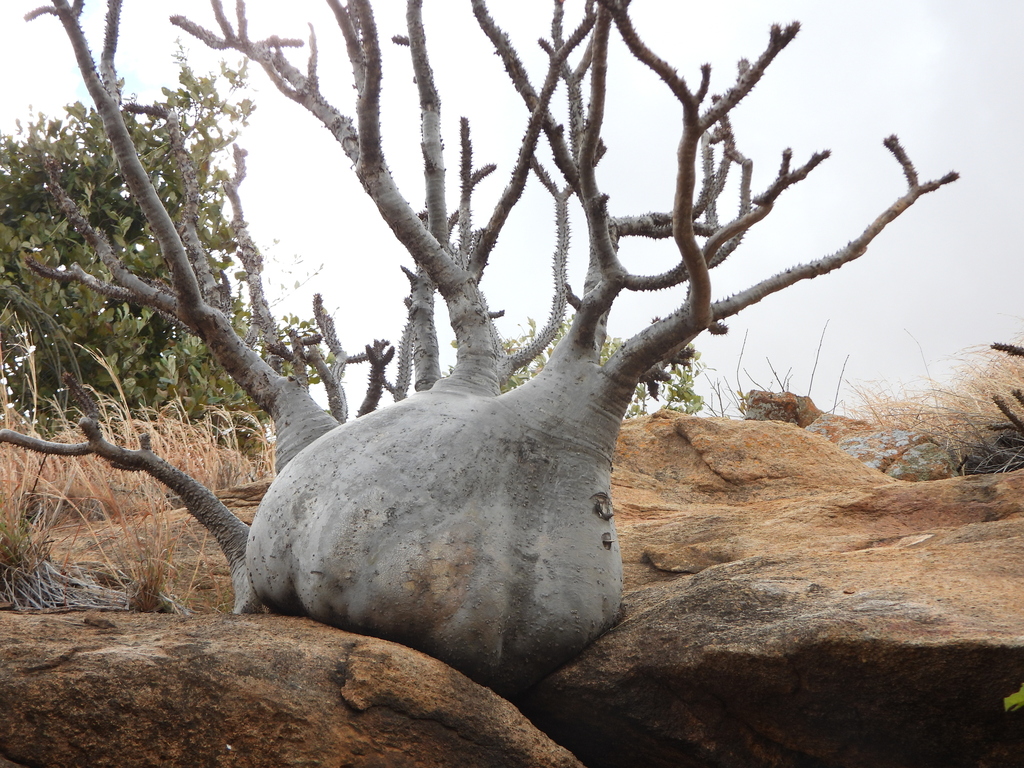
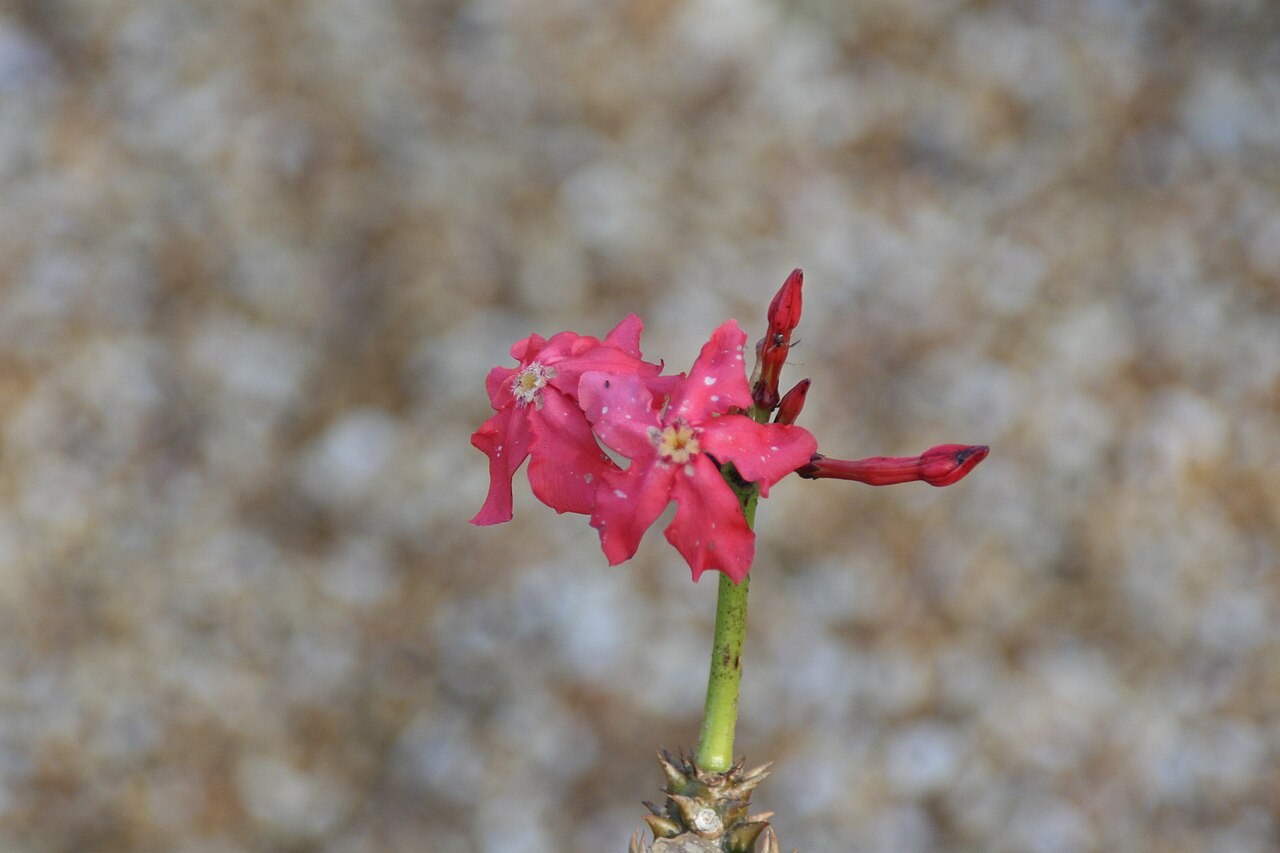
In northern Madagascar live two strikingly similar caudex plants: Pachypodium baronii and Pachypodium windsorii. Both spread their branches from a swollen trunk — the caudex — and in season open red flowers. That red flower is, in fact, the standout trait shared by only these two among the twenty-odd species of Pachypodium. Alike in form and in habitat, the pair has spent a long time drifting between "one species" and "two." Their wavering story is a small mirror of how plant names are decided, and how they change.
The only red-flowered sisters in the genus
Most Pachypodium flowers are yellow or white. Only baronii and windsorii bear vivid red ones, carried above a bottle-swollen trunk. That shared trait is why the two have long been grouped into the small section Porphyropodium — the genus's only red-flowered group.
Recent classification rests on more than appearance. In a broad molecular phylogeny of the genus (Burge et al., 2013, PeerJ), baronii and windsorii came out as a well-supported sister pair (Bayesian posterior probability 0.98, bootstrap 98%). Beyond the impression of their forms, the DNA confirms they are each other's closest relatives in the genus.

A name that wavered for a hundred years
The treatment of windsorii has changed repeatedly over a century. It was first described in 1916 by Poisson as a full species, Pachypodium windsorii. In 1949, however, Pichon demoted it to a variety, P. baronii var. windsorii. Govaerts's 2003 checklist kept the variety treatment, but in 2004 Lüthy restored it once more to a full species — a round trip of species → variety → species.
The verdict today is still not unanimous. Kew's POWO accepts the full species P. windsorii, while the CITES database still treats it as a synonym of P. baronii (one species). "Species or variety" is not a settled fact but an open question on which researchers and institutions disagree.
A scaled-down version, shaped by limestone
The two are both native to northern Madagascar, but their ranges do not overlap. windsorii grows only around the limestone massif known as Windsor Castle, and it is smaller all over than baronii, its trunk settling into a low, rounded bottle — the same body plan, compressed.
The natural reading is that, isolated on a peculiar limestone substrate and separated outcrop by outcrop, a smaller population diverged from a baronii-like ancestor. But this is an inference from habitat notes and morphology, not the conclusion of any study that directly tested the timing or drivers of that split. Nor is there any known evidence of a hybrid origin.

How to read "species or variety"
The easy mistake here is to read "promoted from variety to species" as "revealed to be a separate lineage." Rank — species versus variety — is a judgment about how distinct two populations are, not a claim that their origins differ.
P. windsorii and P. baronii var. windsorii are merely two names, at different ranks, for the same plant based on the same type specimen (homotypic synonyms). P. baronii, by contrast, is a closely related but separate entity. The "promotion" simply means the taxon was judged too distinct to sit comfortably as a variety — the relationship of sisters sprung from a common ancestor does not change.
In cultivation, the name windsorii is still widely used for an appealing, compact, bottle-trunked form. Whichever way the name falls, the story stays the same: a pair of sisters in northern Madagascar that share a red flower.
Sources
- POWO — Pachypodium windsorii / Pachypodium baronii (Plants of the World Online, Kew)
- Burge, D.O. et al. (2013) "Phylogeny of the plant genus Pachypodium (Apocynaceae)", PeerJ 1:e70
- Rapanarivo, S.H.J.V. & Leeuwenberg, A.J.M. (1999) Pachypodium (Apocynaceae): Taxonomy, habitats and cultivation
- CITES Checklist — Pachypodium baronii